Key Points
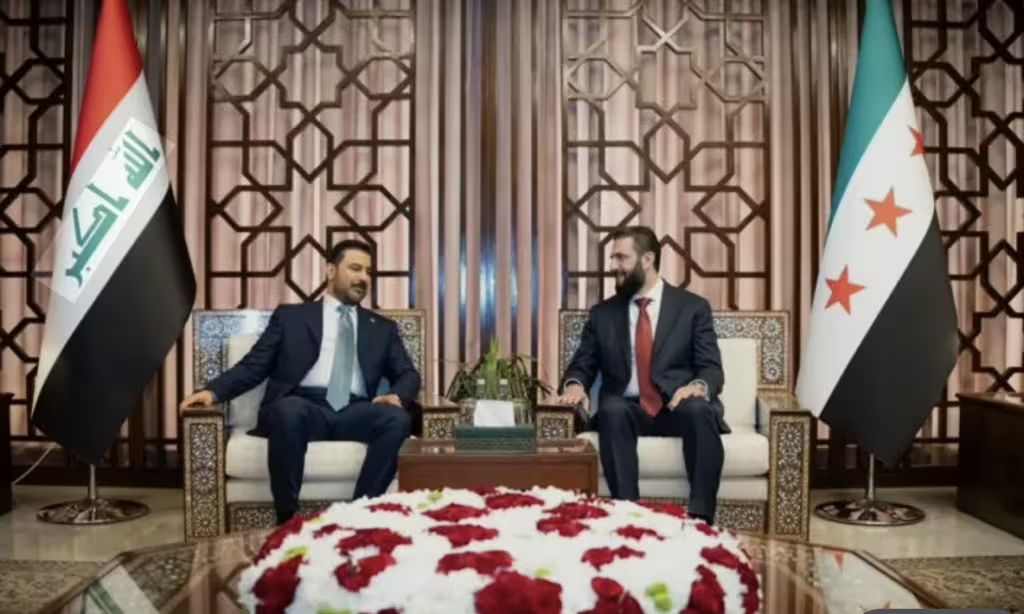
- Syrian President Ahmed al-Sharaa received Iraqi Prime Minister Ali al-Zaidi in Damascus for bilateral and delegation-level talks.
- Border security, counterterrorism, water sharing and the fate of ISIS detainees were set to dominate the agenda.
- Sharaa said 3,000 Syrians sit among detainees handed by the international coalition to Baghdad.
The latest:
Syrian President Ahmed al-Sharaa received Iraqi Prime Minister Ali al-Zaidi in Damascus on Wednesday, with the two due to hold bilateral talks before chairing an expanded session of both delegations. The Iraqi prime minister’s media office said the agenda covered bilateral relations and ways to develop them across sectors, serving what it called the shared interests of the two peoples.
Details:
- The format: The Iraqi prime minister’s media office said Sharaa and Zaidi would first hold bilateral talks on ways to strengthen relations in various fields, then jointly chair an expanded meeting of the two delegations. The office did not name the ministers travelling with Zaidi or disclose the length of the visit.
- The agenda: Shared border security and counterterrorism were set to top the discussions. An Iraqi government source told Iraqi state media before the trip that the visit aimed to strengthen bilateral ties and address political, security and economic files of mutual interest.
- Border assessment: Speaking to Iraq’s Dijlah television ahead of the visit, Sharaa said the border with Iraq remains secure so far and that security coordination between the two capitals is ongoing. He said the threat posed by ISIS has receded gradually, but not to a level that allows full reassurance.
- Syrian concerns: Sharaa said Syria has security concerns it is conveying to the Iraqi government, stressing the need for continued coordination to prevent armed organizations from building a threat to either country. He did not specify which groups or which stretches of the frontier those concerns involve.
- Water file: Sharaa described water as one of the most important files shared by the two countries, calling for it to be handled with a strategic vision that goes beyond immediate needs. He urged investment in both countries’ agricultural capacity, describing them as a food basket for the entire region.
- Regional framing: Sharaa said Syria and Iraq face a historic opportunity to rebuild decision-making authority in the region and build two strong states capable of protecting their interests. He pressed for military decision-making to be unified in the hands of the state, alongside anti-corruption efforts and expanded economic and trade ties.
- The detainees: On prisoners transferred by the international coalition to the Iraqi government, Sharaa said the handover took place during a period marked by clashes and the withdrawal of American bases from Syria. He said it covered people held in prisons over links to ISIS “or others”.
- The numbers: Sharaa said 3,000 Syrians are among those detainees, and that the file was discussed with Iraq’s Supreme Judicial Council. He said the council’s head visited Syria and the justice ministry, where the two sides agreed to draw up a program to address the case.
- Classification plan: Sharaa said some of the Syrian detainees have no connection to ISIS, and that work is underway to sort them into categories. Syria’s responsibility for them and the possibility of returning them home would then be studied based on that review.
Between the lines:
Sharaa’s framing paired a reassurance with a caveat: the border is secure, but ISIS risk has not fallen far enough for comfort. His call to unify military decision-making in the hands of the state, delivered to an Iraqi audience, reads as a message addressed beyond Damascus. The detainee classification plan suggests Syria is preparing to absorb returnees selectively rather than wholesale.
What’s next
Watch for a joint statement from the expanded delegation meeting, any announced mechanism on water sharing, and whether the program agreed with Iraq’s Supreme Judicial Council sets a timeline for sorting and returning the 3,000 Syrian detainees.