Key Points
- A Nanotyrannus skeleton named Jodi fetched $47.3 million after a 12-minute bidding war among six contenders.
- Sotheby's had estimated $6 to $9 million; the fossil auction record is $50.1 million, set in July.
- Paleontologists warn the sale may put one of three known specimens beyond scientific reach.
The latest:
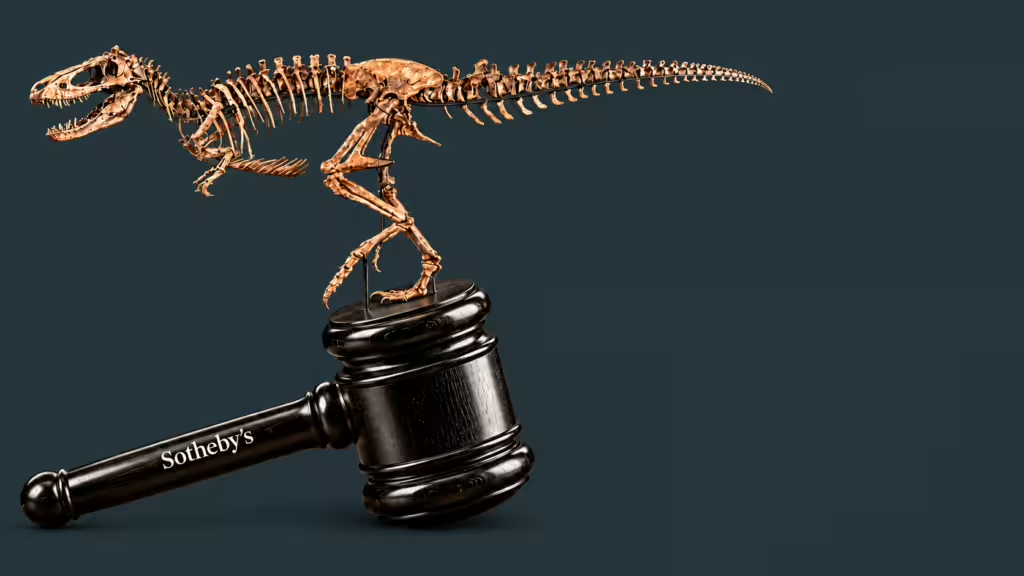
A 19.6-foot Nanotyrannus skeleton sold for $47.3 million at Sotheby’s in New York, more than five times its high estimate, after six bidders fought over it for 12 minutes. The specimen, named Jodi, is one of only three relatively complete skeletons of the species known to science, and the price fell just short of the fossil auction record set three months earlier.
Details:
- The price gap: Sotheby’s had estimated the skeleton at $6 to $9 million. The final $47.3 million narrowly missed the auction record for any fossil, set in July when an exceptional T. rex skeleton named Gus sold for $50.1 million, according to CNN.
- The specimen: Jodi measures 9.6 feet tall and 19.6 feet long, just over half the length of Gus. Sotheby’s described it as exceptionally preserved, made up of 191 bone elements including a virtually complete skull, with missing bones replaced by custom 3D-printed and sculpted elements.
- The species dispute: The very existence of Nanotyrannus is contested in paleontology. Researchers have only recently tipped the balance toward treating it as a distinct dinosaur rather than a juvenile T. rex, which makes complete specimens unusually scarce and likely helped push the bidding higher.
- The discovery: Montana rancher Jodi Pierson found the skeleton in 2019, and the fossil carries her name. It was excavated by Clayton Phipps, a commercial paleontologist known as the Dinosaur Cowboy, who in 2006 unearthed the Dueling Dinosaurs a short distance from the same site.
- The other two: The Dueling Dinosaurs, featuring a Triceratops and a smaller tyrannosaur now identified as a Nanotyrannus, is held at the North Carolina Museum of Natural Sciences in Raleigh. The third known skeleton, Jane, sits at the Burpee Museum of Natural History in Rockford, Illinois.
- Full rights: Sotheby’s said Jodi is an adult based on size and bone development, and was offered with full rights, containing no copyrighted elements from other dinosaurs. The buyer can produce and sell replicas to museums or collectors. The purchaser’s identity has not been disclosed.
- The scientific objection: Steve Brusatte, professor of paleontology and evolution at the University of Edinburgh, told CNN by email it is “harrowing” to think the skeleton could disappear into a collector’s vault rather than be displayed in a museum, noting the species itself was only recently confirmed as real.
- The bubble warning: David Hone, a paleontologist and reader in zoology at Queen Mary University of London, said he was very surprised by the price and judged dinosaur valuations a bubble that must eventually burst. He added that the specimen’s scientific value is hard to assess without verified expert study.
- Access question: Hone said he would be very surprised if Jodi entered a public collection. Until it does, he said, it is effectively outside of science.
Background:
The skeleton comes from the Hell Creek Formation, a fossil-rich geological zone spanning Montana, Wyoming and the Dakotas. One of the first T. rex skeletons was found there in 1902, and the species was named on the basis of fossils unearthed in the area.
Between the lines:
The sale sharpens a conflict scientists have raised repeatedly: a species whose validity was settled only recently now has one of its three complete skeletons in private hands. The full-rights clause points to a commercial afterlife in replica sales rather than research access, and Hone’s assessment is that specimens outside public collections sit outside science altogether.
What’s next
Watch whether the anonymous buyer places Jodi on public display or loans it for study, and whether the next major fossil auction tests Hone’s assessment that dinosaur prices are a bubble.