The latest:
Neither of Israel’s rival blocs cleared the 61 seats needed to govern, according to exit polls published by the main television networks after polls closed Tuesday night at 10 p.m. Channel 12 projected 52 seats for the opposition bloc, 50 for Netanyahu’s alliance and 18 for the Arab parties. Public broadcaster Kan 11 also projected an inconclusive result.
Details:
- The projections: Channel 13 projected 53 seats for the opposition, 50 for Netanyahu and 17 for the Arab parties, close to Channel 12’s split of 52, 50 and 18. Israeli exit polls have a mixed record of accuracy in close races.
- Likud’s late surge: Final pre-election polling had put Likud near 20 seats, but exit polls showed the party at 24, ahead of every other list. The additional seats appeared to come at the expense of Netanyahu’s own allies rather than the opposition, leaving his camp’s total largely unchanged.
- Record Arab turnout: Ra’am and the Joint List were projected at 17 or 18 seats, above pre-election estimates of roughly 13 and beyond the 15 seats Arab parties have never previously exceeded. Turnout reached 86.8% in Sakhnin, 84.9% in Kafr Qasim and 82% in Rahat, according to the Central Elections Committee.
- Turnout: The committee reported 77.7% national turnout for the 26th Knesset by 10 p.m., with 5,695,682 ballots cast, a figure it said was not final because voters already in line could still vote. That is a rise of about 7.1% over the same point in the 25th Knesset election.
- The Arab vote: Thabet Abu Ras, a specialist in Arab-Jewish relations, said Arab citizens concluded they had to fight for their citizenship and full political participation after a government he said worked to marginalize and incite against them. Ra’am leader Mansour Abbas said turnout showed frustration had turned into hope.
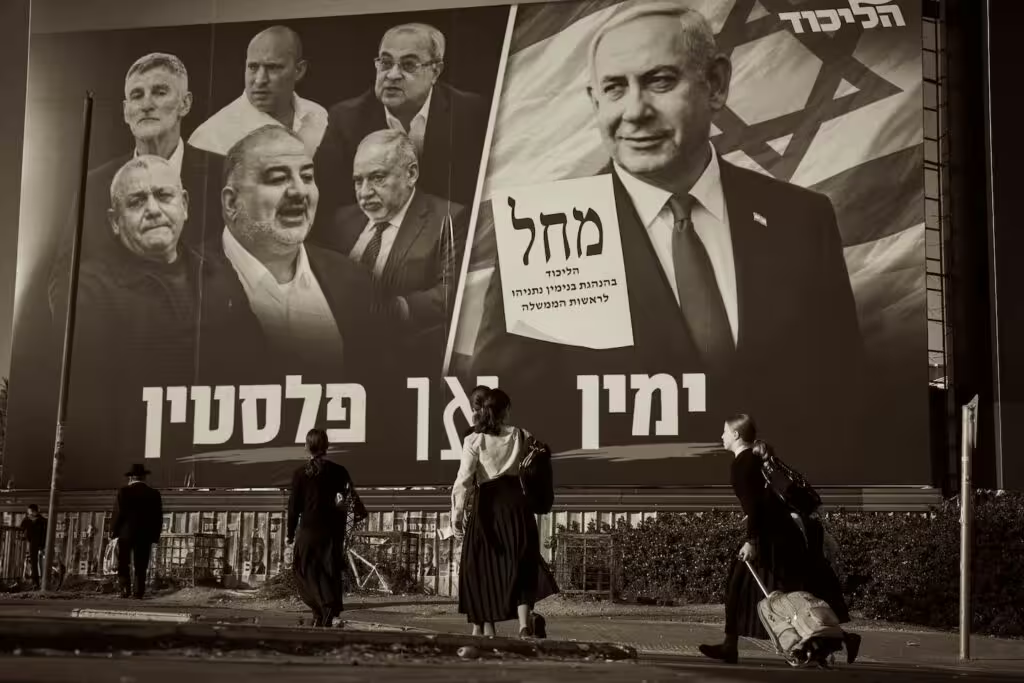
- Netanyahu’s campaign: Responding to high turnout in majority-Arab towns, Netanyahu accused Arab citizens of trying to steal the election and made repeated public appeals to anti-Arab sentiment to drive his base to vote. Deputy committee director Dean Livni told reporters there were no reports of large-scale irregularities.
- The far right: Finance Minister Bezalel Smotrich, whose Religious Zionism was projected at about six seats, told supporters Jewish settlements would be built in Gaza and Israel would not withdraw from Lebanon or Mount Hermon. National Security Minister Itamar Ben Gvir, also projected at six, called a unity government with Gadi Eisenkot a paralyzed government.
- The opposition’s claim: Yair Golan of the Democrats told supporters the change camp had won and that Israelis had voted out Netanyahu and Likud, urging a change government be formed quickly. Avigdor Lieberman, projected at about eight seats, urged patience and said the picture would be clearer by Friday.
- The unity option: Analysts are weighing a national unity government joining Netanyahu and Eisenkot, the former military chief whose son was killed in the Gaza war. Eisenkot has pledged not to serve under a man he has called unfit to lead Israel, and Netanyahu is not expected to cede the premiership.
- What was at stake: Netanyahu’s bloc of nationalists and ultra-Orthodox parties campaigned on a more religious Israel and a tighter grip on the West Bank and Gaza. Eisenkot’s camp framed the vote as the last chance to preserve liberal democracy and demanded accountability for the failure to prevent the October 7, 2023 attacks.
Background:
This was Israel’s first national election since the October 7, 2023 Hamas attack, the deadliest day for Jews since the Holocaust, which triggered three years of war that left Gaza largely in ruins and displaced nearly its entire population.
Between the lines:
The arithmetic points to the Arab parties. With both blocs short of 61 and the opposition’s edge resting on 17 or 18 Arab seats, Eisenkot cannot govern on the Jewish parties alone, yet he and potential partners have been reluctant to rely on Arab support since October 7. Likud’s four-seat gain came from inside Netanyahu’s own camp, meaning his symbolic win as largest party did not expand his path to a majority.
What’s next
Final results, including soldiers’ ballots, may take several days. President Isaac Herzog will then task the leader he judges best placed to assemble 61 Knesset members. Lieberman said the picture should be clearer by Friday.