Key Points
- Jordan says its air strikes killed 20 ISIS members inside Syria late Monday.
- Syrian authorities reported at least seven dead, including three children, a woman and an elderly man.
- Damascus denied any coordination, opened an investigation and closed the Nassib border crossing with Jordan.
The latest:
Jordanian air strikes inside Syria killed 20 ISIS members, Amman said Tuesday, describing the operation as retaliation for last Friday’s church shooting in Karak that killed nine Christians. Syrian authorities put the toll at a minimum of seven people, among them three children, a woman and an elderly man. Damascus denied Jordan’s claim that the strikes were coordinated between the two governments.
Details:
- The Jordanian account: Government spokesman Mohammad Al Momani said the strikes killed 20 ISIS members and were based on field information, aimed at neutralising threats and operations against Jordan. He said Jordan’s patience with the movements of these organisations had run out, and expressed regret over the civilian deaths. He did not disclose where in Syria the strikes took place.
- The military framing: Jordan’s armed forces said they hit the hideouts of militants responsible for Friday’s attack on the Hamoud church in Karak, calling the operation retaliation for its victims. The Information Ministry said the strikes killed and wounded many members of these groups and destroyed a number of their vehicles.
- The Syrian response: Damascus denied any coordination with Amman, launched an investigation and informed Jordan of its complete reservation over the strikes, according to the Foreign Ministry, which also expressed solidarity with the families affected. Shortly after the strikes, Syria closed the Nassib border crossing with Jordan.
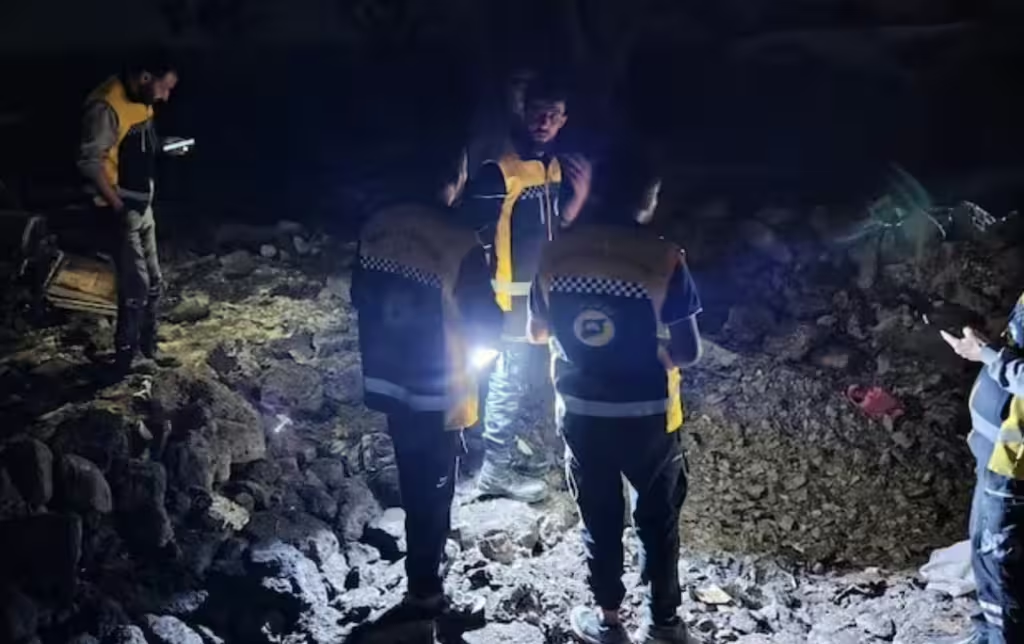
- On the ground: At least one strike hit an area near Mismiyah in Deraa governorate, about 30km south of Damascus, residents told The National. Dozens attended a funeral near Mismiyah on Tuesday for three children, a woman and one of the men killed. Footage recorded by The National showed a destroyed building and collapsed corrugated iron in the rubble.
- The family: The woman killed was the wife of Massed Al Salem, 67, and the three children were his grandchildren, living in a tent pitched in an unfinished part of the building. Al Salem said the family had erected the tent until they had money to continue building. “Money did not come to us and this disaster occurred,” he said.
- The church attack: Friday’s shooting in Karak killed nine Christians, all men, mostly from the Halasah clan, one of Jordan’s most prominent families. The Information Ministry said the attackers were linked to organisations in Syria. On Monday, Jordanian authorities said they had arrested three suspects, all Jordanians from the same family, after a three-day manhunt.
- The minority: The attack was the largest against Jordan’s Christian minority since the 1950s. Christians number about 250,000 out of a population of 11 million.
- The terrain: Mismiyah lies in the northern part of Al Lajat, the black desert, a 50,000-square-kilometre plateau of volcanic rock stretching between Syria, Jordan and Saudi Arabia. The rugged area sits at the centre of the Captagon trade and has become a refuge for armed groups. Previous Jordanian strikes have typically hit suspected drug trafficking sites.
Background:
Syria’s government under President Ahmad Al Shara, who took power after Bashar Al Assad’s removal in December 2024, has been rebuilding ties with Jordan and other Arab states. King Abdullah II and Al Shara agreed to deepen cooperation, particularly on border security.
Between the lines:
The strikes test a relationship both capitals had been building deliberately. Amman says it coordinated with Damascus; Damascus says it did not and registered a complete reservation, a gap over a basic procedural fact that is harder to absorb than the strikes themselves. The closure of Nassib carries economic weight: the two governments had been developing transport routes as a trade alternative during disruption in the Strait of Hormuz.
What’s next
Watch the outcome of Syria’s investigation, whether Nassib reopens, and whether Amman releases locations or evidence for the strikes. Also watch the judicial track for the three Jordanian suspects arrested over the Karak church attack.