Key Points
- Authentic Brands Group accuses Anthropic of training Claude on 274 Elvis Presley recordings without permission.
- The suit, filed Friday, seeks $150,000 per track, roughly $41m in total damages.
- It is among the first major AI copyright actions brought by an artist's estate.
The latest:
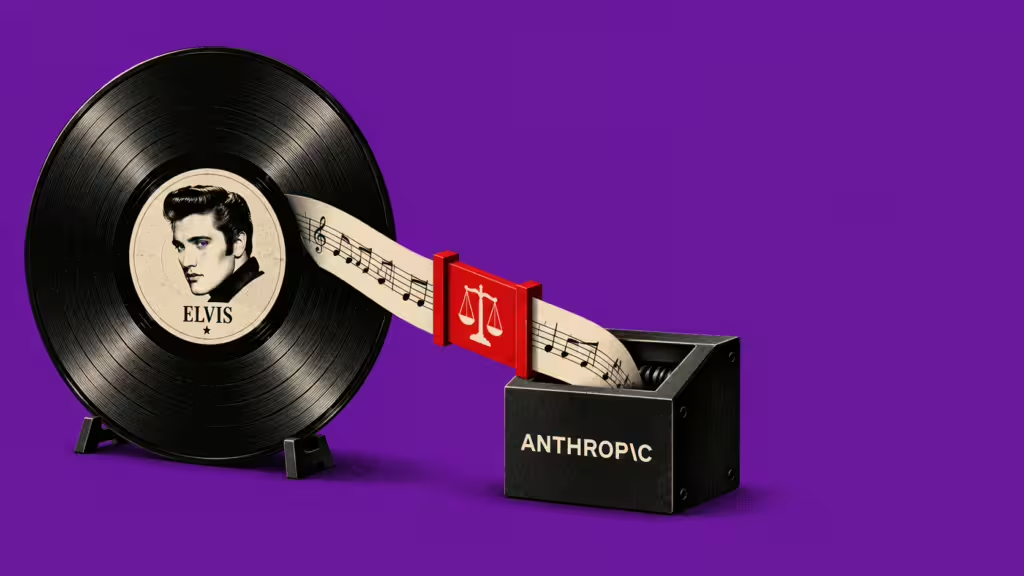
The owners of Elvis Presley’s catalogue have taken Anthropic to court, accusing the AI developer of training its Claude models on 274 of the singer’s recordings without authorization. Authentic Brands Group, which controls Presley’s music and likeness, filed the case on Friday and is seeking $150,000 per infringed track. That works out to about $41m, or roughly £31m.
Details:
- The plaintiff: Authentic Brands Group is the licensing organization that owns rights to both Presley’s music catalogue and his likeness. It is pursuing the claim over 274 individual songs, among them Can’t Help Falling in Love, All Shook Up and A Little Less Conversation, according to the complaint first reported by Billboard.
- The core allegation: The filing alleges that Anthropic built its entire business model on copyright infringement at a scale never seen before, in the words of lead attorney Richard Busch. It further claims that from its inception, Claude has produced infringing output drawn from virtually every song in every catalogue available online.
- The guardrails claim: The plaintiffs allege Anthropic installed filters to limit infringing musical outputs only after being caught, and that the company knew those measures were ineffective. On that basis the suit argues the infringement was knowing and willful, a characterization that can expand the damages available.
- The money: The $150,000 per-track figure matches the ceiling for statutory damages in willful US copyright cases. Multiplied across 274 recordings, the estate puts its claim at about $41m. No settlement discussions or hearing dates have been disclosed.
- Why it is different: AI firms have already faced copyright claims from the Recording Industry Association of America and from labels including Sony, Universal and Warner Records. Anthropic has itself previously been sued over the alleged use of tens of thousands of songs. This action stands out as one of the first major challenges filed directly by an artist’s estate.
- The precedent at stake: The outcome could shape how AI companies are permitted to use existing music catalogues, setting terms that would apply well beyond Presley’s recordings. Anthropic has not issued a public response to the allegations.
- The technology: AI music systems analyze large volumes of recorded audio to learn the sounds, structures and expressions of songs, then let users generate their own tracks from text or speech prompts. That training step is the exact point the estate is contesting.
- The wider dispute: Musicians have repeatedly objected to their music and voices being used by AI models without consent, and have warned that AI-generated slop could displace human-made songs. Some AI bots have begun impersonating living artists on streaming services.
- The platform response: Spotify said last week it had removed roughly 50m tracks classed as AI slop from its user recommendations over the past year. The company did not say how many of those recordings remain available to stream on the platform.
Between the lines:
The estate’s choice to foreground the guardrails argument points at intent rather than volume. Statutory damages rise sharply where infringement is found willful, and the complaint’s claim that filters arrived only after Anthropic was caught is what carries the $150,000-per-track figure. Without that finding, the $41m demand shrinks considerably.
What’s next
Watch for Anthropic’s formal answer to the complaint and any motion to dismiss, which would be the first test of whether the training claim survives. Also watch whether other artist estates file parallel actions.