Key Points
- A bronze plaque now marks the Paris site Louis Daguerre photographed in 1838, capturing the first humans on camera.
- The spot sits in today's Place de la République, built after Baron Haussmann redesigned the area in the mid-1850s.
- The image survives mainly through a 1937 copy, because the original plate was destroyed in World War II.
The latest:
A bronze plaque has been installed at the exact Paris spot where a shoeshine boy and his customer became the first human beings ever recorded in a photograph, in 1838. Identifying the location took filmmakers Maximilien Van Aertryck, Axel Danielson and Kalle Boman two years of archival and 3D reconstruction work. The city published images of the marker through its photographic service.
Details:
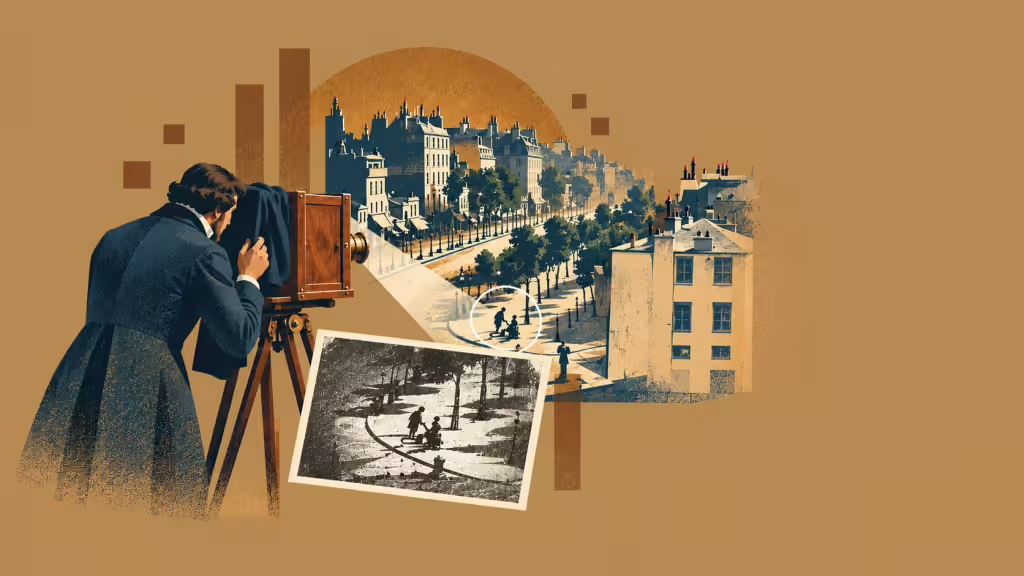
- The image: Daguerre’s View of the Boulevard du Temple was taken on a spring morning in 1838 from the window of his upstairs studio, where he had been testing an invention he had worked on for the better part of a year. It shows a tree-lined thoroughfare that appears almost entirely empty.
- Why only two: The boulevard was not deserted that day. Daguerre’s machine required an exposure of five to 10 minutes, so only the shoeshine boy and his client stayed still long enough to register, while everyone else moving along the street left no trace on the plate.
- The geography: Daguerre’s studio and the adjacent theatre stood on what is today Rue Léon-Jouhaux. The stretch of boulevard he photographed is now occupied by Place de la République, laid out by Baron Haussmann in the mid-1850s, which erased the street layout visible in the original picture.
- The method: The filmmakers first made a 3D scan of Place de la République and the Boulevard du Temple to calculate distances between buildings, then rebuilt the 1838 neighbourhood using paintings, prints, engravings and maps drawn from Parisian archives.
- The margin: That reconstruction went to two architectural firms, which worked independently and arrived at two points roughly six feet apart. Rather than choose between them, the filmmakers split the difference and placed the plaque midway between the two results.
- The lost plate: Daguerre sent the original plate to Ludwig I, King of Bavaria, in 1839. It was badly damaged during Allied bombing in World War II, and the picture endures largely through a copy made in 1937 by Museum of Modern Art curator Beaumont Newhall in New York.
- The next search: The team is now hunting for a negative of the image. No timeline has been announced, and the filmmakers have not said where they believe such a negative might survive.
- The origin: The trio used Daguerre’s early image in And the King Said, What a Fantastic Machine, a 2023 Sundance-awarded documentary built from archival footage to tell a 200-year history of image culture. They decided to pursue the location one evening in 2024 while standing in Place de la République.
- The framing: Van Aertryck told Radio France the photograph marks the beginning of a new era and called it poetic, pointing to the empty boulevard and the two tiny figures within it. He said the plaque is a reminder that “past generations also experienced a technological upheaval” whose consequences had to be managed.
Background:
Daguerre’s process, the daguerreotype, produced a direct positive image on a metal plate and required subjects to hold still for minutes. That constraint shaped early photography: streets appear empty, and portraits were rare until exposure times fell sharply in the following decades.
Between the lines:
The filmmakers’ own argument ties the 1838 plate to the present: a technology that rewrote how people saw the world, arriving faster than anyone could absorb it. Van Aertryck frames the plaque less as a heritage marker than as a warning about managing technological upheaval — a reading made easier by the fact the original plate itself did not survive the century it helped define.
What’s next
Whether the search for a negative produces anything is the next concrete test. Any find would alter how the earliest surviving photographic image of human beings is reproduced and studied.