The latest:
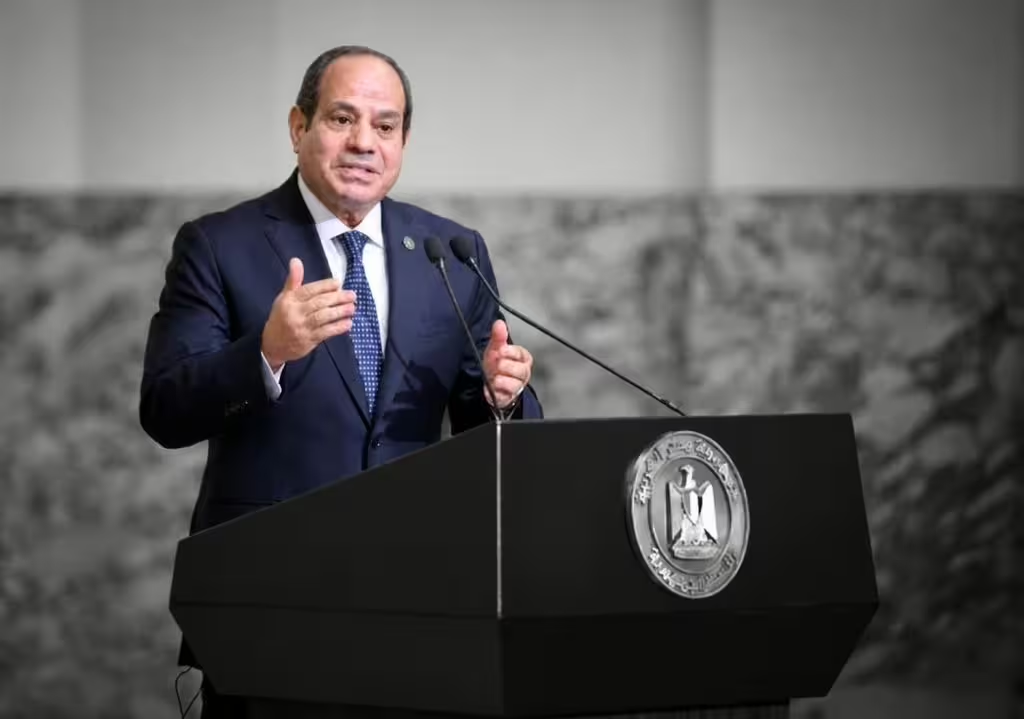
Egypt’s presidency will end in 2030 and the question of his departure is closed, President Abdel Fattah al-Sisi said Saturday, ruling out any further amendment to the constitution. Speaking at a graduation ceremony at Egypt’s Military Academy, the 71-year-old president said his duty was to protect the state and hand over its banner flying high. He had alluded to the subject repeatedly in recent days without being conclusive.
Details:
- The statement: Reuters quoted Sisi as saying the period through 2030 would mark the end of his presidency, if he lives, and that the issue is entirely settled and will not be discussed further. He said he had already stated that the Egyptian constitution would not be touched.
- The setting: The remarks came at a ceremony marking the graduation of new classes at the Egyptian Military Academy, according to Cairo News Channel. Sisi described the armed forces as the shield and sword of the nation, and said preserving them is a duty falling on all Egyptians.
- The legal clock: Amendments approved in a 2019 referendum extended the presidential term from four to six years and allowed Sisi to run for a third term, clearing his path to remain in office until 2030. He began his current six-year term after winning re-election in December 2023.
- The election record: Sisi won the 2014 and 2018 votes with roughly 97% of ballots each time, and took 89% in 2023. Critics described those contests as having predetermined outcomes.
- The Saudi pledge: In the same speech, Sisi said Egypt would carry out any step Saudi Arabia requests to protect its security and sovereignty, and called on parliament to convene an emergency session to authorize such a move if requested. He said Egypt stands firmly behind defending Gulf territory.
- The Gulf framing: Sisi said Egyptians must not forget the support Gulf states extended to Egypt, linking the pledge to Saudi Arabia’s exposure to Houthi attacks from Yemen. He did not specify what form any Egyptian action would take, nor a date for the parliamentary session he requested.
- The succession line: Sisi said the state is committed to training cadres capable of leading the country, and that those who do not carry that responsibility will not be allowed to assume it. He named no individual and set out no mechanism for a transfer of power.
- The critics’ case: Rights organizations say tens of thousands have been jailed during Sisi’s decade in power, in a crackdown that swept up liberals, leftist activists and Islamists alike. Sisi and his supporters argue the arrest campaign was necessary to stabilize Egypt and curb Islamist extremism.
- The road to power: A former general, Sisi came to power in 2013 by removing Mohamed Morsi, Egypt’s first democratically elected president and a Muslim Brotherhood figure, after mass protests. Morsi had been elected following the uprising that toppled Hosni Mubarak.
Background:
The 2019 amendments were approved by referendum. Opponents called them a step toward entrenched one-man rule, comparing the trajectory to Mubarak’s 29 years in office, which ended with his removal in the 2011 uprising.
Between the lines:
Two commitments sit in one speech. Sisi closed the constitutional question his critics have used to argue his rule is open-ended, while asking parliament for advance authorization to act militarily on Saudi Arabia’s behalf. The cadre-training line is the closest he came to addressing what follows 2030, and it names no successor and no process.
What’s next
Whether parliament convenes the emergency session Sisi requested, and whether Riyadh makes any formal request. Egypt’s next presidential election is due at the end of the current term in 2030.