Key Points
- Economists al-Hashimi and Salem question Iraq's borrowing path and the design of its economic institutions.
- IMF chief Georgieva confirmed October 17 that Iraq requested a loan programme with Fund support.
- Their critiques target accountability, policy coordination and whether Iraq can turn resources into production.
The latest:
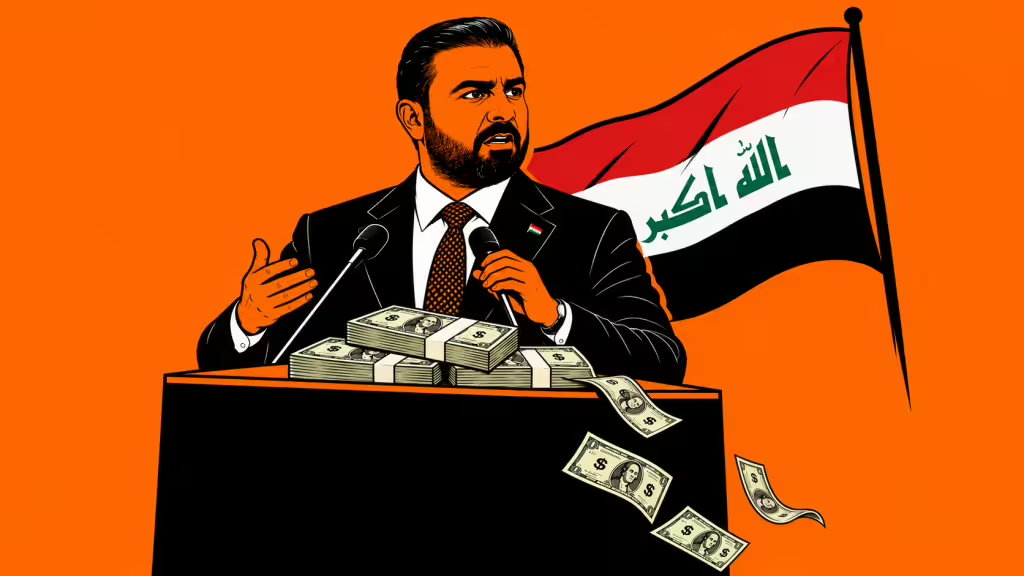
Iraq’s request for an International Monetary Fund loan programme has opened a credibility argument at home, with economist Ziyad al-Hashimi saying the move contradicts the government’s own case for devaluing the dinar. IMF Managing Director Kristalina Georgieva confirmed on October 17 that Baghdad had asked for a programme and said the Fund intended to provide strong financial and policy support.
Details:
- The IMF confirmation: Georgieva’s October 17 remarks establish only that a request was made. They do not establish that a programme received final approval or that any funds have been disbursed, and the size, financing terms and policy commitments were not set out in her announcement.
- Al-Hashimi’s core charge: According to the remarks supplied for this report, al-Hashimi says the prime minister had defended cutting the dinar’s value as a way to avoid more painful measures, external borrowing among them. Going to the IMF, he contends, undermines that justification and raises questions about public finance management.
- The household cost: Al-Hashimi warns an IMF-supported programme could carry commitments to restrain spending, raise revenue and reform subsidies, with fuel and electricity potentially affected. These are outcomes he anticipates rather than confirmed conditions attached to the requested programme.
- His demand: He calls on the government to explain publicly why external financing is needed, how the money would be used, and what obligations Iraq would assume in return.
- The precedent: Iraq is not the first country in the Middle East and North Africa to seek IMF lending. The Fund approved a $5.34 billion Stand-By Arrangement for Iraq in 2016, following emergency financing in 2015, according to the IMF.
- Salem’s target: Imad Abdul Latif Salem criticises the proposed Ministry of Digital Economy, arguing Iraq’s priority should instead be a Ministry of Economy with a substantive mandate to develop production, strengthen private enterprise and coordinate policy across government.
- The sweeping claim: Salem contends Iraq lacks an economy or a private sector in the institutional sense, a deliberately broad critique. His underlying argument is that the country lacks the productive structures and effective institutions needed to turn economic activity into sustained development.
- The merger plan: Salem proposes consolidating ministries rather than multiplying them: abolishing the Ministry of Trade and merging Planning and Finance into a single ministry preparing both the investment and operating components of the budget.
- The coordination argument: That merged institution would work alongside a Ministry of Economy and the central bank to improve coordination between fiscal, monetary and trade policies. Modernisation, in Salem’s view, requires more than attaching contemporary labels to ministries.
Background:
Iraq’s exchange-rate adjustment was presented by the government as the alternative to harsher options, including external borrowing. That framing is what al-Hashimi now measures the IMF request against.
Between the lines:
The two critiques run on separate tracks but meet at the same point. Al-Hashimi asks what Iraq may have to accept to obtain financing; Salem asks whether its institutions could use the resources effectively if it got them. Read together, borrowing terms and ministerial restructuring are both judged against productive capacity rather than against each other.
What’s next
Watch for IMF board action on the requested programme, any published terms on spending, revenue or subsidy reform, and whether Baghdad advances the Ministry of Digital Economy proposal Salem opposes.