Key Points
- Meta published Muse Spark Open weights on October 15, 2026, an 816-billion-parameter mixture-of-experts model
- The 4-bit NVFP4 build fits on 4 Blackwell Ultra cards or two Mac Studios
- Enterprises can run long-horizon agents on-premises, keeping customer and code data out of external clouds
The latest:
An 816-billion-parameter model with roughly 42 billion active parameters per token is now downloadable, after Meta published the open weights of Muse Spark Open on October 15, 2026. Built by Meta Superintelligence Labs, the model takes text, image, video and audio inputs, outputs text, and supports a 1 million-token context window at inference. Meta says it was trained for long-horizon agentic work such as coding and customer-service agents.
Details:
- The architecture: According to the model card, Muse Spark Open uses a sparse mixture-of-experts design with 256 experts, sliding-window attention and a Perception Encoder. It is multilingual, trained on data spanning more than 100 languages, though Meta states it was not evaluated on every language present in pretraining data.
- Benchmark position: At xhigh reasoning effort, Meta reports an Artificial Analysis Intelligence Index score of 39, against 45 for GLM 5.3, 44 for Kimi K3, 40 for Qwen3.8 and 26 for Inkling. On MCP-Atlas it leads at 89.2 versus 84.5 for Qwen3.8 and 82.3 for Kimi K3.
- Where it trails: The same card shows Kimi K3 ahead on several agentic and reasoning tests: OSWorld Verified 84.8 to 80.4, Toolathlon Verified 76.5 to 72.8, Terminal-Bench 2.1 85.0 to 76.4, and DeepSWE 1.1 at 68 against 60. GPQA Diamond reads 89.0 versus 93.5.
- Safety numbers: On adaptive StrongREJECT v2, where lower is better, Meta reports 0.5 for Muse Spark Open against 86.4 for Inkling, 66.6 for Kimi K3 and 65.6 for Qwen3.8. It cites a 98.1% honesty rate on MASK, a 0% misbehavior rate on Agentic Misalignment, and over 98% refusal of harmful requests on SecureBio’s BioTIER.
- Jailbreak resistance: Meta says the model refused 99.2% of jailbreak attempts on an internal benchmark and 94.8% across PolyGuard’s cyber portion, RedCode and CyberBench 2024, against 75.5% and 70.2% for Kimi K3 in the same setup.
- Deployment guidance: Meta added post-training to harden the model as a standalone system without guardrails, but recommends deploying it inside a wider system with use-case-appropriate safeguards, and requiring human confirmation for irreversible actions in agentic deployments.
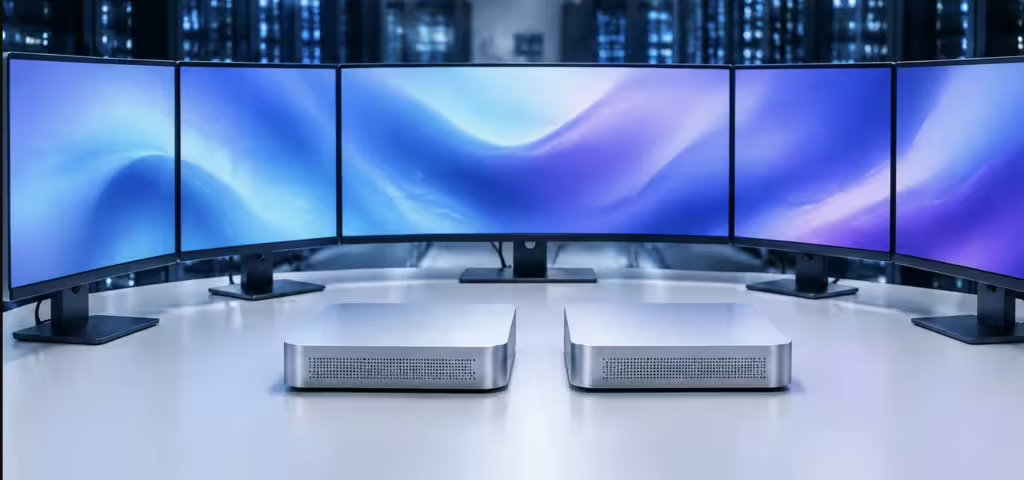
- Hardware footprint: BF16 weights run about 1.6 terabytes; the NVFP4 build drops to roughly 530 gigabytes and fits on 4 Blackwell Ultra cards or 8 H200s. Via MLX, two M5 Ultra Mac Studios with 512GB unified memory each will run it, or four 256GB machines over Thunderbolt 5.
- Throughput claims: DFlash V2 speculative decoding on SGLang delivers 3.7 times single-request throughput on AMD MI355X and 2.9 times at 16 concurrent requests with accuracy preserved, averaging 6.4 accepted tokens per step. FP8 via AMD Quark matched BF16 accuracy on GSM8K.
- The license: The Muse Model License permits fine-tuning, distillation, merging, redistribution and sale, but requires prominent display of “Built with Muse Spark Open.” Providers serving the model to third parties with over 20 million dollars in revenue across any 12 consecutive months must notify Meta and sign a separate agreement.
- Where to get it: Weights are on Hugging Face in BF16 and NVFP4, with GGUF conversions from Unsloth and ggml-org. Hosted inference is live at Baseten, Fireworks AI, Groq in limited preview, Modal, Nebius, OpenRouter and Together AI, plus SageMaker, Google Cloud Model Garden and Microsoft Foundry. Pricing is not stated.
Background:
Muse Spark Open is the open-weight version of Muse Spark, developed by Meta Superintelligence Labs. Access requires login and identity details, and the usage policy bars illegal activity, harassment, malware and disinformation, and states the model is not directed at anyone under 18.
Between the lines:
The benchmark spread points to a specific bet rather than a frontier claim. Meta leads on tool-selection tests like MCP-Atlas while trailing Kimi K3 on terminal, desktop and software-engineering agent tasks, positioning the model as a controller for enterprise workflows more than a general coding rival. The 20 million dollar revenue trigger keeps large resellers inside a negotiated relationship while leaving internal corporate deployment unrestricted.
What’s next
Watch for independent reproductions of the Artificial Analysis and safety scores outside Meta’s own card, pricing announcements from the hosted inference partners, and whether competing labs respond with open weights at comparable scale.