Key Points
- Mubadala-owned GlobalFoundries will build two New York chip plants with up to $21 billion in Japanese government backing.
- Washington is buying roughly 4% of the company and shifting $955 million in incentives toward its expansion.
- The plants target automotive and industrial chips, cutting US reliance on East Asian suppliers.
The latest:
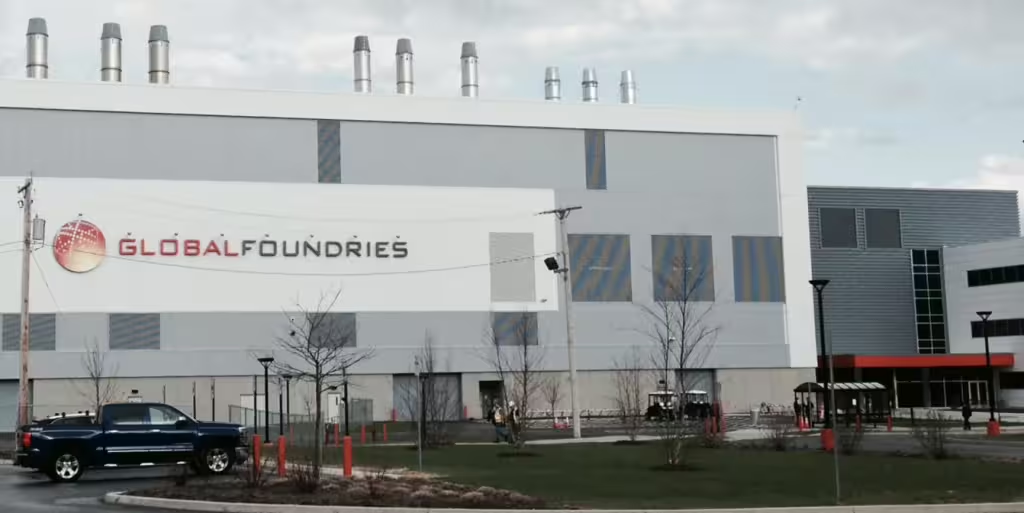
Two new semiconductor plants are going up in New York under a financing package carrying up to $21 billion in Japanese government backing, Bloomberg reported. The facilities will be jointly owned by the United States and Japan and operated by GlobalFoundries, the chipmaker nearly three-quarters owned by Abu Dhabi’s Mubadala. Washington is simultaneously taking a roughly 4% equity stake in the company.
Details:
- The ownership structure: The two factories will be jointly owned by the US and Japanese governments and operated by GlobalFoundries, according to Bloomberg. That leaves an unusual arrangement in which two states hold the assets while a company nearly three-quarters owned by Abu Dhabi’s sovereign wealth fund runs the production lines.
- The US stake: The American government is purchasing a roughly 4% equity position in GlobalFoundries. Bloomberg reported the purchase is intended to give US taxpayers a share in the company’s growth rather than limit the return on public money to grants alone.
- The federal money: Washington is reallocating $955 million in incentives toward GlobalFoundries’ expansion and modernization programs. The figure is a redirection of funds already committed under existing chip incentive programs rather than a newly appropriated sum.
- The company’s commitment: GlobalFoundries is committing $5 billion of its own capital to its existing plants in New York and Vermont .The spending runs alongside the two new facilities and covers upgrades to sites already in operation.
- What they will make: The plants will produce chips used in cars, industrial equipment and communications gear, Bloomberg reported. These are mature-node components rather than the advanced logic chips that dominate artificial intelligence demand, and they underpin manufacturing supply chains across the automotive sector.
- The timeline: The first factory is scheduled to open in 2029. The second is contingent on demand, and no opening date has been set for it, leaving the full $21 billion ceiling dependent on market conditions that have not been specified.
- The strategic aim: The new capacity is intended to reduce US dependence on East Asian suppliers for chips, according to Bloomberg. Taiwan, South Korea and Japan currently dominate global foundry output, a concentration Washington has treated as a national security exposure.
- The Abu Dhabi link: GlobalFoundries remains nearly three-quarters owned by Mubadala, the Abu Dhabi sovereign wealth fund. The arrangement places an Emirati-controlled manufacturer at the center of an American industrial policy push built around supply chain security.
Background:
GlobalFoundries was spun out of AMD’s manufacturing operations and became Mubadala’s flagship technology holding. It is the largest US-headquartered foundry and has concentrated on mature-node chips rather than competing at the leading edge against TSMC and Samsung.
Between the lines:
Three governments now have direct financial exposure to one company. Washington holds equity and is redirecting $955 million in incentives, Tokyo is backing up to $21 billion, and Abu Dhabi retains nearly three-quarters ownership. The second plant’s dependence on demand suggests the headline figure is a ceiling rather than a commitment, and the automotive and industrial focus points to supply chain security rather than the AI race.
What’s next
Watch for construction milestones ahead of the first plant’s scheduled 2029 opening, terms of the US equity purchase, and whether demand conditions trigger a decision to proceed with the second facility.