Headline:
Summary:
The latest:
A suspected plot against RAF Fairford, the English base used by American bombers to strike Iran, was very likely coordinated inside Iran and almost certainly directed by the Islamic Revolutionary Guard Corps (IRGC), Prime Minister Andy Burnham told parliament Monday. Britain summoned Tehran’s ambassador, sanctioned two Iranians and joined nearly 30 governments in a joint condemnation. Iran denied any role.
Details:
- The assessment: Burnham told lawmakers the government’s judgment is that the operation was very likely coordinated in Iran and almost certainly directed by the IRGC. He said Britain would dismantle Iran’s use of criminal networks, target their funding streams and impose further sanctions to limit the Guard’s capacity to cause harm.
- The operation: Police were alerted to three suspicious vehicles near the Gloucestershire base in the early hours of September 27. Armed officers and military bomb-disposal teams deployed across the rural area, dozens of nearby homes were evacuated and a large cordon was thrown around the site.
- The arrests: Seven men, all in their twenties, were arrested and later released on bail under what police described as strict conditions. No one has been charged. Police said six are British nationals and one holds dual British-Iranian citizenship; none have been publicly identified.
- The evidence: Police said a quantity of accelerant was recovered from three vans linked to the first five men detained at the scene, but no usable explosives were found. Home Secretary Shabana Mahmood told parliament an unnamed individual known to authorities and based in Iran is believed to be behind the plan.
- Tehran’s denial: Iran’s ambassador to Britain, Seyed Ali Mousavi, said Tehran had no role and urged London to produce evidence supporting its claims, according to IRNA. He said Iran was ready to cooperate with British authorities. Tehran said in July that any base used for aggression against Iranian territory was a legitimate target.
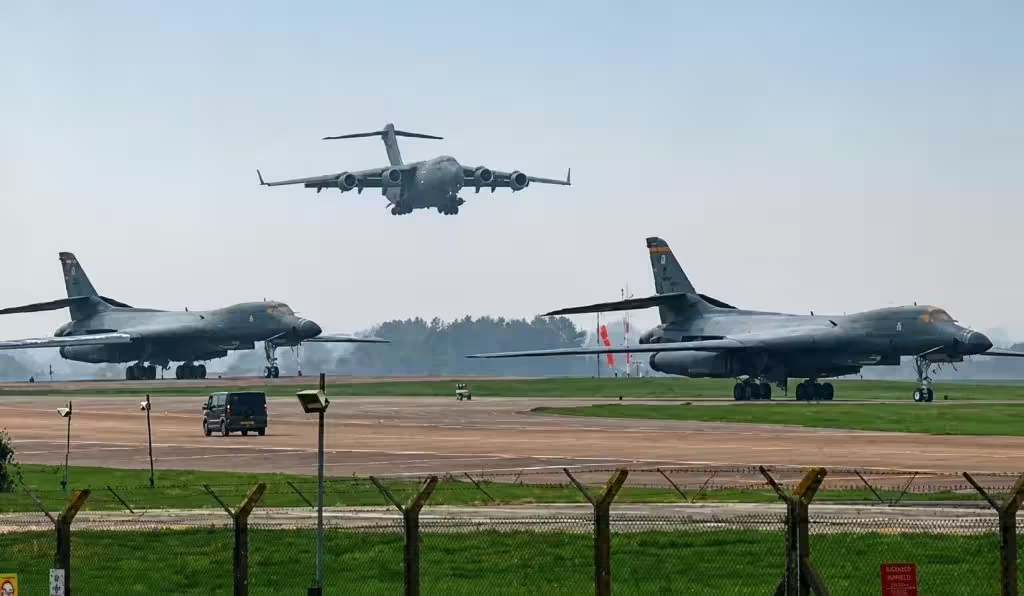
- The bombers: The Pentagon said the United States withdrew its bombers last week from RAF Fairford, roughly 160 kilometers west of London, and redeployed them to home bases. Around a dozen B-1 aircraft were moved back to American soil. Downing Street insisted the base remains secure.
- The sanctions: The Foreign Office designated two Iranians with travel bans and asset freezes: Rouhollah Bazghandi, described by Britain as head of IRGC counter-espionage operations, and Shahram Alireza Tamarzadeh Jaki, named as a broker for the already-sanctioned Zindashti criminal network. Burnham signaled further measures could follow.
- The allied statement: Foreign ministries of nearly 30 countries, including the United States, Canada, France and Germany, condemned Iran’s use of violent attacks, naming lethal plotting, arson, sabotage and cyberattacks. The statement endorsed Britain’s attribution and warned that those acting for Iran would be identified, investigated, disrupted and prosecuted.
- The trend: British officials said national security cases involving hostile state activity, including Iran, rose 50% in the six months to December 2025. Britain said last year it had identified 20 credible Iran-backed threats to kill or kidnap people in the UK. Tehran has repeatedly denied such accusations.
- Washington’s role: The State Department said Secretary of State Marco Rubio spoke by phone with Foreign Secretary Ed Miliband on Monday about holding Iran accountable and securing American assets in Britain. Miliband said Iran’s attempts to undermine UK security through criminal networks and proxies were unacceptable.
Background:
RAF Fairford, in the Cotswolds, has served as a forward operating site for the US Air Force for decades. Britain recently approved an American request to fly B-1 and B-52 bombers from the base for what London called defensive strikes on Iranian missiles and launch sites.
Between the lines:
The gap between the attribution and the casework is the story: no charges, no usable explosives, and seven men bailed, yet London is confident enough to sanction an IRGC officer and secure a 30-country endorsement. Mahmood framed Fairford as part of a pattern in which Iran pays criminals or recruits naive volunteers, preserving deniability — which is also why prosecutions lag behind political attribution.
What’s next
Watch whether police charge any of the seven bailed men, whether Britain announces the further sanctions Burnham signaled, and whether the US returns its B-1 bombers to Fairford.