The latest:
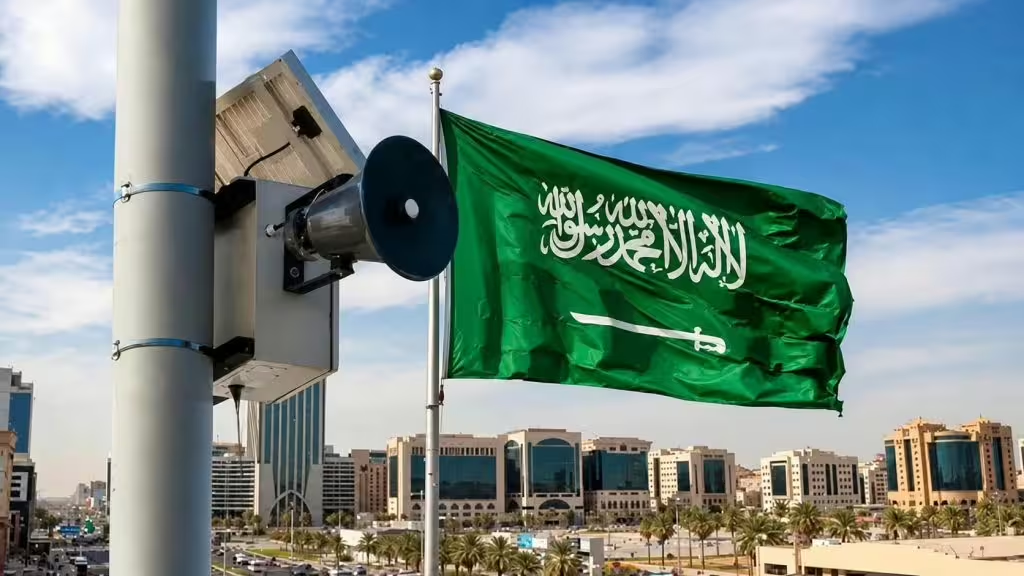
Saudi Arabia stopped issuing public warnings of incoming military attacks days before a series of strikes on Riyadh’s airport killed at least 18 people and wounded over 300, Reuters reported. The government has not explained the absence of alerts ahead of the four attacks on the capital last week. Civil defence resumed warnings on Monday, its first since September 29.
Details:
- The numbers: Four attacks hit Riyadh over the past week, with the Saturday airport strike the deadliest, Reuters reported. Two Western officials said Riyadh was struck roughly a dozen times this month while no public warnings were issued until Monday. At least 18 people were killed and more than 300 wounded.
- The system: Saudi Arabia began pushing threat alerts to mobile phones and social media through a national early-warning system in May, Reuters reported. Despite escalating Houthi attacks, it went quiet. The last alert before last week’s strikes was issued on September 29 for the southern province of Najran, according to civil defence posts on X.
- No response: Saudi civil defence, the emergency and rescue agency under the interior ministry that issues early warnings, did not respond to emailed questions about why no alerts were sent, Reuters reported. The Saudi government media office also did not respond.
- The explanation: Two officials with direct knowledge said that before last week’s airport attacks, an allied Western government asked Saudi authorities why the alerts had stopped. The response was that the notifications were too disruptive and that many citizens complained they were waking them at night. Saudi officials did not respond to requests for comment.
- The Gulf contrast: Every Gulf state has been hit by Iranian drones and missiles since the US-Iran war began in February, but governments handled warnings differently, Reuters reported. Qatar’s interior ministry sent mobile alerts before nearly every attack, telling residents in July to stay home and away from windows. Bahrain and Kuwait repeatedly sounded sirens.
- Embassy channel: Western embassies issued their own internal missile and drone alerts to staff while no public warnings were going out, according to three people familiar with the matter and notices seen by Reuters. One said they drew on US and other Western intelligence plus input from Saudi authorities. Internal alerts went out during the first two airport attacks.
- Saturday’s gap: Even the embassies received no internal warning before Saturday’s airport strike, the people said, offering no explanation for the lapse.
- Information curbs: Civil defence has continued warning residents against sharing images, rumours or information about interceptions and impact sites, including in a Monday post, under government regulations issued in March. It also kept issuing bad-weather warnings for rain and flooding, most recently on Monday.
- Riyadh’s message: Saudi Arabia hosted the World Petroleum Council energy conference on Monday despite senior oil executives pulling out. Energy Minister Prince Abdulaziz bin Salman thanked attendees for travelling to Riyadh “because you know that this country is safe,” while acknowledging the danger had not passed.
- Defence limits: Ali Shihabi, a Saudi analyst close to the government, said that with or without early warnings the kingdom would struggle to defend all its assets given its size, citing airports, pipelines and oil facilities. He said there were not enough Patriot systems, interceptors and batteries to cover everything at once.
Background:
Saudi Arabia is fighting Iran-aligned Houthis in Yemen while trying to project calm at home and abroad. Riyadh launched its national early-warning system in May, after Gulf states came under drone and missile fire following the start of the US-Iran war in February.
Between the lines:
Regional analysts told Reuters the approach may backfire, because the absence of warnings deepened uncertainty inside the kingdom. Former US ambassador Michael Ratney said Riyadh was balancing public messaging against fear of domestic disruption, but ended up amplifying anxiety. Saudi academic Sultan Alamer said the government wants both a military campaign and public confidence. The embassy alerts show warning information existed; the decision was whether to publish it.
What’s next
Watch whether civil defence sustains public alerts after Monday’s resumption, whether Riyadh explains the two-week gap, and whether further strikes hit the capital or southern cities named in Monday’s warning.