Key Points
- Meta released Muse Wonder on Monday, claiming frontier-level performance against OpenAI and Anthropic models.
- Its Muse personal agent has near nine million downloads, but growth and retention are slipping.
- The model is Meta's test of whether its superintelligence overhaul can win the agent market.
The latest:
Meta released a new artificial-intelligence model on Monday that it says puts the company at the AI frontier, the target it set when it created Meta Superintelligence Labs. The model, Muse Wonder, will soon power Muse, Meta’s month-old personal-assistant agent, for subscribers on both paid tiers. Meta’s AI chief Alexandr Wang said the model is competitive with the very best models available.
Details:
- The benchmark claim: Meta said Muse Wonder outperforms OpenAI’s Astra and Anthropic’s Fable on several tests. Wang said it is not only a competitive frontier model but the strongest option for personal and professional agents, and the best choice to power an experience like Muse. Meta did not publish the individual test results.
- What is new: According to Meta, the model adds improved memory, sharper focus to help users work through difficult goals, and deeper expertise in health, finance and legal subjects. Those areas point at the use cases an always-on assistant would need to justify a paid subscription.
- The adoption problem: Muse has amassed nearly nine million global downloads since launching last month. Sensor Tower data shows downloads have started to slow, and Muse retention trails ChatGPT at the 14-day mark, the window that typically separates a product people try from one they keep using.
- The pricing tiers: The model will reach subscribers of both the $20-a-month and $100-a-month plans, according to Meta. The company did not give a date for the rollout, nor did it say whether any version of Muse Wonder reaches users outside the paid tiers.
- Meta’s diagnosis: Wang said some users have a clear sense of what they want the product for and how it can improve their lives. For others less familiar with AI or agents, he said, understanding that is “more of a hurdle to get on board.” The framing places the obstacle in user familiarity rather than model capability.
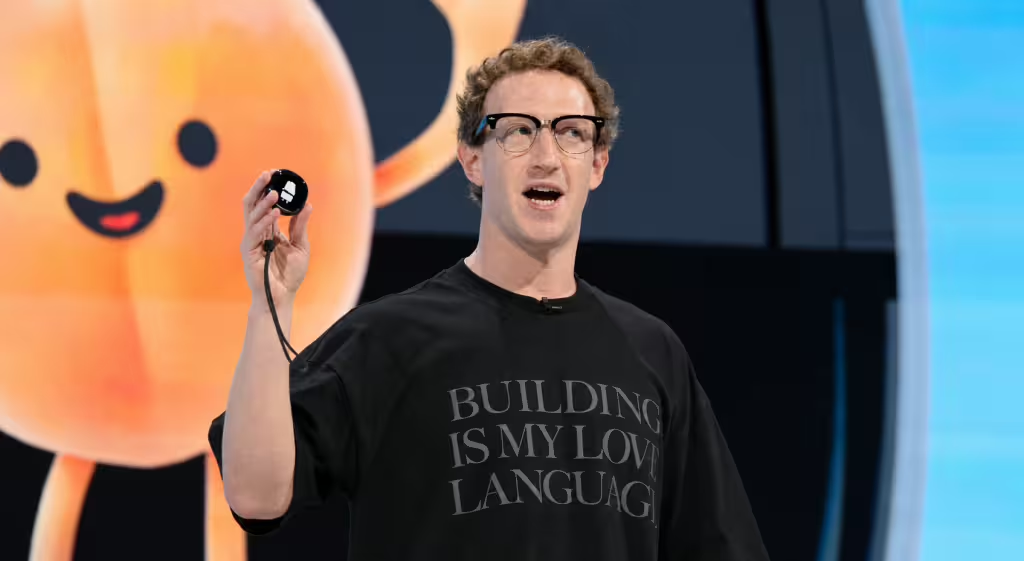
- The reset: Meta overhauled its AI operation in spring 2025 after the disappointing launch of Llama 4. Chief Executive Mark Zuckerberg hired Wang from Scale AI to run the newly created Meta Superintelligence Labs, built around a pitch of delivering personal superintelligence to the company’s billions of users.
- The stakes inside Meta: Muse is the product that goal turned into. Zuckerberg told a conference last month that the agent is the centerpiece of what the company is building, tying the credibility of the entire Superintelligence Labs reorganization to whether one consumer app can hold its users.
- The field: OpenAI released a competing agent, Dots, at its developer conference nearly two weeks ago. Google offers Gemini Spark, and the startup Instinct has launched an agent that has emerged as Muse’s main competitor so far, crowding the category within weeks of its debut.
Background:
Meta’s AI effort was rebuilt after Llama 4 landed poorly in spring 2025. The response was structural: a new unit, Meta Superintelligence Labs, a leader hired from Scale AI, and a consumer product meant to carry the strategy to a mass audience.
Between the lines:
The model’s listed upgrades read as answers to the retention gap rather than to a benchmark race. Memory, sustained focus and health, finance and legal expertise are what turn a one-off trial into daily use, which is precisely where Sensor Tower places Muse behind ChatGPT. Wang’s explanation locates the problem in user onboarding, an argument that only holds if the next download and retention curves bend.
What’s next
Watch the rollout date to both subscriber tiers, the next Sensor Tower download and 14-day retention readings for Muse, and whether Meta publishes the test results behind its claims against Astra and Fable.