
The latest:
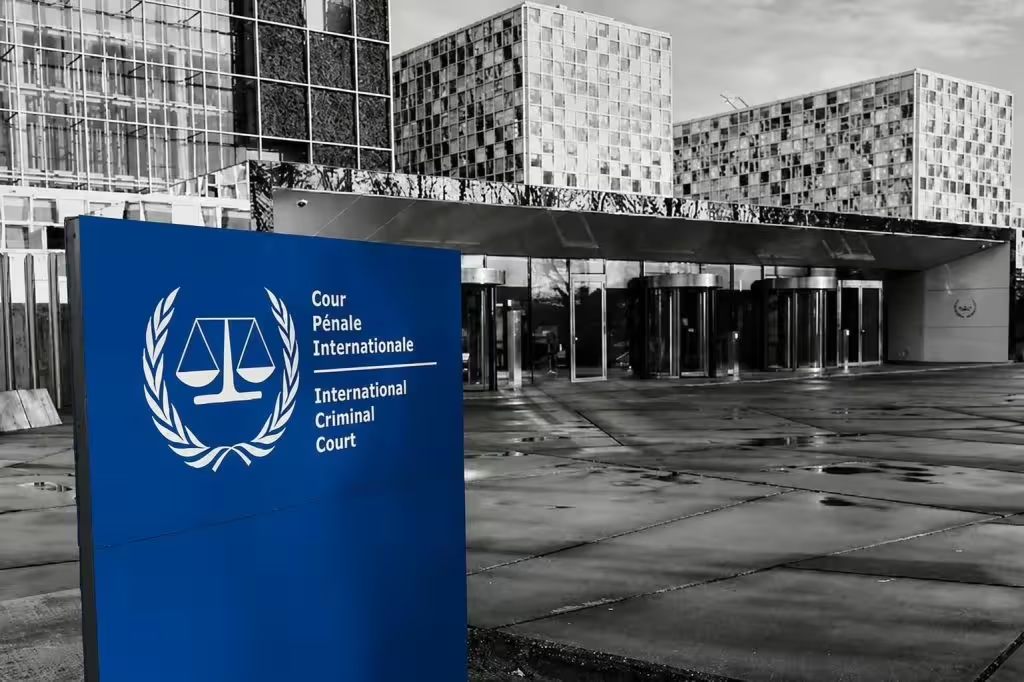
Sweeping US financial sanctions will sever the International Criminal Court from American banks, technology firms and the dollar once a six-month grace period expires, Secretary of State Marco Rubio announced Friday. Rubio said Washington would block dealings with the court, cut off its resources and paralyze its ability to operate, while leaving room for what he described as a negotiated outcome.
Details:
- The US case: Rubio said President Donald Trump would never allow the court to prosecute Americans, and that the United States and its people are not subject to the authority of what he called an illegitimate ICC. He pledged to dismantle the institution piece by piece until the threat to Americans is gone.
- Rubio’s terms: He said Washington still hopes for a diplomatic solution, and that the measure gives member states a chance to negotiate and present a resolution addressing US concerns. If those efforts fail, he said, the United States will adjust its steps accordingly.
- The mechanism: The sanctions freeze ICC assets and rights held in the United States and ban transactions involving them by American entities or routed through the US. The State Department said companies with commercial ties to the court will receive 180-day licenses to wind down or continue work without financial penalty.
- The escalation: In February 2025, weeks into his term, Trump ordered agencies to prepare sanctions, saying the court was violating American sovereignty and undermining the national security and foreign policy work of the US and its allies, including Israel. Seventeen ICC judges and prosecutors were already sanctioned.
- The trigger: The announcement came hours after a Norwegian committee awarded the Nobel Peace Prize to Navi Pillay, a South African lawyer who served nine years as an ICC judge and as the UN’s top human rights official. Trump had sought the prize for himself.
- The grievances: Washington has objected to the court’s ability to investigate US soldiers in Afghanistan and to its actions against Israel. In November 2024 the ICC issued arrest warrants for Prime Minister Benjamin Netanyahu and former defense minister Yoav Gallant over alleged war crimes and crimes against humanity in Gaza.
- The court’s answer: The ICC said the move is an attempt to obstruct justice and an assault on the rule of law and the international legal order. President Tomoko Akane said the court will continue exercising its mandate fully, acting only on the basis of law and evidence.
- Allied pushback: Canada, Denmark, Germany, France, Italy, Japan, the Netherlands and Britain warned in a joint statement that the sanctions, if applied, would significantly affect the court’s work, its staff and their families. The European Commission called the step deeply regrettable and said the six-month delay leaves room for dialogue.
- The countermeasure: Belgian Foreign Minister Maxime Prevot urged the EU to activate its blocking statute, which would bar European companies from complying with the US measures. Dutch Foreign Minister Tom Berendsen described the statute as the nuclear option and said The Hague is in talks with the Commission on rapid activation.
- Scale and limits: Of roughly 200 countries, 125 have signed the Rome Statute; the United States and Israel never ratified it. Defenders note the court has no police force and depends on member states to make arrests. Venezuela, Chad and Nauru announced withdrawals this year.
Background:
The court was established in 2002 in The Hague to try genocide, war crimes and crimes against humanity when member states cannot or will not. US opposition predates Trump: the George W. Bush administration also fought the court’s reach over Americans.
Between the lines:
Rubio’s 180-day licensing window reframes the sanctions as leverage rather than a death sentence, aimed at pressuring the 125 member states into renegotiating the court’s reach over Americans. That is why Belgium’s blocking-statute push matters more than the condemnations: it would test whether European governments will legally shield the court, or quietly let companies comply.
What’s next
Watch whether the European Commission activates the blocking statute before the 180-day licenses lapse, how member states respond to Akane’s appeal for support, and whether further states follow Venezuela, Chad and Nauru in withdrawing.