Key Points
- OpenAI said Iran-based users produced roughly 100 AI articles published by at least 20 news outlets.
- Seven fabricated bylines carried content on U.S. military action against Iran, the company said.
- The case shows small newsrooms absorbing fabricated content through ordinary syndication relationships.
The latest:
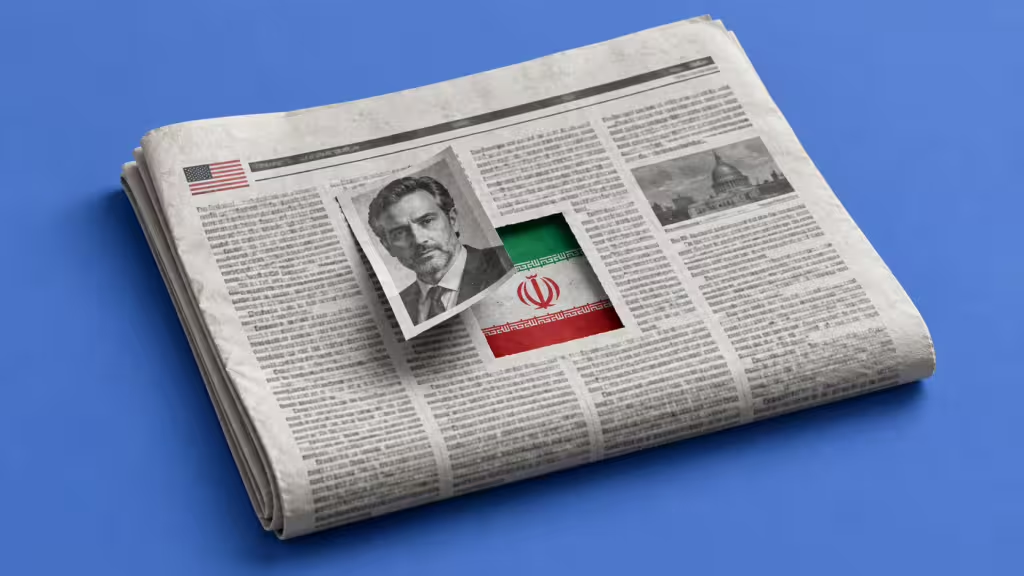
Roughly 100 AI-generated articles were placed across at least 20 news outlets by an operation OpenAI attributes to users based in Iran, the company said Thursday. The campaign seeded content about U.S. military action in Iran, much of it stressing the war’s costs to Americans. OpenAI described it as a for-hire influence campaign run by a commercial outfit.
Details:
- The findings: OpenAI said in a Thursday report on political influence campaigns that about 100 articles produced with ChatGPT reached at least 20 outlets. The users sent their instructions to the chatbot in Persian, according to the company, which described the operation as commercial rather than state-run in its own accounting.
- The bylines: Seven fabricated author names appeared across the series, OpenAI said. One, Ervin Hoskins, surfaced on war-critical pieces in the Port St. Joe Star in Florida and in larger publications including Daily Kos and Middle East Monitor, which together count more than 3 million Facebook followers.
- The fake author: The author photo attached to the Hoskins column in the Star was generated using OpenAI’s own artificial intelligence tools, according to the company’s online verification tool. The Hoskins opinion piece warned last month that “the bill will follow Americans beyond the fighting itself.”
- How it landed: Port St. Joe Star publisher David Adlerstein said by email that the Hoskins column was pitched by PeaceVoice, a small liberal think tank in Oregon that had supplied the paper with content for years. Gulf County, where the paper is based, has a population of about 15,000.
- The editor’s account: Adlerstein said he usually declines PeaceVoice columns because the paper serves a heavily Republican area, but ran this one as thought-provoking rather than a strident attack on President Donald Trump. He said his existing relationship with PeaceVoice meant he saw no need to verify the author’s identity.
- Earlier cases: Business Insider and Wired removed a series of articles last year published under the byline Margaux Blanchard that appeared to be AI-generated. Who or what was behind those stories and other apparently fake personas remained unclear, unlike the Hoskins material now tied by OpenAI to an organized operation.
- The content line: Many of the articles emphasized negative effects of the war on Americans rather than arguing Iran’s case directly, according to OpenAI. The company did not name the commercial outfit it says ran the operation, nor did it list the 20 outlets that carried the material.
- Disclosure: The Washington Post has a content partnership with OpenAI. The findings on the Iranian operation come from OpenAI’s own detection work on accounts using its chatbot, and the company is the sole source identifying who was behind the Hoskins persona.
Between the lines:
The distribution path is the story: the Star did not buy or commission the piece, it received it through a syndication relationship years old. A weekly serving a county of 15,000 had no screening layer between a think tank’s inbox pitch and print, which is why an AI-generated byline and AI-generated headshot cleared publication without a check.
What’s next
Watch whether the 20 outlets identified by OpenAI issue retractions, whether PeaceVoice explains how the Hoskins submission reached it, and whether OpenAI names the commercial operator in later reporting on the accounts.