Key Points
- The Swedish Academy awarded the 2026 Nobel literature prize to Canadian poet and essayist Anne Carson.
- Carson, 76, writes across poetry, prose and translation, drawing on ancient Greek literature and myth.
- She is the first Canadian woman to take literature's most prestigious award, after Hungary's Laszlo Krasznahorkai in 2025.
The latest:
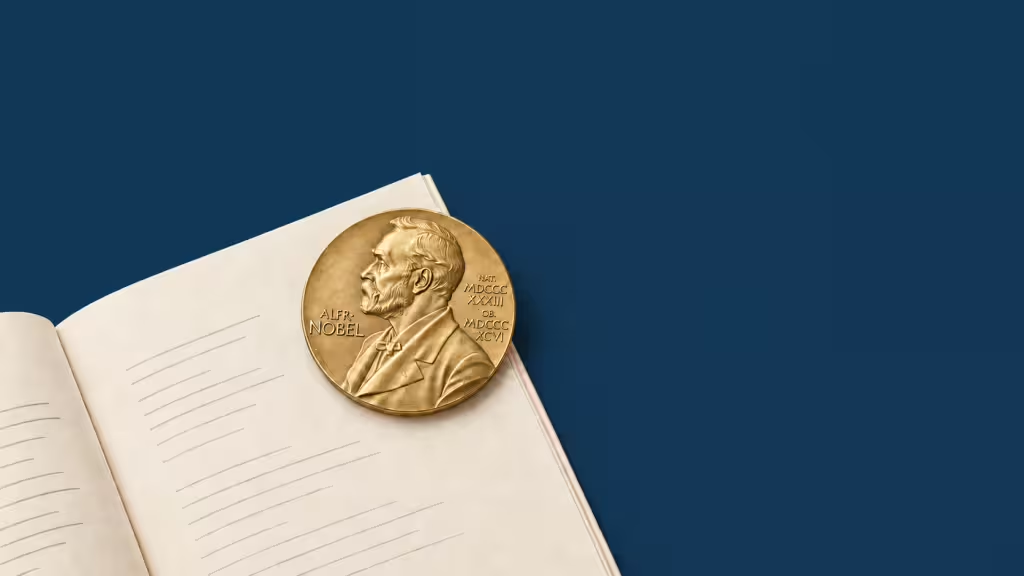
The 2026 Nobel prize in literature went to Anne Carson, the Canadian poet and essayist whose work moves between verse, essay and classical translation. The Swedish Academy cited a bold and inventive body of work that, in playful dialogue with the classical tradition, has created new forms for contemporary literature. Carson, born in Toronto in 1950, will receive the medal and diploma in Stockholm in December.
Details:
- The citation: The Academy framed the award around Carson’s engagement with antiquity rather than any single book, praising an oeuvre built in playful dialogue with the classical tradition. Her writing draws heavily on the literature and mythology of the ancient Greek world, and routinely crosses between poetry, prose and translation within a single volume.
- The breakthrough book: Carson’s best-known work is Autobiography of Red, a 1998 novel in verse built from the surviving fragments of the ancient Greek poet Stesichorus. It recasts the myth of Geryon, the red-winged monster killed by Herakles, as the story of a modern teenage boy working through heartbreak and desire.
- The first book: Her debut, Eros the Bittersweet, appeared in 1986 and set the pattern for everything after it: literary criticism fused with an extended meditation on desire and the ancient Greek tradition. The form has stayed deliberately unstable across four decades of publishing.
- Earlier honours: In 2001 Carson became the first woman to win the TS Eliot prize, for The Beauty of the Husband. The same year, Men in the Off Hours won the inaugural Griffin poetry prize. She has also held Guggenheim and MacArthur fellowships.
- The range: Men in the Off Hours gathered verse essays, poems, epitaphs and prose about artists and historical figures. Decreation combined poetry, essays and an opera. Later works include Red Doc> and Float, each extending the refusal to settle into a single genre.
- The outlier object: Nox, published in 2010, is the clearest statement of Carson’s avant-garde method. It takes the form of an accordion-fold box holding a reproduction of a notebook she assembled after her brother’s death, making the physical object part of the work rather than a container for it.
- Peer recognition: Susan Sontag counted Carson among the very few writers in English she would read without qualification, saying: “If there’s a magazine that has something of hers in it, I buy it automatically.” The endorsement helped carry Carson’s reputation beyond academic and poetry circles.
- The prize record: The literature Nobel has now been awarded 119 times since 1901. Recent laureates include Annie Ernaux, Bob Dylan, Abdulrazak Gurnah, Louise Gluck, Peter Handke and Olga Tokarczuk. Last year’s winner was Hungarian author Laszlo Krasznahorkai, known for dystopian and avant-garde writing.
Background:
The Swedish Academy has leaned toward formally difficult, genre-resistant writers in recent cycles, with Krasznahorkai in 2025 and Handke in 2019. Carson, who built her career largely outside commercial fiction, fits that line more closely than occasional populist picks such as Bob Dylan in 2016.
Between the lines:
Carson’s selection rewards a body of work that resists classification: a verse novel drawn from Stesichorus fragments, an opera folded into an essay collection, a notebook reproduced inside a box. Honouring that catalogue signals the Academy is comfortable defining literature by form-making rather than genre, and extending the prize’s reach from the novel toward poetry and the essay.
What’s next
Carson is due to receive the medal and diploma at the Nobel ceremony in Stockholm in December, where laureates traditionally deliver a lecture. Publishers typically respond with reissues, a measurable test of how far the prize moves a poet’s sales.