Key Points
- Government forces retook the Bab el-Mandeb coastline up to Mocha on Monday, the Yemeni government said.
- The Houthis seized the strait area last month, jolting energy markets already strained by Hormuz closure.
- Control of the waterway shapes shipping risk between the Mediterranean and the Indian Ocean.
The latest:
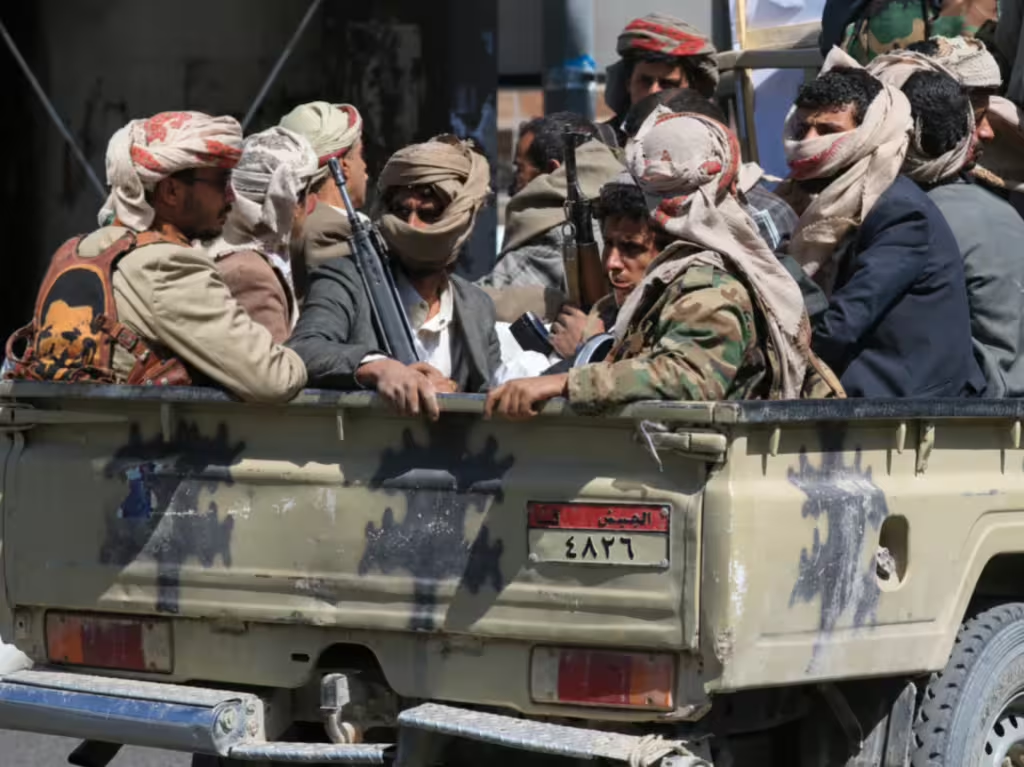
Saudi-backed Yemeni government forces advanced along the Bab el-Mandeb coast on Monday and reached the outskirts of Mocha, with the Defence Ministry saying the city had fallen. Four government sources said Houthi fighters were pulling back into the highlands under heavy Saudi air cover. The Houthis dismissed the government’s claims as baseless.
Details:
- The advance: Government forces moved up the coastline to Mocha and had already taken key positions including an airstrip in Dhubab district at the mouth of the strait, according to the government. The Houthis seized the area last month, a loss that sent shockwaves through energy markets.
- The denial: The Houthis, who have held much of Yemen’s populous north including Sanaa since 2014, said the government’s claims of gains were baseless. Reuters said it could not independently confirm how far government forces had pushed.
- Saudi role: Riyadh, which arms and trains the government forces, said on Monday it had struck hundreds of targets to provide air cover for the strait and the ground advance. Saudi Arabia has sought logistical help from allies to restore free Red Sea traffic and stop Houthi attacks on its territory.
- Taiz under pressure: Five government military sources said Houthi fighters took sections of a mountain road near Taiz, leaving the city encircled; one government source denied the road had been cut. Taiz, Yemen’s third city, holds over half a million people and a garrison of thousands of government fighters.
- Taiz fighting: Houthi fighters advanced on Sunday night into al-Turbah, a town atop a promontory on the road, five government sources said, while another government source denied it. Houthi attacks last week damaged a culvert on the Taiz-Aden road, making it impassable.
- Houthi claim: A Houthi-run news agency cited a military source saying the group had driven government forces out of al-Mawasit district in Taiz province and reached the home of Rashad al-Alimi, head of Yemen’s interim presidential council. The group also threatened to attack air traffic in Saudi airspace.
- Casualties: The Houthi-run health ministry said two people were killed and seven wounded in strikes on the Sanhan and Sa’wan districts of Sanaa province. The Yemeni government said it had launched attacks on several fronts, including in Sanaa province.
- Humanitarian toll: The UN migration agency said 184,000 people have been displaced since the war resumed. In al-Mudhaffar, outside Taiz and inside the besieged zone, residents queued at a petrol station for fuel and cooking gas. “This is the daily state in Taiz,” said one man in the line, Shehab Hazaa.
- Presidential line: Alimi said on Sunday he would fight until the country is freed from what he called the grip of the terrorist militia. The government has not set out a timeline for operations beyond the coastal front.
Background:
Yemen’s war restarted this summer after a 2022 ceasefire collapsed, spilling over from the US-Iran conflict. The Houthis seized Sanaa in 2014; a Saudi-led air campaign the following year ended in stalemate and one of the world’s worst humanitarian crises.
Between the lines:
Retaking the coast narrows Houthi options against shipping but does not remove them: the group can still strike vessels with drones from positions further up the coast and inland. The simultaneous encirclement of Taiz suggests both sides are trading territory on separate fronts rather than one side breaking through, with Iran’s closure of Hormuz compounding pressure on energy routes.
What’s next
Watch whether the government consolidates control of Mocha, whether the Taiz-Aden road reopens, and whether Houthi forces act on their threat against Saudi airspace. UN displacement figures remain the clearest measure of escalation.