Key Points
- Netanyahu pledged Hamas would never again govern Gaza and threatened those involved in the 2023 attack.
- Herzog demanded an investigation into missed warnings and cautioned that political polarization could create national vulnerability.
- The anniversary linked Israel’s unfinished military objectives to accountability for security failures and national cohesion.
The latest
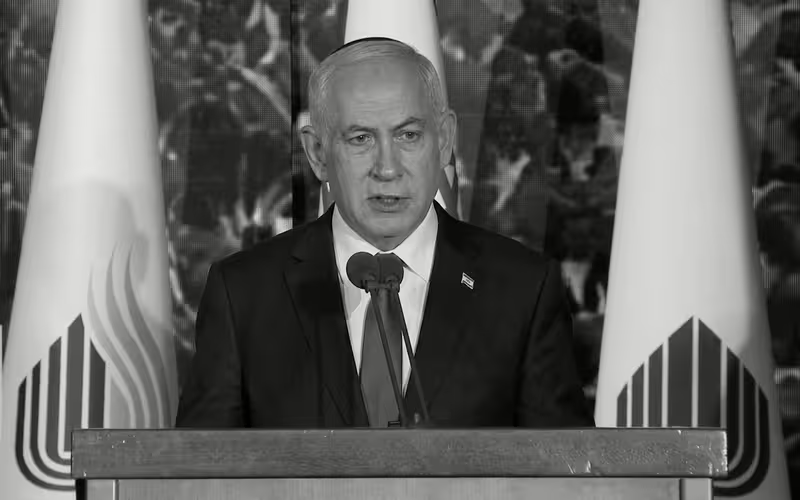
Three years after the October 7 attack, Prime Minister Benjamin Netanyahu vowed at Israel’s state memorial ceremony in Jerusalem to keep pursuing those responsible and prevent Hamas from ruling Gaza again, while President Isaac Herzog demanded a full investigation into the failures preceding the assault. Addressing the Mount Herzl ceremony, Netanyahu said Israel still had “missions” to complete and declared that everyone involved in the attack or holding Israeli hostages was “living on borrowed time.” Herzog called for the country to confront both missed security warnings and deepening internal divisions.
Details
- Unfinished mission: Netanyahu said Israel would continue “settling accounts” with Hamas operatives while preventing the group from rebuilding its military and governing capacity. He connected the Gaza campaign with recovering hostages and confronting Iran and its allies, arguing that Israeli operations had weakened Tehran’s missile infrastructure, nuclear program, and military and scientific personnel.
- Security estimate: An Israeli source said IDF Military Intelligence chief Maj. Gen. Shlomi Binder told the security cabinet that approximately 6,000 people crossed from Gaza during the assault and about 4,000 had since been killed. Binder said 2,000 remained and would be pursued. The figures were presented as Israeli security assessments.
- Continued targeting: The IDF said it killed Saqr Nabil Musa Qaisi, identifying him as a Hamas Nukhba operative who participated in the infiltration. The military alleged that Qaisi later presented himself as director of Deniz Feneri, described as a humanitarian aid organization, and used that position to support Hamas activities.
- Lebanon opening: Netanyahu said Israel would continue striking Hezbollah when necessary while working to create conditions for peace with Lebanon, where he said an overwhelming majority wanted peace with Israel. His position distinguished military action against the Iran-backed organization from a possible longer-term relationship with the Lebanese state.
- Missed warnings: Herzog recalled the female surveillance soldiers at Nahal Oz who detected unusual developments near Gaza before the attack. “They saw, they reported and they raised the alarm,” he said, but nobody assembled the information into a complete picture. At 6:29 a.m., the observers reported infiltrators approaching under the military code “Turkish Horse.” Seven were abducted; six returned alive, while Cpl. Noa Marciano was killed in captivity.
- Election divisions: As Israel heads toward an election, Herzog described dangerous political disputes and deep division as warning lights that must be heeded. He defended democratic disagreement but stressed that political opponents and their children would continue sharing the same country, protecting it and building its future together.
What’s next
Attention now turns to whether Israel authorizes the full investigation Herzog demanded into pre-attack intelligence and security failures, and how accountability shapes the approaching election.