Key Points
- Morocco’s first woman prime minister must build a coalition after PAM won 97 of 395 seats.
- Her urban-development record aligns with infrastructure investment and Morocco’s preparations for the 2030 World Cup.
- The transition matters to the UAE as strategic ties span investment, development and regional diplomacy.
The latest
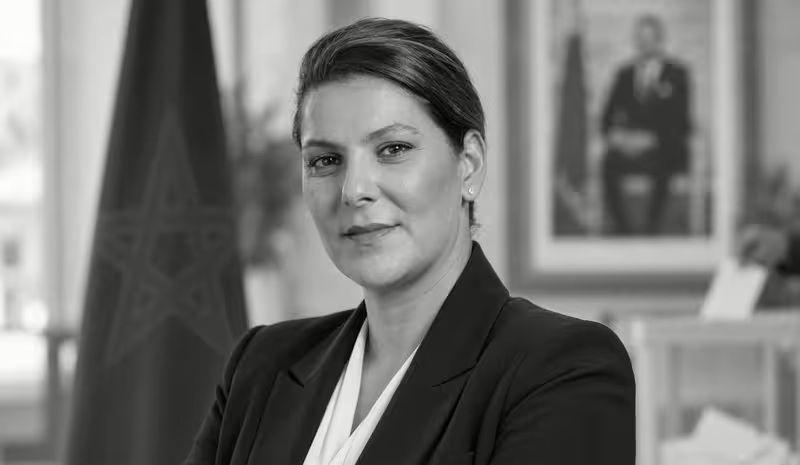
King Mohammed VI appointed Fatima Ezzahra El Mansouri as Morocco’s first woman prime minister on September 29, tasking the 50-year-old lawyer with forming a government after her Authenticity and Modernity Party won the September 23 legislative elections. Her elevation places a politician with experience as Marrakech mayor and urban-planning minister in charge as Morocco seeks coalition stability, faster growth and stronger investment links with the UAE and other Gulf states.
Details
- Election arithmetic: PAM secured 97 of 395 seats in the House of Representatives, ahead of the National Rally of Independents on 66 and Istiqlal on 65. Turnout was just over 38%, leaving El Mansouri to negotiate with rival parties rather than govern with an outright majority.
- Economic program: PAM campaigned for average annual growth of 5%, inflation around 2% and one million jobs over five years. The incoming government faces youth unemployment, economic inequality and declining confidence in political institutions while preparing major infrastructure works for the 2030 FIFA World Cup.
- UAE partnership: Morocco and the UAE describe their relationship as a strategic partnership spanning infrastructure, investment and development. During President Sheikh Mohamed bin Zayed Al Nahyan’s June 2026 visit to Morocco, the two countries discussed international and regional challenges, including issues concerning the Gulf and wider Middle East.
- Gulf agenda: The Gulf Cooperation Council has framed relations with Morocco as a strategic partnership covering political, economic, security and development cooperation. A dedicated Gulf-Morocco Investment Forum was being prepared in 2025 to expand trade and investment across renewables, logistics, tourism, manufacturing, agriculture and technology. The GCC has also backed Morocco’s territorial integrity, including its position on Western Sahara.
- Development experience: El Mansouri became Marrakech’s first woman mayor at 33 and returned to the post in 2021. She also served as minister responsible for national planning, urban planning, housing and urban policy, areas relevant to World Cup construction and potential Gulf investment.
- Regional reach: Morocco combines an Atlantic economy with commercial links across Africa and Europe, giving Gulf investors access to sectors beyond hydrocarbons and a potential gateway to African markets. Its diplomatic ties with Israel, Arab states and the United States further shape its role in regional cooperation.
Background
El Mansouri is the second woman to lead an Arab government, after Tunisia’s Najla Bouden, who served from 2021 to 2023. Jackie Kadosh, head of Marrakech’s Jewish community, said she hosted Jewish delegations at her home as mayor and attended the community’s synagogue on Yom Kippur several times.
What’s next
El Mansouri’s immediate test is to secure coalition partners in the 395-seat chamber. The governing agreement will determine how PAM’s growth, jobs and infrastructure pledges are allocated among participating parties, making the completion of coalition negotiations the next formal decision point.