Key Points
- Riyadh will host more than 25,000 delegates at Saudi Arabia’s first World Energy Congress.
- Ministers and executives will debate energy security, affordability, lower emissions and accelerating technological change.
- The gathering advances Riyadh’s ambition to become a wider global energy, technology and investment hub.
The latest
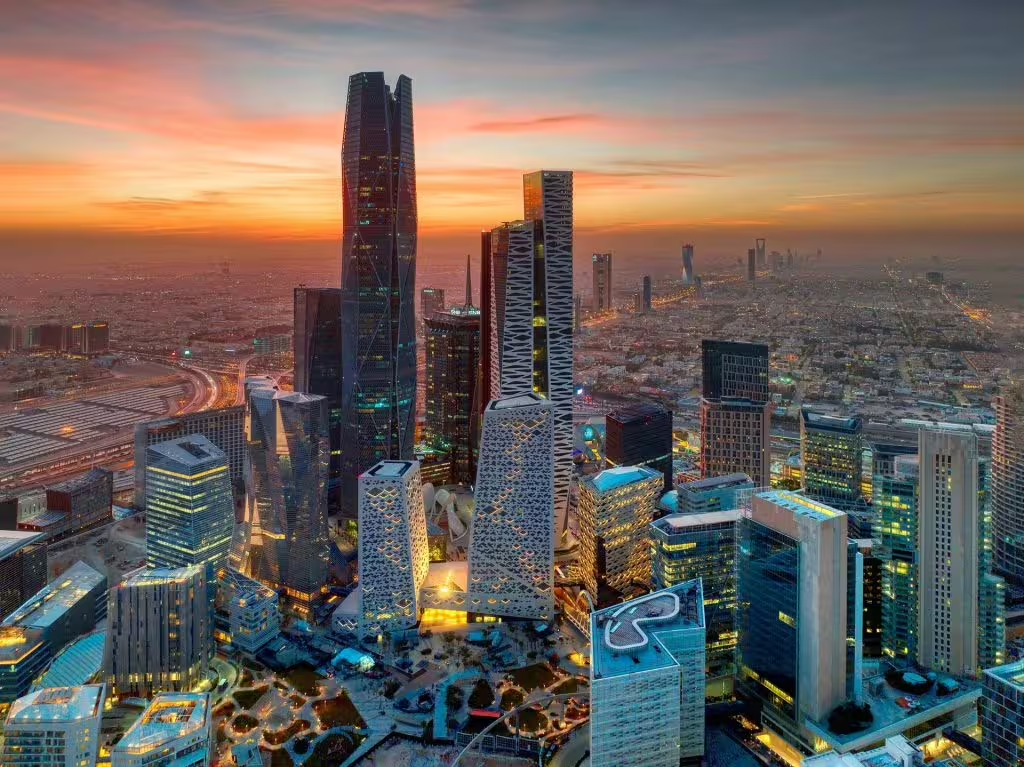
Saudi Arabia will host the 25th World Energy Congress from October 11 to 15, bringing around 100 energy ministers, 500 chief executives and 800 speakers to the Riyadh Front Exhibition and Conference Center. Representatives of about 1,000 companies will attend the event, held for the first time in the Kingdom, as governments and industry leaders confront the competing demands of secure, affordable supplies, faster innovation and lower emissions.
Details
- Congress agenda: Under the theme “Energy for All: Pathways to a Sustainable Future,” the five-day congress will include more than 30 plenary, strategic and ministerial sessions. Discussions will cover energy security, critical-mineral supply chains, carbon capture and storage, carbon markets, renewable energy and technologies designed to strengthen resilience.
- Investment shift: Global energy investment is projected to reach a record $3.4 trillion in 2026, rising 5% from the previous year, the International Energy Agency’s World Energy Investment 2026 report projects. Clean energy, grids, storage and efficiency are expected to attract about $2.2 trillion, nearly twice the roughly $1.2 trillion forecast for oil, gas and coal.
- Saudi strategy: The Kingdom is combining its position as a leading oil producer with Vision 2030 investment in technology, infrastructure, renewable energy, artificial intelligence and new industries. Its strategy maintains traditional energy production while developing lower-carbon technologies and emerging sectors, positioning Riyadh as both a hydrocarbon supplier and an investor in technologies reshaping the energy system.
- AI applications: Executives from Saudi Aramco, Siemens Energy, Microsoft and Samsung E&A are expected to discuss AI applications in predictive maintenance, exploration, industrial automation, grid management, supply-chain optimization and demand forecasting. Gulf investment in data centers, cloud infrastructure and large-scale energy projects is connecting digital expansion more closely with electricity demand and energy production.
- Senior participants: Expected participants include BP CEO Meg O’Neill, ExxonMobil Chairman and CEO Darren Woods, and TotalEnergies Chairman and CEO Patrick Pouyanné. Saudi Energy Minister Prince Abdulaziz bin Salman and WPC Energy President Pedro Miras are also due to participate.
- Energy week: Riyadh Energy Week will add the International Energy Forum ministerial meeting, Clean Energy Ministerial and Mission Innovation sessions, alongside OAPEC events. Additional programs will address carbon circularity, women in energy, young professionals, social responsibility, AI and digitalization.
Background
The congress comes as geopolitical tensions sharpen concerns about oil and gas production, shipping routes and infrastructure. The Strait of Hormuz remains a critical chokepoint for international energy flows, while Red Sea disruptions have exposed vulnerabilities along alternative maritime routes. Reliable exports and investment in infrastructure, technology and alternative energy sources remain central to Gulf producers’ long-term economic resilience.
What’s next
From October 11 to 15, the congress will hold a dedicated ministerial dialogue on Saudi Arabia’s economic transformation, alongside sessions examining investment, supply security, lower-carbon technologies, storage, grids and AI-enabled energy infrastructure.