Key Points
- Kpler says 10 million barrels a day crossed the Strait of Hormuz in September.
- Iran shut the waterway in March; prewar regional exports ran near 19 million barrels daily.
- Analysts say supply still trails demand, keeping fuel costs elevated worldwide.
The latest:
An average of 10 million barrels of oil a day moved through the Strait of Hormuz this month, according to tanker-tracking firm Kpler, a sharp recovery from the trickle recorded early in the war with Iran. Another 6 million barrels a day left Gulf states through pipelines and ports bypassing the strait. Prewar flows through all routes ran near 19 million barrels daily.
Details:
- The numbers: Kpler put September transits at 10 million barrels a day through the strait, against 16 million before the war. TankerTrackers.com calculated a lower figure of 7.4 million for the same month. Kpler estimated Gulf crude exports overall at roughly 85 percent of their prewar level.
- August baseline: The trackers diverged last month too: Vortexa measured 6.4 million barrels a day through the strait, Kpler 5.9 million and TankerTrackers 5.5 million. All three were well under half the prewar total, making September the first month of clear recovery across every methodology.
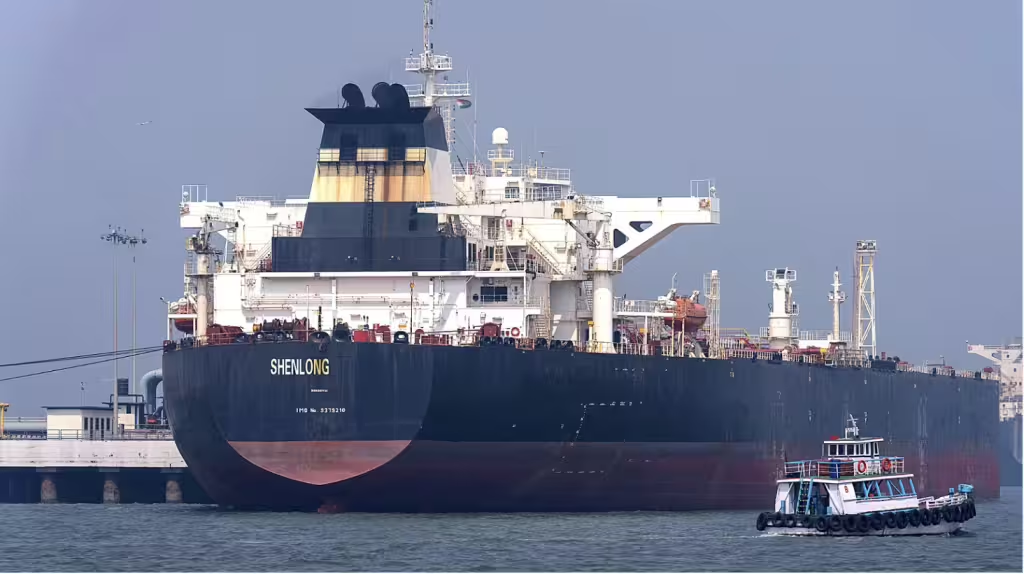
- Why trackers differ: Most tankers switch off their transponders crossing the strait to avoid being spotted by Iran, so transits cannot be observed directly. Firms reconstruct them from signals outside the waterway, satellite imagery and other data. A single large tanker can carry 2 million barrels.
- The US role: A US military operation protecting tankers appears to have encouraged larger shipments by Saudi Arabia and the United Arab Emirates, according to analysts. President Trump, his administration and military officials have said for weeks that the strait is open and oil is moving through it.
- The dispute in Washington: Adm. Brad Cooper, head of Central Command, said in a Sept. 19 video on X that 1 billion barrels had shipped out “in the last couple months.” Spokesman Capt. Tim Hawkins said that meant a few months, and declined to give a daily average since May.
- The suspicion: Congressional Democrats and intelligence analysts, speaking anonymously about confidential assessments, said Central Command had not been transparent about its methodology and suspected inflated estimates produced under White House pressure. Hawkins rejected that, saying the figures draw on military operations, the shipping industry and Gulf states.
- The Pentagon response: Hawkins said more than 13 million barrels a day crossed the strait over the past two weeks. The White House replied through the Defense Department, whose spokeswoman, Kingsley Wilson, strongly rejected the idea that Central Command faced pressure and stood by the flow figures.
- The safety record: Arsenio Dominguez, secretary general of the International Maritime Organization, said last week the strait is not open to navigation because it is not safe. The UN agency counts 85 ships attacked since the war began and 24 mariners killed.
- The market: Per-barrel prices remain well above prewar levels, and higher gasoline and diesel costs are weighing on consumers globally. Dan Pickering of Pickering Energy Partners said global supply still falls short of demand and the market remains tight.
- The risk ahead: Jim Krane of Rice University’s Baker Institute assessed that Iran retains a wide array of escalation options but appears to be holding back. A major Saudi pipeline that bypasses the strait was shut down after an attack this month.
Background:
Iran closed the Strait of Hormuz in March, weeks after the war began at the end of February. A US naval blockade has since prevented Iran from exporting its own crude by tanker, cutting off a principal source of state revenue.
Between the lines:
Martin Navias of King’s College London judged that rising Gulf exports show pressure now falls on Iran rather than Washington. The counterweight is cost: the flows depend on a US protection mission that consumes significant resources, and Kpler’s Matt Smith argued production and refining cannot normalize until the crossing risk is removed entirely.
What’s next
Watch October tracker readings from Kpler, Vortexa and TankerTrackers for whether the September rebound holds, whether Central Command releases its methodology to Congress, and whether the damaged Saudi bypass pipeline restarts.