Key Points
- TypeSafe AI's Jev model, launched last week, targets developers with decisions instead of text.
- The start-up closed a $40mn seed round at a $200mn valuation over a year ago.
- Cheap task-specific models could pressure the pricing power of OpenAI and Anthropic.
The latest:
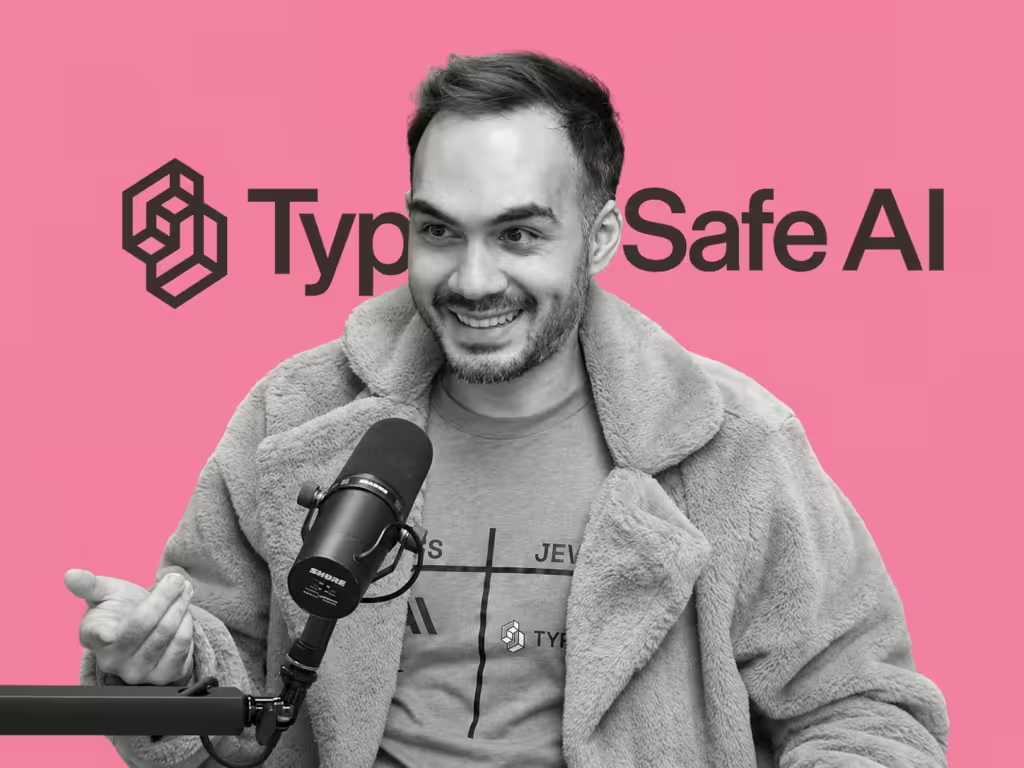
A start-up last valued at $200mn is now fielding funding offers that would value it at $10bn or more, people familiar with the matter told the Financial Times, days after releasing a model built for software developers rather than chat users. TypeSafe AI, founded by former OpenAI researcher Diogo Almeida, says its Jev model handles routine classification work at a fraction of the cost of large language models.
Details:
- The product: Jev produces no sentences, explanations or images. According to the FT, it makes fast decisions inside software applications — approving, blocking or flagging a request, routing a support ticket, or underwriting insurance and credit risk. It sits in the back end of software and has no consumer-facing interface.
- The pricing claim: TypeSafe says each query is roughly 100 times cheaper and faster than an LLM query, charging about 4.2 cents per million tokens against several dollars per million for large language models. It attributes the gap to a model that selects from a limited set of answers using a probability calculation rather than long reasoning chains.
- The technical case: The underlying methods resemble older deterministic machine learning systems that return fixed responses and therefore do not hallucinate, according to the company. That design cuts the number of tokens burned per request, which is where the cost reduction comes from.
- Early traction: Hosting platform Vercel said Jev drew more than twice as much interest from paid developer accounts in its first 24 hours as any previous model launch, including releases from OpenAI and Anthropic. OpenRouter reported tokens sent to Jev more than tripled over the weekend, and the launch video on X generated 40mn views in under a week.
- The investor view: James Hardiman, general partner at DCVC, which led TypeSafe’s most recent round, said the start-up is already profitable because of drastically lower computing costs, making the model orders of magnitude cheaper to use than leading LLMs. He said its launch introduced sobriety into a debate dominated by warnings of an AI apocalypse.
- The founder’s thesis: Almeida said he conceived Jev four years ago at OpenAI, asking what share of AI calls in a real economic revolution would be for human consumption versus computer consumption. He argued that work with strong financial incentives to automate remains unautomated because current AI performs poorly at it.
- The skeptics: Anastasios Angelopoulos, chief executive of model evaluation platform Arena, said: “It’s unclear to me what makes these models different from standard ‘zero-shot classifiers’, which are relatively well-known technology.” Meta, Google and Hugging Face already offer classification tools that categorise material they were not explicitly trained on.
- What is withheld: TypeSafe has kept details of how it trained Jev tightly under wraps, saying only that it used open-weight models and computer-generated synthetic data. Almeida declined to discuss any new funding round or name prospective investors, saying only that they were battering down the door.
- The name: Jev refers to the Jevons paradox, the observation that making a resource cheaper can raise total consumption as new uses appear. One developer plugged the model into a joke site, AskJev, a nod to the defunct search engine Ask Jeeves.
Background:
TypeSafe closed a $40mn seed round at a $200mn valuation more than a year ago, Almeida said, and emerged from stealth mode only last week. The reported $10bn approaches would mark a 50-fold jump on that mark.
Between the lines:
The bet is structural, not technical. If the classification work described by the FT — approvals, ticket routing, credit underwriting — moves to models priced at 4.2 cents per million tokens, frontier labs lose volume on tasks that never required reasoning chains. Almeida’s thesis cuts the same way: the gap exists because the industry optimised for intelligence, not cost.
What’s next
Watch whether TypeSafe confirms a new funding round and at what valuation, whether Vercel and OpenRouter usage holds beyond the launch spike, and whether OpenAI or Anthropic respond with cheaper task-specific tiers.