The latest:
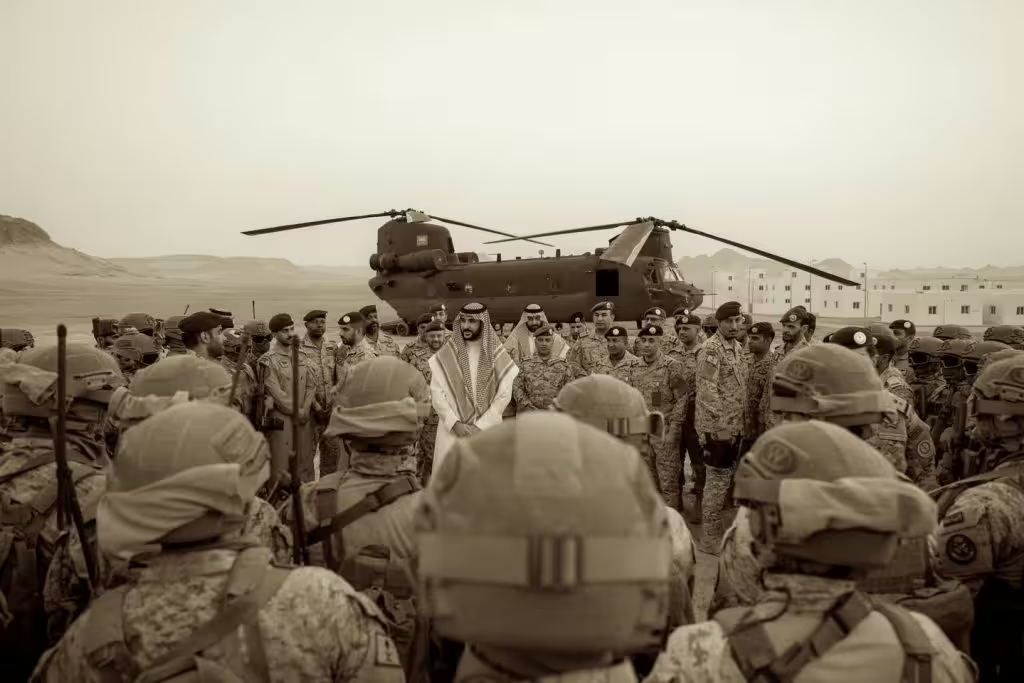
Saudi Arabia’s highest religious authority has called on soldiers to be ready to die fighting the Iran-backed Houthis until the group is removed from power, according to a statement carried by the official Saudi Press Agency late Thursday. Grand Mufti Sheikh Saleh bin Fawzan al-Fawzan addressed troops on the kingdom’s borders and members of the Saudi-led coalition, building his message on Quranic verses and prophetic traditions on sacrifice.
Details:
- The intervention: Al-Fawzan traditionally avoids politics, making the statement an unusual entry into a live military conflict by an authority with vast influence among Muslims worldwide. Reuters described the message as rare and sharply worded, addressed directly to soldiers stationed on the kingdom’s frontier.
- The religious framing: The mufti told the troops they were walking in the footsteps of the Prophet’s companions and defending Islam’s holy sites, instructing them to obey rulers and field commanders and execute orders with precision. The statement invoked jihad and martyrdom language throughout.
- The war aim: Extending the authority of the internationally recognized, Saudi-backed Yemeni government over the entire country was described as among the most urgent obligations. The statement also asked God for the complete defeat of the Houthi group and everyone who assists or supports it.
- The quote: Protecting the nation, guarding its borders and punishing anyone who seeks to lay a hand on a single inch of its territory are “among the greatest duties and most virtuous acts of devotion,” the statement said, adding that lives may be sacrificed for it.
- The sectarian turn: The message adds to a growing religiously framed narrative from authorities in the conservative Sunni kingdom aimed at discrediting the Houthis, who follow a different branch of Islam. State television has recently aired footage of an alleged Houthi attack on a mosque in the kingdom’s south.
- Mecca as flashpoint: Saudi authorities have accused the Houthis of striking Mecca, Islam’s holiest site, and earlier issued emergency alerts for areas including Mecca as well as Jeddah and Yanbu, the kingdom’s main Red Sea oil port.
- The fighting: The Houthis said they launched dozens of missiles and drones at Saudi targets on Thursday. Saudi authorities said they intercepted six ballistic missiles fired by Houthi fighters. The attacks have disrupted oil flows from the world’s largest energy exporter.
- The military track: Army chiefs from Saudi Arabia, Turkey and Pakistan are due to meet on supporting the kingdom under the Mecca joint defense agreement signed in August, which holds that an attack on one party is an attack on all. Turkey’s defense ministry said Gen. Selcuk Bayraktaroglu would travel to the kingdom Friday.
- Tehran’s distancing: Iranian President Masoud Pezeshkian sought to distance Iran from the group in a Fox News interview Thursday, saying the Houthis are responsible for their own actions. The remarks came a day after his address to the UN General Assembly in New York.
- The battlefield: Yemeni government forces lost control of the strategic Bab al-Mandab waterway to the Houthis two weeks ago, a blow to a kingdom mired in the conflict since 2015, when it launched a failed operation to drive the group from Sanaa.
Background:
Yemen’s 12-year civil war was largely frozen after 2022 before escalating again and becoming tied to the wider Iran conflict, which began with US and Israeli strikes on Iran in February. Riyadh says it has intercepted multiple missiles but has struggled to contain the Houthis.
Between the lines:
Pairing the mufti’s martyrdom language with televised claims of attacks on a mosque and on Mecca points to a deliberate reframing of a border war as a defense of Islam’s holy sites. That reframing is also a mobilization tool: it arrives as Riyadh activates an external defense pact rather than fighting alone.
What’s next
Watch the meeting of the Saudi, Turkish and Pakistani chiefs of staff and whether it produces concrete commitments under the Mecca pact, plus any Saudi move toward a wider ground operation in Yemen.