Key Points
- Israeli official says Israel may strike Iranian nuclear facilities again, with or without US participation.
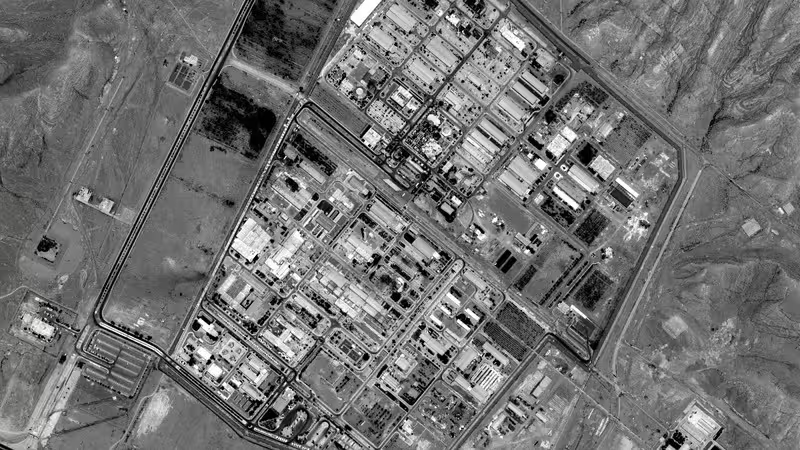
- Concern centers on construction near Natanz and reported efforts to move remaining nuclear assets underground.
- Sanctions, stalled inspections and renewed US-Iran contacts are narrowing choices between diplomacy and confrontation.
The latest
Israel is preparing defensively and offensively for another conflict with Iran and could act alone if Tehran crosses its red lines, an Israeli official told Saudi broadcaster Al Hadath. The warning follows intelligence assessments that Iran is trying to restore parts of its nuclear program and shift remaining elements into protected underground sites near Natanz, as Washington tightens sanctions and reopens indirect contacts with Tehran.
Details
- Underground focus: The head of the International Atomic Energy Agency said the agency observed construction earlier this month at Mount Kolang, or Pickaxe Mountain, near Natanz. Western intelligence services view the location as potentially suitable for nuclear-material storage, while Israeli intelligence reportedly detected efforts to transfer and reinforce parts of Iran’s remaining project there.
- Independent option: The Israeli official said coordination with Washington remains strong and continuous, but argued Tehran is delaying negotiations while betting on political developments in the United States and Israel. Israel’s approach combines continued US coordination with preserving an independent military option if its leaders conclude Iran has crossed a critical nuclear threshold.
- Indirect contacts: Iranian Foreign Minister Abbas Araghchi communicated with US envoys Steve Witkoff and Jared Kushner through mediators on the sidelines of the UN General Assembly in New York. The contacts were the first since an interim arrangement collapsed in July. President Donald Trump described the discussions as productive and said momentum toward an agreement was significant.
- Iranian offer: President Masoud Pezeshkian said Iran was prepared to reach an agreement before the US midterm elections in November and wanted to return to the memorandum of understanding reached in June. He also offered to dilute highly enriched uranium, reiterated that Iran does not seek nuclear weapons, and warned that further attacks would meet a determined response.
- Inspection problem: Pezeshkian said US military operations had prevented the IAEA from inspecting nuclear material stored beneath Pickaxe Mountain. International inspectors have struggled to determine what remains of Iran’s nuclear stockpile and infrastructure after previous attacks, leaving uncertainty over material that cannot be fully monitored and the condition of remaining facilities.
- Economic squeeze: Washington has expanded sanctions against Iranian-linked entities and targeted the aviation sector, warning service providers of possible secondary sanctions. Iranian carriers lost permission to operate to the UAE until further notice, with flights suspended from September 24. The Israeli official said sanctions, internal divisions and domestic pressure could push Tehran toward military responses in the region.
What’s next
The next concrete test is whether Washington and Tehran reach an agreement before the US midterm elections in November, the timetable identified by Pezeshkian. Inspector access near Natanz and any further restrictions on Iranian aviation will provide additional indicators.