The latest:
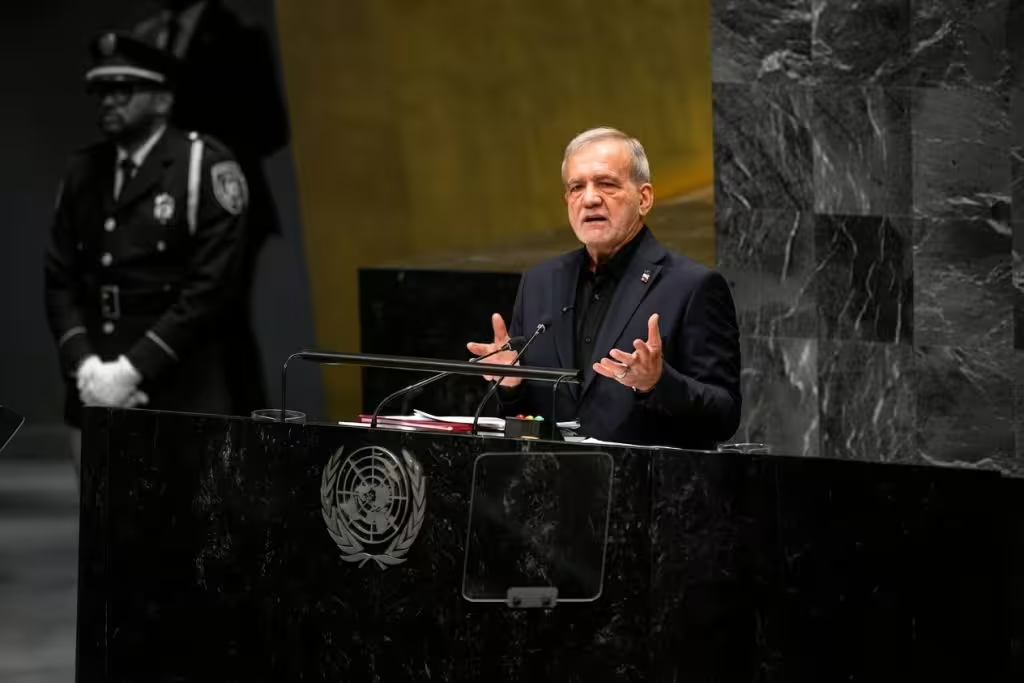
Iran will never be forced to surrender and will not accept restrictions on its nuclear program, President Masoud Pezeshkian told the UN General Assembly on Wednesday, holding up photographs of people he said were killed in American and Israeli strikes. He said Tehran remains ready for dialogue, but not under the language of force. The US delegation walked out as he began.
Details:
- The diplomacy: Iranian and American representatives met through Qatari mediators on Tuesday, the first such contact since the July collapse of a peace agreement, according to Iranian officials. Foreign Minister Abbas Araghchi led the Iranian side; US envoy Steve Witkoff and Jared Kushner represented Washington on the sidelines of the General Assembly.
- Trump’s account: Trump said his representatives held a meeting of more than three hours with Iranian representatives aimed at formally ending the war, describing it as very good and highly useful, and said further talks were possible. Witkoff called the session encouraging, constructive and successful.
- Tehran’s demands: Foreign Ministry spokesman Esmail Baqaei wrote on social media that the Iranian side demanded a halt to the war, the lifting of the naval blockade on its ports, and the return of seized Iranian assets. A senior Iranian official told Reuters the talks also covered reopening the Strait of Hormuz.
- Expectations gap: Secretary of State Marco Rubio said Tuesday’s contacts focused mainly on exchanging ideas and messages, and that any agreement would require sustained effort over a long period. The Iranian official told Reuters differences remain while diplomatic efforts continue. General Yahya Rahim Safavi, adviser to Supreme Leader Ayatollah Mojtaba Khamenei, told state television the Supreme Leader had given the government a free hand to negotiate.
- The charges: Pezeshkian accused Washington and Tel Aviv of violating international law by striking civilian infrastructure, citing a bombing of a school in Minab that Iran says killed more than 175 girls. He said Iran struck only military targets, a claim contested by accounts of Iranian missile and drone attacks on civilian sites in Israel and Gulf states.
- Nuclear position: Pezeshkian said Iran needs only to meet its energy requirements and rejects nuclear weapons, while refusing any limits on peaceful nuclear technology. He questioned why IAEA inspectors are sent to Iran while Israel’s arsenal goes unmonitored, calling it a double standard.
- Trump’s ultimatum: In his own address Tuesday, Trump said he faced a choice between reaching a deal that helps Iran prosper economically or obliterating it. He predicted an agreement once the US midterm elections conclude in early November, and urged other countries to join his economic blockade of Tehran.
- Air blockade: Treasury Secretary Scott Bessent said Iranian airlines would be forced to halt operations from September 23 under threat of secondary sanctions. Mahan Air suspended flights to Turkey at Ankara’s request, and a Tehran travel agency reported suspensions to Baghdad, Muscat, Qatar, Georgia and Azerbaijan. A Mahan aircraft still landed in China.
- Gulf threat: Mohsen Rezaei, secretary of Iran’s Supreme National Security Council, warned that if Iran’s neighbors cooperate with Washington and ground Iranian flights, Tehran will paralyze their airports. He said the Strait of Hormuz will never reopen unless the United States meets Iranian conditions.
Background:
Iran closed the Strait of Hormuz at the war’s outset to squeeze global oil markets; Washington imposed a counter-blockade targeting Iranian crude exports. A ceasefire has largely held since Trump pulled back from a threatened campaign against Iranian infrastructure last spring.
Between the lines:
The gap between rhetoric and channel is the story. Pezeshkian refused nuclear limits from the podium while his foreign minister sat with Witkoff and Kushner through Qatari mediators, and Safavi’s statement that Khamenei has given the government a free hand suggests the negotiating mandate now exists. Rubio’s long-timeline framing and Trump’s post-midterm prediction both point to talks measured in months.
What’s next
Watch whether a second round of Qatari-mediated contacts is scheduled, whether the naval and air blockades ease, and Trump’s stated timeline tying a deal to the early-November US midterm elections.