The latest:
The Golan Heights are an inseparable and eternal part of Israel, Defense Minister Israel Katz said, rejecting Syrian President Ahmed al-Sharaa’s statement that the plateau is Syrian land. Katz added that the Israeli army will not withdraw from the buffer zone it has controlled inside Syria since Bashar al-Assad’s ouster in 2024, and vowed to act as needed to stop Syria becoming a threat.
Details:
- The Israeli position: Katz said in a statement that Israel will not leave Mount Hermon or the security zone, territory he tied to the 1973 war and handed back to Syria under the 1974 disengagement agreement. He argued the agreement’s terms were violated once Syria became, in his words, an Iranian base.
- The condition set: Israel will stay on Mount Hermon and in the security zone as long as there is a jihadist threat to the border and Israeli communities, Katz said, naming both Syrian government security forces and other armed groups. He set no timeline and named no withdrawal mechanism.
- The legal backdrop: Israel annexed the Golan Heights in 1981, but most of the international community continues to regard the plateau as Syrian territory, according to The Times of Israel. That gap turns Sharaa’s assertion of sovereignty into a live diplomatic dispute rather than a rhetorical one.
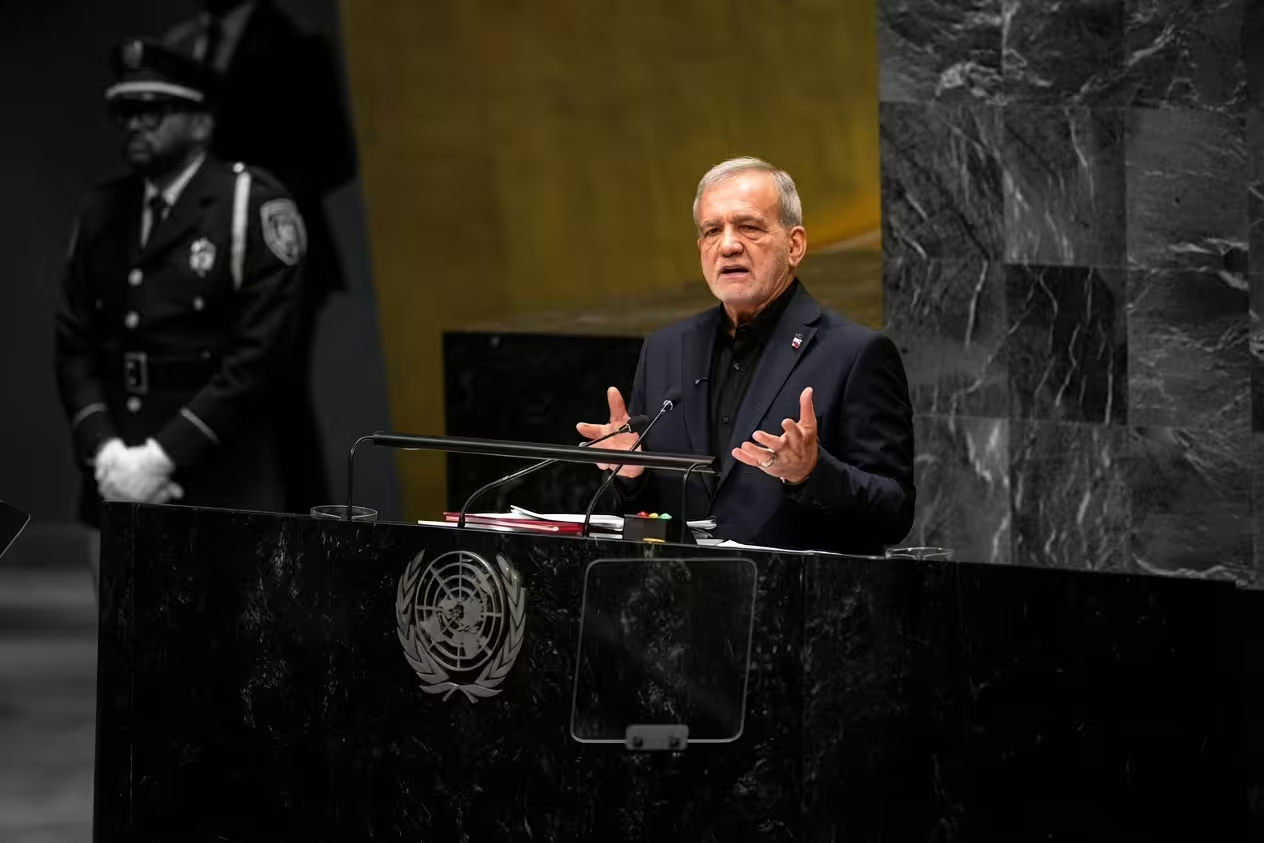
- Jordan’s warning: King Abdullah II told the UN General Assembly on September 22 that this Israeli government’s appetite has become a regional threat, and that Syria is the alarm bell. He accused Israel of repeated incursions, gradual territorial expansion and new military positions, including around vital water resources.
- The Jordanian read: The king said Israel is testing step by step how far it can expand, pushing at legal boundaries, according to The Jerusalem Post. Amman framed its criticism around regional strategy this time rather than its usual files of Jerusalem, Gaza and the West Bank.
- Amman’s interests: Jordan hosted close to a million Syrian refugees during Assad’s rule and faced Iranian-backed drug smuggling across the border. It sees the new Damascus government as a stabilization opportunity, and believes smuggling still originates from Suwayda under networks inherited from the old regime.
- The friction point: Israel is pushing to demilitarize southern Syria and has backed the Druze in Suwayda, some of whom have floated their own state in the south and an alliance with Israel, per The Jerusalem Post. Jordan views that prospect with concern.
- Wider strikes: Israel has bombed Damascus and, more recently, a military base in northern Syria, while warning Turkey against intervening, The Jerusalem Post reported. Israeli officials have publicly threatened the new Syrian government, and talk in Jerusalem includes a possible future confrontation with Turkey over Syria.
- The regional shift: Saudi Arabia, Egypt, Jordan and Turkey now assess that Israel is filling the vacuum left by Iran’s retreat, and view it as a potential threat on balance-of-power terms, according to The Jerusalem Post. That marks a reversal from the Abraham Accords period.
Background:
Israeli forces entered the buffer zone on December 8, 2024, as Assad’s government collapsed, and have kept up strikes on Syrian territory since. The 1974 disengagement agreement that governed the line for five decades is now effectively suspended.
Between the lines:
The Jerusalem Post assesses that Jordan’s UN intervention signals a broader regional recalculation rather than a routine complaint. Amman’s stakes are domestic: northern Jordanians have historic ties to southern Syria, and the kingdom fears a security vacuum there produces extremist groups and smuggling it cannot contain. Katz’s open-ended condition for staying gives Jordan no horizon for the stabilization it wants in Damascus.
What’s next
Watch for a Syrian government response to Katz, any move toward a new security arrangement replacing the 1974 agreement, and further Israeli strikes inside Syria. Jordan is expected to hold its position pending the upcoming Israeli elections.