The latest:
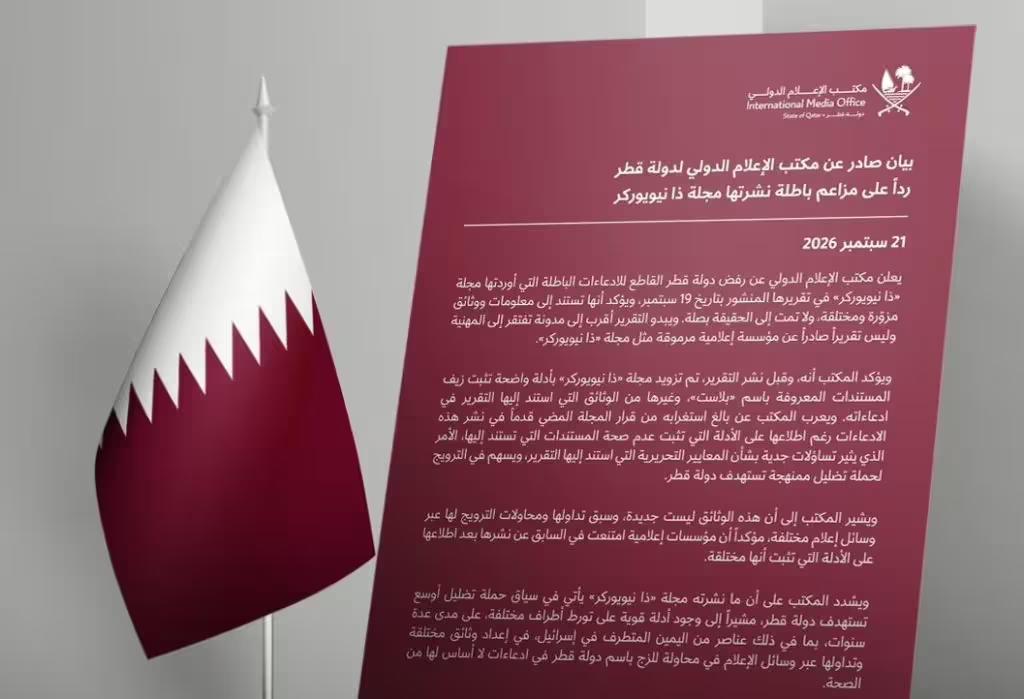
Qatar’s International Media Office rejected what it called baseless allegations that Doha provided funds to Hamas, saying every riyal of Qatari assistance went to Palestinians in Gaza for basic needs. The statement, issued Monday, said aid deliveries were coordinated entirely through mechanisms that Israeli authorities and international partners joined and supervised. It followed a New Yorker report published on September 19.
Details:
- The denial: The media office said all Qatari assistance was directed to Palestinians in Gaza to meet essential needs, and that delivery operations ran through channels Israeli authorities and international partners took part in and oversaw. The statement offered no further detail on the report or on the sources behind the funding allegations.
- The trigger: The New Yorker piece of September 19 dealt with what has been labeled Qatar-gate, covering Doha’s relations with Hamas and with Israeli figures close to Prime Minister Benjamin Netanyahu. Qatar’s statement cited that publication date directly.
- Doha’s legal argument: Qatar’s position is that the money it sent into Gaza was humanitarian aid aimed at civilians rather than Hamas’s military wing, and that the mechanism for moving and distributing it was coordinated with Israel and international parties.
- The older cases: US relatives of victims of attacks in Israel sued Qatar Charity, Qatar National Bank and Masraf Al Rayan under the Anti-Terrorism Act and JASTA, alleging support for Hamas and Palestinian Islamic Jihad. In March 2023 the court denied dismissal for Qatar Charity and Masraf Al Rayan while granting Qatar National Bank’s personal-jurisdiction motion. Those suits do not concern October 7; case records place some attacks between 2014 and 2016.
- The newest filing: In November 2025 a fresh suit, Estate of Ezra Schwartz et al. v. Qatar Charity et al., was filed in federal court in New York by families of several victims, including the relatives of Eitam and Naama Henkin, naming Qatar Charity and Bank of Palestine under Section 2333 of the Anti-Terrorism Act.
- Service fight: The court in January 2026 allowed plaintiffs to serve Qatar Charity electronically through its American lawyers, then in February refused the organization’s request to reconsider, noting it had received and rejected a mailed service attempt. The ruling was procedural, not a finding of liability.
- Where it stands: Qatar Charity filed dismissal motions in May and July 2026, plaintiffs replied, and the court set a briefing schedule. On July 9 it denied the older motions as moot after new ones were filed, with the case continuing.
- The evidentiary bar: In Atzili v. Islamic Republic of Iran, a Washington federal court found October 7 plaintiffs had not sufficiently established a specific link between transactions allegedly routed through Binance-linked entities and the attacks, rejecting the argument that failing to halt Hamas-linked transactions alone proves liability.
- Parallel enforcement: The Justice Department announced in July 2026 the arrest of the director of a Turkish charity, accusing him of coordinating with Hamas leadership and supplying funds and goods under humanitarian cover. That criminal case involves no Qatari defendant.
Background:
US courts distinguish sharply between money entering Gaza and material support for a designated terrorist organization. The decisive questions are the nature of the funds, the beneficiary, how they were used, and whether they substantially contributed to a specific attack.
Between the lines:
Read against the docket, Doha’s emphasis on Israeli supervision and civilian beneficiaries tracks the exact element plaintiffs must prove under the Anti-Terrorism Act: a causal chain from funds to a named attack. The Atzili ruling shows how demanding that chain is, while the Schwartz case keeps a Qatari institution inside it. The statement functions partly as pre-emptive defense against a theory that would sharpen if funding were tied to specific attacks.
What’s next
Watch the New York federal court’s ruling on Qatar Charity’s pending dismissal motions in the Schwartz case, and whether any October 7 plaintiff succeeds in tying alleged Qatari funding to a specific attack.