The latest:
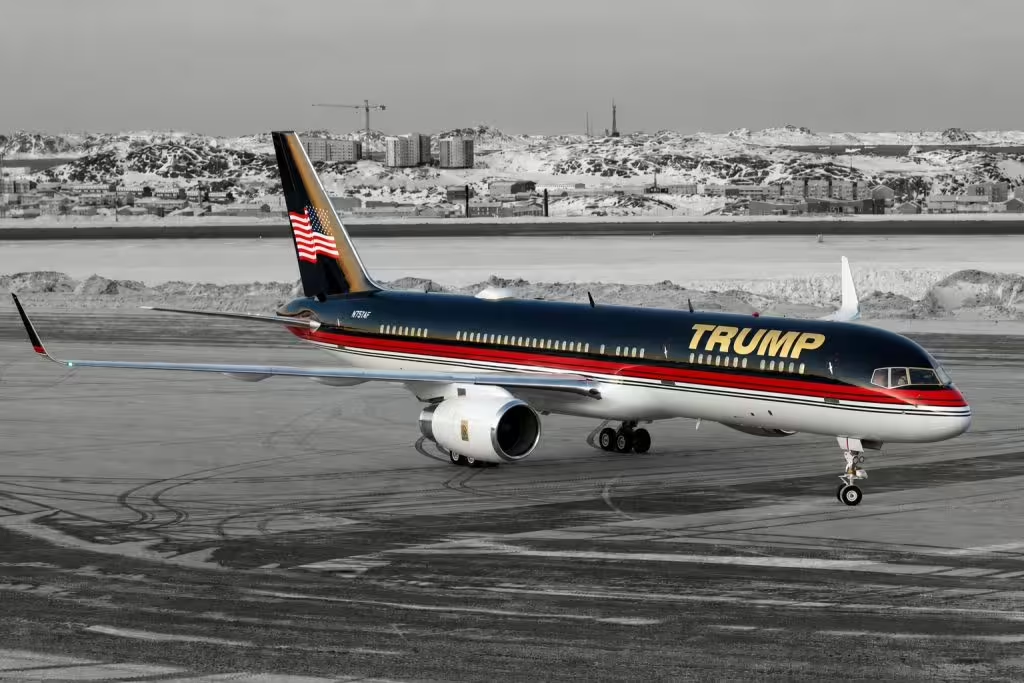
A security arrangement covering Greenland was announced Friday by President Trump, who said Washington had secured permanent control over security on the semi-autonomous Danish territory and would immediately begin building a larger military presence there. Greenlandic and Danish leaders issued statements shortly afterward signaling a signing next week at the UN General Assembly in New York, but framed the terms in markedly different language.
Details:
- Trump’s framing: In a post on Truth Social, Trump said the United States would forever hold the full ability to do what is necessary in Greenland to protect the island and American security. He called it a lifetime agreement with no end date and said it would carry no cost to the United States.
- The veto clause: Trump said no US adversary could establish a base, maintain a military presence, or make sensitive investments in Greenland without explicit written American consent. A State Department official, speaking anonymously, said only the US and its allies would be permitted to make such investments.
- Copenhagen’s version: Danish Prime Minister Mette Frederiksen said Friday evening the agreement recognizes the Kingdom’s sovereignty, its territorial integrity and the Greenlandic people’s right to self-determination, and said it strengthens Arctic and North Atlantic security to the benefit of NATO and Europe.
- Nuuk’s version: Greenlandic Prime Minister Jens-Frederik Nielsen said the accord recognizes Greenland’s interests and its standing in international cooperation, and called it in everyone’s interest. Neither Danish nor Greenlandic officials confirmed Washington had obtained the veto right Trump described.
- The pushback: Two people familiar with the negotiations said Trump’s claim of permanent control over Greenland’s security overstates the authorities Washington actually gains. A US military official said American forces would cooperate with Danish and Greenlandic counterparts rather than impose control over them.
- What changed, and what didn’t: A 1951 US-Denmark agreement already grants Washington wide latitude to operate military facilities on the island and has no expiration date. That accord admitted NATO forces but did not explicitly bar hostile states, the restriction Trump says the new deal adds.
- Rubio’s claim: Secretary of State Marco Rubio called the deal a major victory, saying it permanently addresses American national security concerns in Greenland at no cost to taxpayers, and that the island will forever remain part of North America’s strategic defense zone.
- The independence clause: The State Department official said the agreement is designed to remain fully in force even if Greenland becomes a fully independent state — a core administration objective, given that Denmark still manages Greenland’s defense and many Greenlanders support independence.
- On the ground: Washington kept more than a dozen bases on the island during the Cold War, all eventually closed except Pituffik Space Base. American officers have visited in recent weeks aiming to reopen old sites, and Danish public broadcasting reported this week that US soldiers were inspecting the Narsarsuaq runway.
- The January crisis: As tensions escalated in January, the Danish military drew up detailed plans to blow up airfields in Greenland in the event of a US invasion, and sent troops there with explosives and blood supplies. Talks then moved to secret monthly meetings in Washington.
Background:
Trump has pursued acquiring Greenland since his first term, and said earlier this year that anything less than US ownership would be unacceptable, calling possession of the territory psychologically important to him. Danish and Greenlandic leaders rejected the idea outright.
Between the lines:
Both capitals are selling the same text to opposite audiences: Trump needs permanence and control, Frederiksen needs sovereignty. Imran Bayoumi of the Atlantic Council assessed the announcement offered little new substance, arguing Washington could likely have obtained many of these outcomes through direct negotiation without damaging the relationship. The veto’s practical value is limited: a non-NATO state building bases on alliance territory was already highly unlikely.
What’s next
The signing is expected next week on the sidelines of the UN General Assembly in New York, when the text itself will show whether Washington won a written veto. Watch also for movement on reopening Narsarsuaq.