The latest:
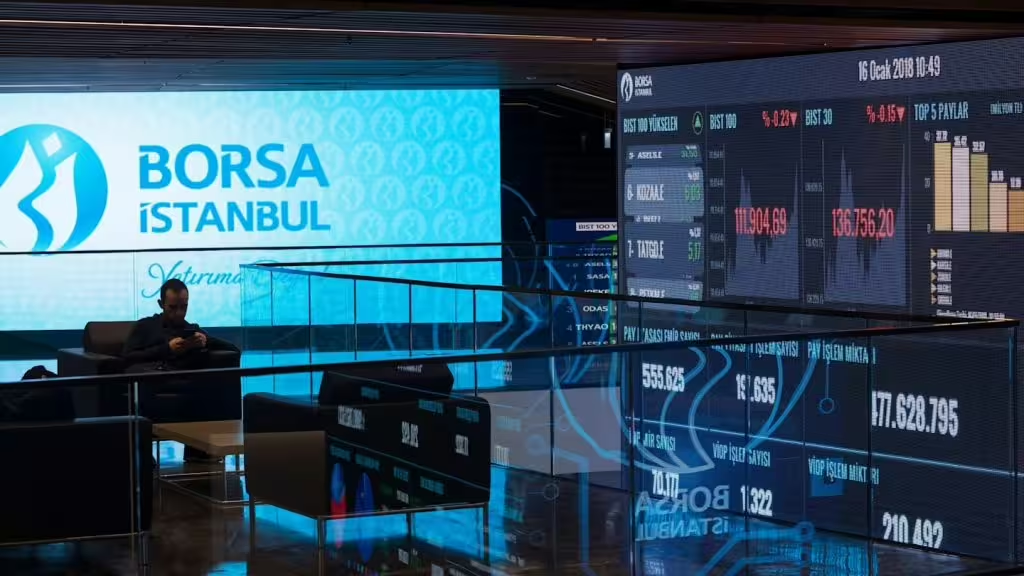
Turkish authorities moved on Thursday to shore up financial stability after several investment funds failed to meet client withdrawal requests, triggering a sell-off that knocked more than 8% off the main equity index during the week, according to Reuters. The central bank expanded repo funding to 300 billion lira and lifted bank borrowing limits in the interbank money market tenfold.
Details:
- The trigger: Tera Portfoy, which manages roughly $13.7 billion in assets, said Wednesday it had defaulted on redemption payments in its money market and equity funds, Reuters reported. The announcement came a day after Pusula Portfoy disclosed similar difficulties, setting off the market-wide sell-off.
- The liquidation: The Capital Markets Board suspended trading and ordered the liquidation of several funds run by seven portfolio management firms, including Tera Portfoy, Pusula Portfoy and Hedef Portfoy, on the TEFAS electronic fund platform, according to Reuters.
- The scale: A source familiar with the matter told Reuters the funds set for liquidation hold a combined portfolio of 891 billion lira, or $21.4 billion, spread across roughly 353,000 investors. The size explains why authorities treated the failures as a systemic liquidity question.
- The market moves: The main index dropped more than 5% on Wednesday, then rebounded 2.6% intraday Thursday after the official measures, Reuters reported. It stayed down 6.9% for the week, the weakest since 19 March 2025. The banking index was up 8% by 12:07 GMT.
- Margin rules: The Capital Markets Board cut the minimum capital maintenance requirement for margin trading to 20% from 35% until 2 October, letting brokerages apply the floor per their own risk policies. The banking regulator gave listed banks temporary flexibility on capital adequacy for share buybacks.
- Official framing: The Financial Stability Committee, Turkey’s top coordinating body for financial sector risk, said after a Thursday meeting the problems were concentrated in a specific segment of the fund market and were temporary and manageable, ruling out broader structural risk.
- The diagnosis: Analysts told Reuters that after August changes to fund regulation, sharp declines in thinly traded stocks left funds holding them unable to raise cash, forcing sales of core holdings. Cemal Demirtas of Ata Invest said the response points to broader intervention rather than a temporary fix.
- Investor reaction: Piotr Matys of ITC Markets said the decisive central bank and regulator response offered relief to equity investors but that “it is too early to declare that the sell-off is over.” Hasnain Malik of Tellimer said the episode has little to do with macroeconomic conditions.
- Prior warnings: Index provider MSCI said in June it remained concerned about shareholder transparency and coordinated trading in the Turkish equity market, adding that a review of the market’s classification could follow if authorities failed to make credible progress on reforms.
- The wider claim: The New York Times reported that several large asset managers were accused of manipulating the market by buying illiquid shares in affiliated companies, inflating their funds’ net asset values and drawing inflows from small investors. Authorities now describe it as a Ponzi-like scheme.
Background:
Turkish equities rallied sharply over recent years, driven partly by retail traders seeking shelter from high inflation. Regulators had eased collateral requirements, reducing the chance that leveraged investors would face margin calls forcing further selling.
Between the lines:
The New York Times argues the episode is not confined to emerging markets. It draws a parallel to Archegos, which used borrowed money for concentrated bets and could inflate its net asset value without a clean way to realize gains. It also notes US margin debt reached 1.5 trillion dollars by end-August, and says regulators in both Washington and Ankara have been accused of prioritizing market growth over investor protection.
What’s next
The lower 20% margin maintenance floor expires on 2 October. Watch whether MSCI acts on its June warning over transparency and coordinated trading, and whether liquidation of the seven firms’ funds triggers further redemption pressure elsewhere.