The latest:
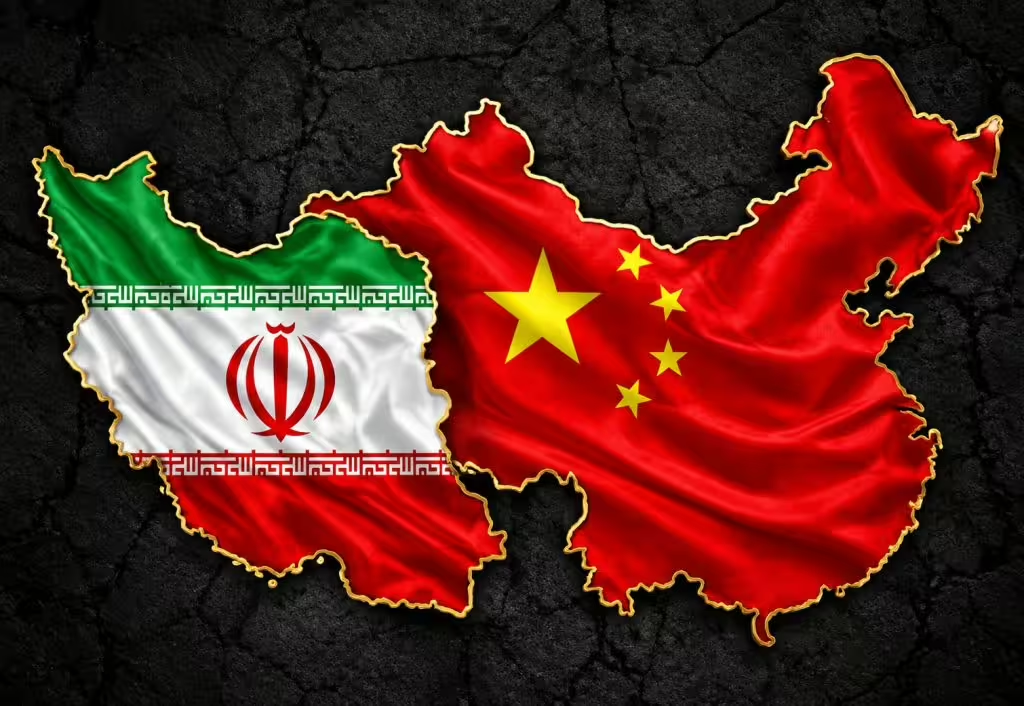
Iran’s foreign minister Abbas Araghchi met his Chinese counterpart Wang Yi three times in roughly two weeks — in Bishkek, New Delhi and then Beijing — in what Iranian lawmaker Fadahossein Maleki described as a trip needed to repair relations with China. Maleki acknowledged Beijing was displeased over certain issues, while Tehran judged Chinese support during the war insufficient.
Details:
- The trigger: The chill surfaced publicly around President Masoud Pezeshkian’s visit to Bishkek, where no formal bilateral meeting with Xi Jinping took place. Maleki now concedes the impression of a cooling was not baseless, pointing to grievances on both sides rather than a single dispute.
- The Security Council: Beijing joined Moscow on Thursday in vetoing a US draft resolution extending the mandate of the expert panel monitoring UN sanctions on Iran — evidence that China is not walking away from Tehran even while bilateral friction persists.
- The Iranian warning: Maleki cautioned that Beijing must be careful not to play both sides of the conflict, a rare public signal from within Iran’s parliament that expectations of the strategic partnership are being reassessed rather than simply reaffirmed.
- The analysts’ read: Many analysts argue the episode exposes the ceiling of the partnership: China provides substantial diplomatic cover, but turns cautious when backing Iran collides with its own economic and security interests in the Gulf. Iranian observers add that Beijing benefits from a Gulf security architecture still underwritten by Washington, without comparable cost, while expanding trade, investment and its presence around regional ports.
- Xi’s BRICS proposal: Xi said Saturday that China is ready to work with BRICS members to help restore peace and stability in the Gulf and the Middle East, offering a four-point proposal at the bloc’s 18th summit in New Delhi — Beijing’s first public signal of an active role six months into the war.
- Split reaction in Tehran: Former foreign minister Mohammad Javad Zarif welcomed the offer on X as an opportunity to reduce tensions. Former parliamentary security committee head Heshmatollah Falahatpisheh accused Xi of courting Trump to win US concessions on new tariffs.
- The skeptics: Hamed Vafaei of Tehran University called reading Xi’s remarks as a mediation offer a “free interpretation,” arguing they reflect gradual evolution in Chinese diplomacy in West Asia rather than a new position.
- Why Beijing hesitates: Analyst Rahman Ghahremanpour told Donya-e Eqtesad that China fears Iran may reject its terms and Washington may reject its initiative, and that a failed mediation would damage its credibility. Canadian analyst Shahir Shahidsaless said routing the effort through BRICS spreads the blame for failure.
- The Yemen incident: Recent reports from Yemen cited the discovery of wreckage from a Chinese-made DF-15 ballistic missile after a Saudi strike on the Houthis, possibly the first operational use of the type by Riyadh.
Background:
Beijing has so far avoided direct mediation, condemning attacks on Iran and issuing a general four-point proposal during Xi’s April visit to Cairo. Some analysts say China quietly backed Pakistani and Qatari mediation efforts in recent months.
Between the lines:
The veto and the repair trip point in opposite directions, and both are real. China is becoming more assertive in defending Iran at the UN while staying selective wherever support for Tehran risks colliding with its Gulf interests — the same calculation Iranian observers describe when they note Beijing draws security benefits it does not pay for. Reformist politician Abbas Akhoundi argued Tehran will ultimately need to engage Beijing directly on Strait of Hormuz security.
What’s next
Watch whether Beijing converts the four-point BRICS proposal into a concrete mediation track, whether Washington engages a BRICS-framed channel, and whether further Araghchi–Wang meetings follow the Beijing visit.