The latest:
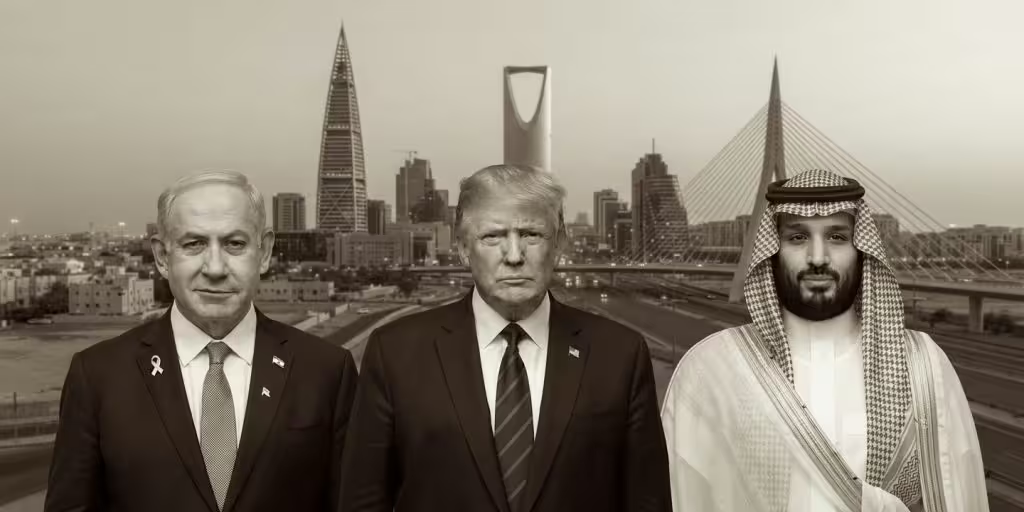
A Houthi blockade on Saudi oil has driven Riyadh to seek help from Washington and even Israel, The Wall Street Journal reported, as the kingdom’s rift with the United Arab Emirates complicates its regional position. The Journal said Saudi requests go beyond asking for US airstrikes, and that the pressure has already created an incentive for closer Saudi-Israeli-Emirati coordination.
Details:
- The request: Riyadh has already asked for Israeli intelligence on the Houthis through intermediaries at US Central Command, according to the Journal, which said such a partnership would be difficult to sustain unless CENTCOM took a leading role in coordinating it.
- Why now: Riyadh’s ability to argue it can manage the crisis without Emirati help has weakened after the Houthis seized strategically important areas along Yemen’s Red Sea coast, the Journal said.
- Israel’s record: Yemen was never historically a focus of Israeli military planning, the Journal noted, but operations there roughly a year ago showed Israel can strike, including a reported operation that killed the Houthi prime minister and around ten senior officials.
- The Mecca pact: Hopes that the new mutual defense arrangement with Pakistan and Turkey, concluded in Mecca, would adequately protect Saudi interests have faded, the Journal said, arguing neither state can supply the strategic alternative Riyadh needs.
- The nuclear deal: The Saudi nuclear agreement negotiated by Donald Trump’s administration has reached Congress, drawing criticism for permitting domestic uranium enrichment, which opponents call a retreat from long-standing US non-proliferation guarantees.
- Trump’s condition: Trump said Saudi accession to the Abraham Accords should be a condition for completing the nuclear agreement, though that condition does not appear in the deal’s official text.
- Proliferation warning: An analysis from the Stimson Center warned that allowing Saudi enrichment could encourage a wider contest for similar capabilities, with the UAE and other American partners demanding equal treatment and Russia and China offering comparable arrangements to their allies.
- The jets: Saudi Arabia is also in line for F-35 Lightning II fighters under a possible 24.3 billion dollar deal approved by the State Department on Thursday, which Congress would struggle to block despite concerns over Chinese access to sensitive US technology.
- The friction: At a critical moment Riyadh refused to open its airspace to American operations, a decision the Journal said hampered Operation Freedom, aimed at securing shipping through the Strait of Hormuz.
- Riyadh’s price: Saudi Arabia insists it first wants a clear path to a Palestinian state, a condition the Journal said became harder after the Hamas attack of October 7, 2023.
Background:
The framework for such cooperation already exists as the Abraham Accords, brokered by Trump’s first administration. Israel-UAE-Bahrain cooperation continues, and Israel and Morocco agreed Wednesday to resume direct flights, exchange ambassadors and upgrade their missions to full embassies.
Between the lines:
The Journal’s case rests on stacking Riyadh’s own vulnerabilities: with the Mecca pact judged insufficient and the Red Sea coast slipping, a US-led regional alignment becomes the strongest option left. It argues Congress’s real lever is not blocking the nuclear deal but pressing Trump to trade it — dropping domestic enrichment, which the argument says a civil program does not require, or joining the Abraham Accords.
What’s next
Congressional review of both the nuclear agreement and the 24.3 billion dollar F-35 sale, whether Riyadh reverses its airspace refusal for US operations, and any confirmation of Israeli intelligence sharing through CENTCOM.