
Key Points
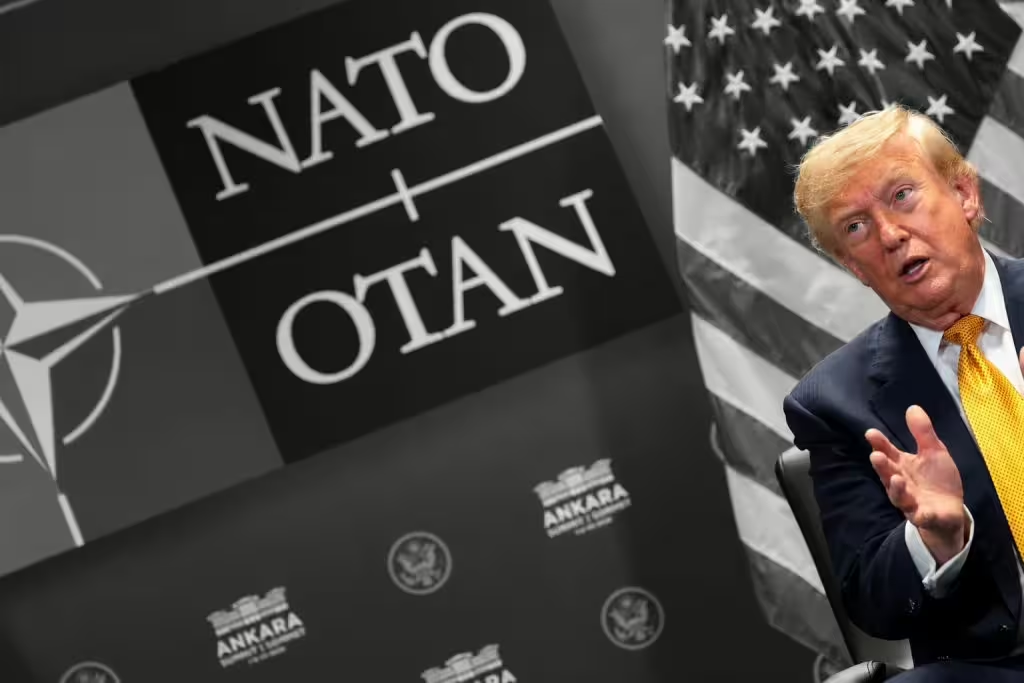
- Reuters found Trump's pressure campaign has strained NATO without triggering the US withdrawal he repeatedly threatened
- Hegseth planned a 25,000-troop cut in June before internal resistance replaced it with a six-month posture review
- At least eight allies are now buying away from US defense firms, Reuters found, eroding Washington's core leverage
The latest:
Washington still has more than 81,000 troops in Europe and keeps funding major NATO bases, even as Pentagon sources tell Reuters a deep force cut remains on the table. A Reuters investigation based on more than 50 current and former Western officials found an alliance badly strained but not broken, with European capitals now planning for a future less dependent on the United States.
Details:
- The blocked cut: US officials told Reuters that Defense Secretary Pete Hegseth intended to announce a roughly 25,000-troop reduction in Europe before June’s NATO ministerial in Brussels. The previously undisclosed figure would have pushed US levels below the 76,000 floor Congress wrote into law last year.
- The review instead: Facing internal resistance, Hegseth told allied ministers the Pentagon would run a six-month posture review scrutinizing countries that hesitate when Washington asks for support. Three people familiar with the matter said one likely outcome is the same 25,000 cut.
- The questionnaire: The Pentagon stayed publicly silent on the review but drafted a 57-question document in August to measure allies’ military, financial and ideological commitment, according to a copy seen by Reuters. One question asks whether a country has declared support for US foreign policy priorities.
- Congressional brake: Nine current and former US officials told Reuters that lawmakers of both parties, alongside US defense contractors with large European customers, can block a NATO withdrawal. Five senior congressional aides described growing bipartisan distrust of Hegseth’s handling of the alliance.
- The troop numbers: US forces in Europe averaged about 65,000 in the four years before Trump’s first term, rose to 74,000 during it, then hit 105,000 under Joe Biden after Russia’s 2022 invasion, per government audits and congressional testimony reviewed by Reuters. Roughly half of Romania’s 2,000 troops left last year.
- Still investing: Reuters found continued US spending at NATO facilities: over 100 million dollars expanding Romania’s Mihail Kogalniceanu air base, 400 million dollars in contracts at Spain’s Moron in May and June alone, and more than 4.2 billion dollars across seven British air bases.
- The Iran contradiction: Italy denied some US military aircraft landing rights at Sigonella in late March, Reuters reported. By late June, more than 500 US military aircraft had transited Italian bases, 343 through Sigonella and 211 through Aviano, according to a third US official. Trump publicly attacked Giorgia Meloni on June 20.
- Buying elsewhere: Reuters identified at least eight of NATO’s 32 members reducing reliance on American arms: Canada, Poland, Denmark, Spain, Norway, Turkey, France and Germany. Canada picked a 1.7-billion-dollar Australian polar radar over a US bid and is weighing Swedish Gripens against F-35s.
- Pentagon pushback: Policy chief Elbridge Colby argued in July that allies should work with the US defense industrial base rather than vainly try to replicate or replace it. An internal email previously reported by Reuters showed Colby discussing suspending Spain’s NATO membership, though the alliance has no such mechanism.
- Russian denial: Moscow’s ambassador to Belgium, Denis Gonchar, denied any Russian role in drone and sabotage incidents in Germany, Poland and Romania, calling them “dirty provocations” by Ukraine and others. European officials blame Moscow for intrusions testing NATO unity and support for Kyiv.
Background:
NATO has anchored US power since 1949, letting Washington deter rivals and project force while Europe sheltered under American protection. Trump’s charge that allies free-ride has been constant across four decades of public life, from a 1987 CNN interview to his 2025 demand that members spend 5% of GDP.
Between the lines:
The Reuters findings point to a pressure campaign working against itself. Allies did raise spending 20% in 2025, as Trump claims credit for, but the same doubts that drove the increase are steering the money away from the American contractors he expected to profit. Former intelligence official JC Lentznitch framed it as real success paired with real fear of abandonment, while diversification by eight members suggests the leverage Washington gains in budgets it loses in procurement.
What’s next
The Pentagon’s six-month posture review is the main variable, with a possible 25,000-troop cut recommendation. Watch whether Canada orders more F-35s or switches, and whether Congress defends the 76,000 statutory floor.