Key Points
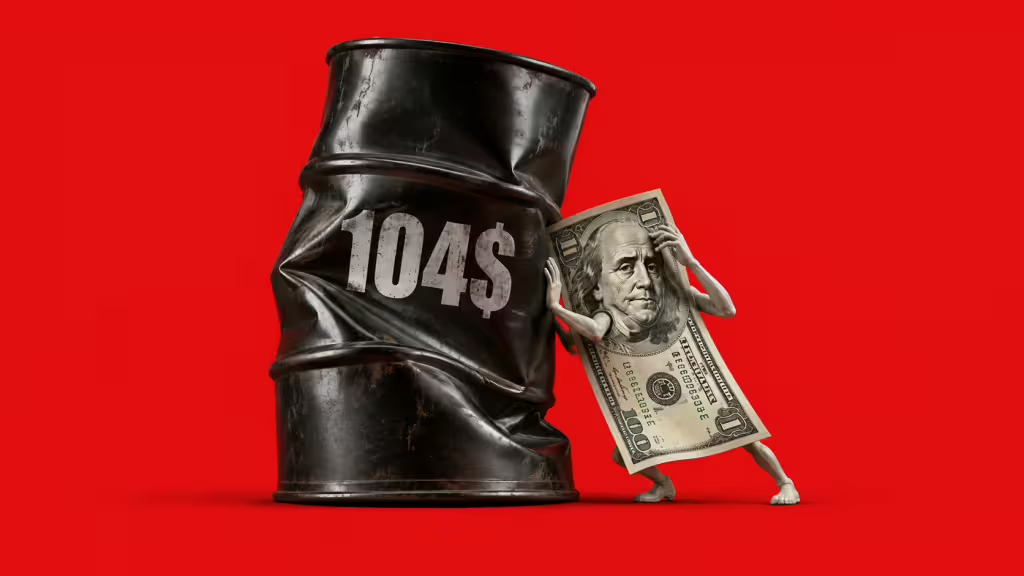
- Brent fell 1.7% to $104.08 a barrel in London as Middle East supply fears eased.
- Saudi Arabia aims to restore half the damaged East-West pipeline within days, full capacity in six weeks.
- Crude is still up about three quarters this year, feeding inflation that pushed the Fed to hike.
The latest:
Brent crude dropped about 1.7% to $104.08 a barrel at 9:51 a.m. in London, extending a 2.7% slide from Wednesday, as signs mounted that Middle East supply disruptions are receding. Saudi Arabia is seeking to return roughly half the damaged East-West pipeline’s capacity within days and restore full operations within six weeks, a person familiar with the matter told Bloomberg.
Details:
- The pipeline: The East-West line carries crude across Saudi Arabia to its Red Sea coast and was damaged in attacks last week, an event that initially pushed prices higher. It has become a vital alternative route for cargoes that would otherwise transit the Strait of Hormuz, still contested between Washington and Tehran.
- Trader caution: Haris Khurshid, chief investment officer at Karobaar Capital, told Bloomberg he would not describe the situation as a complete removal of risk, adding that the market is regaining some capacity but “not regaining its safety margin.”
- The year’s rally: Crude has gained roughly three quarters of its value this year after the war between the United States and Iran cut flows from the Middle East, while the Russia-Ukraine conflict continues, according to Bloomberg.
- Inflation channel: The sharp rise in oil and fuel costs has fed global inflationary pressure, prompting the Federal Reserve to raise interest rates on Wednesday and signal further tightening ahead. No timetable for additional moves was specified.
- Conflicting Hormuz figures: U.S. Energy Secretary Chris Wright told Fox Business that 18 million barrels of crude and petroleum products crossed the strait on one day this week, with a seven-day average of 11 million barrels a day. Clarksons Research put the daily figure at about 8 million barrels, per Bloomberg.
- Gulf diplomacy: Trump is scheduled to meet leaders from three Gulf states next Tuesday in New York on the sidelines of the United Nations General Assembly to discuss the conflict, Axios reported, citing people familiar with the plan. The participants were not named.
- Trump’s framing: Speaking at a campaign event in North Carolina, Trump said the war would end very soon and that a deal could be reached at any time Washington wants, without offering specifics on terms or timing.
- Congress acts: Congress gave final approval to a bill granting Trump new authority to impose tariffs on countries buying Russian petroleum products, potentially including China and India. The measure heads to the president’s desk and drew praise from Ukrainian officials seeking signs of U.S. support.
- Russian refining hit: Kyiv has targeted Russian refineries for months with waves of drone attacks, pushing Moscow to ban most diesel exports to prioritize domestic supply. Officials are weighing an extension of the curbs into October, while U.S. retail prices for the industrial fuel hit a record.
Between the lines:
The retreat in Brent rests on an expected repair, not a resolved conflict: Hormuz remains disputed, and the pipeline restart is a workaround for a chokepoint whose throughput analysts and Washington measure differently, by as much as 10 million barrels a day.
What’s next
Watch whether half the East-West line returns within days, Trump’s Tuesday meeting with Gulf leaders in New York, his signature on the Russian oil tariff bill, and Moscow’s decision on extending the diesel export ban.