Key Points
- Both countries agreed to replace liaison offices with embassies and appoint ambassadors.
- New York talks also set goals for investment, taxation, flights and senior visits.
- The upgrade would give six-year-old normalization a permanent diplomatic and commercial structure.
The latest
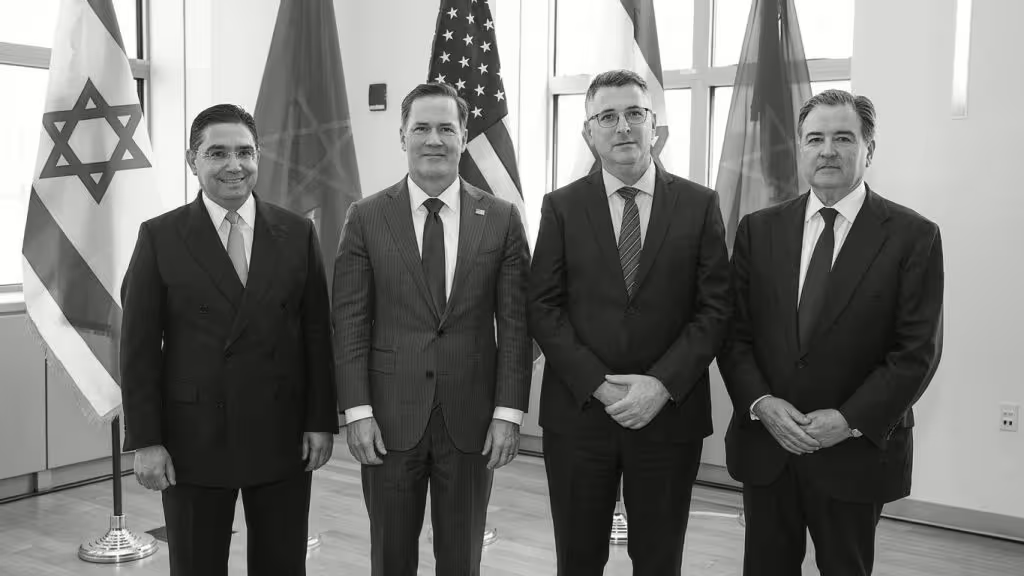
Israel and Morocco agreed to upgrade their liaison offices to full embassies and appoint ambassadors, moving their six-year-old normalization process toward a more permanent diplomatic footing. The agreement emerged from New York talks involving Israeli Foreign Minister Gideon Sa’ar, Moroccan Foreign Minister Nasser Bourita and US Ambassador to the United Nations Mike Waltz. The Israeli government said the three sides reaffirmed support for stronger bilateral relations.
Details
- Current missions: Israel and Morocco now operate liaison offices rather than embassies. Israel opened its office in Rabat in 2021, after diplomatic relations were restored in December 2020 under the US-brokered Abraham Accords. The planned change would replace the interim representation model with full diplomatic missions.
- Economic timetable: The countries aim to conclude an investment-protection agreement and a separate accord preventing double taxation by the end of 2026. Both measures are designed to facilitate reciprocal investment and reduce legal and financial barriers facing companies operating across the two markets.
- Expanded aviation: Direct air services are due to expand to include Moroccan airlines by the end of 2026. The governments also plan reciprocal high-level visits in the coming months, adding political engagement to closer business travel, tourism and exchanges between the two countries.
- Commercial priorities: The original normalization framework identified trade, investment, technology, civil aviation, tourism, water, agriculture, energy and telecommunications. Israeli companies have expertise in water management, agriculture, cybersecurity, technology and renewable energy, while Morocco offers access to North African and European markets, plus an expanding industrial and tourism base.
- Political pressures: Morocco maintained diplomatic relations with Israel after the Israel-Hamas war began in October 2023, while public opposition to normalization grew amid the war in Gaza. Rabat continued emphasizing the Palestinian issue as the bilateral relationship operated within wider regional tensions.
- Accords framework: Morocco joined the United Arab Emirates and Bahrain in normalizing relations with Israel, while Sudan entered the framework. Unlike Israel’s earlier peace treaties with Egypt and Jordan, the accords combined diplomatic normalization with economic, technological, tourism and security cooperation.
- Strategic dimension: Israel formally recognized Moroccan sovereignty over Western Sahara in 2023, a decision welcomed by Rabat. Waltz said the latest talks would advance security, trade and regional integration, presenting the development as evidence of the durability of the Abraham Accords.
Background
Morocco was once home to one of the Arab world’s largest Jewish communities, before large-scale emigration to Israel following its establishment. Israeli officials have repeatedly highlighted historical connections between Moroccan and Jewish peoples as a foundation for bilateral relations. Full embassies can widen political dialogue, consular services and economic diplomacy.
What’s next
By the end of 2026, attention will turn to concluding the investment-protection and double-taxation agreements and adding Moroccan airlines to direct routes. Before that deadline, reciprocal senior visits are planned in the coming months as both governments advance the embassy upgrade.