Key Points
- Dubai and Abu Dhabi joined Riyadh on Oxford Economics’ list of fast-changing urban economies.
- Dubai rose to 42nd globally, while Abu Dhabi placed 84th and retained strong human-capital scores.
- Their selection reflects intensifying Gulf competition for investment, technology, companies and highly skilled workers.
The latest
Dubai and Abu Dhabi were named among 28 “cities to watch” in Oxford Economics’ latest Global Cities Index, alongside Riyadh, as Gulf governments deepen efforts to diversify beyond hydrocarbons. The index assesses hundreds of cities across economics, human capital, quality of life, environment and governance. The three Gulf cities are pursuing distinct models but competing for the same resources: international capital, multinational companies, entrepreneurs and skilled workers. Their progress comes as regional conflict tests confidence in the Gulf’s expanding non-oil economy.
Details
- Overall rankings: Dubai rose nine places from 2025 to 42nd overall, ranking second in human capital and 53rd in economics. Abu Dhabi fell 11 positions to 84th, but placed sixth in human capital and 110th in economics. New York, London and Paris remained the index’s top three cities.
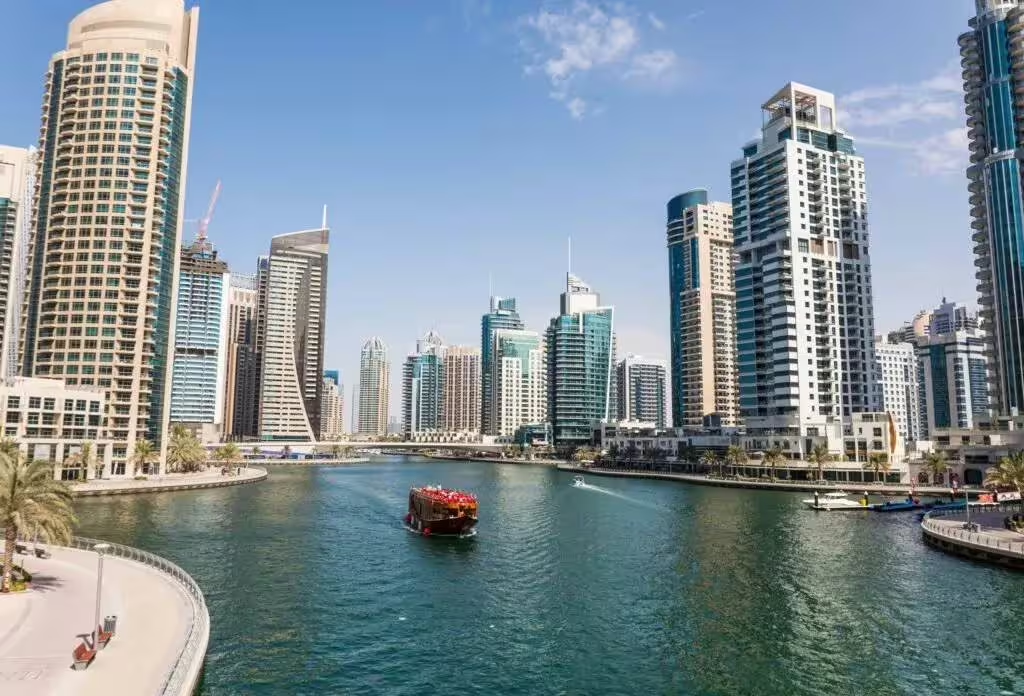
- Dubai strategy: Dubai’s diversified model is anchored in tourism, aviation, logistics, financial services, real estate, technology and international trade. Golden Visas and long-term residency programmes for retirees and high-income residents are designed to encourage deeper professional and economic roots. Its position between Europe, Asia and Africa strengthens its role as a trading hub and regional headquarters base.
- Abu Dhabi investment: Abu Dhabi’s strategy converts energy wealth and sovereign investment capacity into long-term productive assets. Priority sectors include artificial intelligence, advanced manufacturing, clean energy, life sciences, financial services, infrastructure, data centres and semiconductor-related activities. Miral also plans to invest billions of dirhams in new hotels and attractions on Yas Island, expanding the capital’s tourism and entertainment infrastructure.
- Riyadh acceleration: Riyadh jumped 47 places to 50th globally, ranking fourth in human capital and 18th in economics. Its rise reflects Vision 2030 efforts to attract foreign investment and develop technology, finance, tourism, entertainment and advanced manufacturing. The capital is pursuing a broad transformation backed by the scale of Saudi Arabia’s economy.
- Economic test: The UAE’s non-oil private sector posted its fastest expansion since December 2024 in August, based on the S&P Global UAE Purchasing Managers’ Index. Saudi Arabia’s non-oil economy recorded its strongest growth in six months. Oxford Economics said the conflict involving Iran could pressure the region’s ability to attract foreign workers and capital.
- Urban growth cycle: Oxford Economics argues that successful cities can create a self-reinforcing cycle: strong economies attract talent, talent raises productivity and innovation, and better quality of life draws more businesses and workers. The Gulf cities’ rise signals a shift from a regional role measured largely through oil and gas production toward competition built around technology, infrastructure and human capital.
What’s next
The next S&P Global purchasing managers’ readings for the UAE and Saudi Arabia will show whether the recent pace of non-oil expansion is sustained as regional conflict continues to test investor confidence.