The latest:
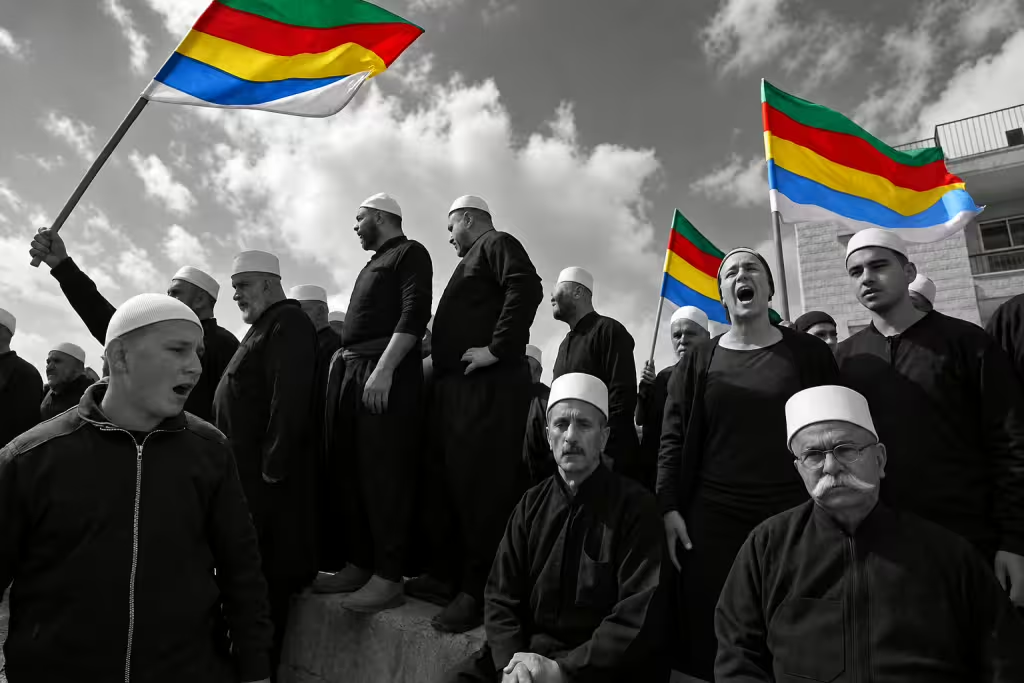
Israeli citizenship applications from Golan Druze surged to 3,750 in 2025, up from 500-600 a year between 2022 and 2024, according to interior ministry figures cited by The Times of Israel. Community figures tie the shift to two mass killings: a Hezbollah rocket strike on a Majdal Shams football pitch in July 2024, and the Suwayda bloodshed of July 2025.
Details:
- The numbers: Applications among Golan Druze first rose in 2021 and held at 500-600 annually through 2024, The Times of Israel reported, before reaching 3,750 in 2025. Interior ministry data show that as of March 2026, roughly 40% of Druze in the four Golan towns are naturalized citizens.
- The first tragedy: An Iranian-made Falaq-1 rocket fired by Hezbollah hit a football pitch in Majdal Shams on the evening of July 27, 2024, killing 12 Druze children. Adham Safadi, a Red Star of David paramedic who lost his 11-year-old daughter Fenis, said the town’s bomb shelter left children six seconds to reach safety.
- The second tragedy: Fighting erupted in Syria’s Suwayda province in July 2025 between Druze residents and Bedouin tribes. Forces sent by President Ahmad al-Sharaa were accused of siding with the tribes and carrying out mass killings. Residents now call it the Druze October 7.
- Conflicting tolls: The Syrian Observatory for Human Rights put the Suwayda death toll above 2,000 over several days, including 789 Druze civilians, while a committee formed by the Syrian government reported documenting 1,760 killed. Government forces and allied fighters were accused of executing civilians.
- Israel’s response: Druze leaders in Israel pressed the government to intervene. Israel carried out airstrikes on southern Syria and Damascus with the declared aim of forcing the attacking forces to withdraw. Druze in a Galilee village set up an operations room to organize medicine and food shipments into Syria.
- The separatist call: Syrian Druze leader Hikmat al-Hijri last month renewed his call for the minority to break from Syria and form a union with Israel, saying Israel is the only state capable of preventing another bloodbath. Druze make up roughly 3% of Syria’s population.
- Sharaa’s pledges: After the Suwayda violence, Sharaa vowed to hold perpetrators accountable and reaffirmed his commitment to minority rights. In June he said Syria was working toward a security arrangement with Israel that could eventually lead to full peace. Washington last month removed Syria from its state sponsors of terrorism list.
- The distrust: Safadi dismissed those pledges, describing Sharaa as “a wolf in a suit.” Lorena Kizel Khatib, chief executive of the Druze organization Together We Are Responsible for One Another, called the Suwayda bloodshed the single most powerful catalyst for the community’s shift.
- Divided families: Israel’s 1967 capture of the plateau and its 1981 annexation split families across a hostile border and a UN-patrolled buffer zone. Druze students attended university in Damascus until the 2011 civil war, marriages were arranged across the line, and Golan apples crossed under special arrangements.
- Military service: Safadi said young Druze now volunteer for the army and police, jobs requiring citizenship. In March, Master Sergeant Maher Khatar, 38, of the combat engineering corps was killed near a post in southern Lebanon alongside Sergeant Or Demri, in the town’s first military funeral.
Background:
Majdal Shams, home to 29,000 people, is the largest of four Druze towns in the Golan alongside Masada, Ein Qiniyye and Buqata. The Druze faith, which broke from Shia Islam in the 11th century, rejects converts and holds that communities stay loyal to the state where they live.
Between the lines:
The loyalty question has been replaced by a protection question, in Kizel Khatib’s framing. Both catalysts came from actors tied to Damascus: Hezbollah, Bashar al-Assad’s closest ally, and forces under his successor. That leaves no Syrian authority the community associates with safety, even as most families still hope to reunite with relatives across the buffer zone.
What’s next
Watch whether the security arrangement Sharaa described in June advances, whether the US-brokered Israel-Lebanon framework signed June 26 produces a final deal, and whether 2026 citizenship applications hold at 2025 levels.