Key Points
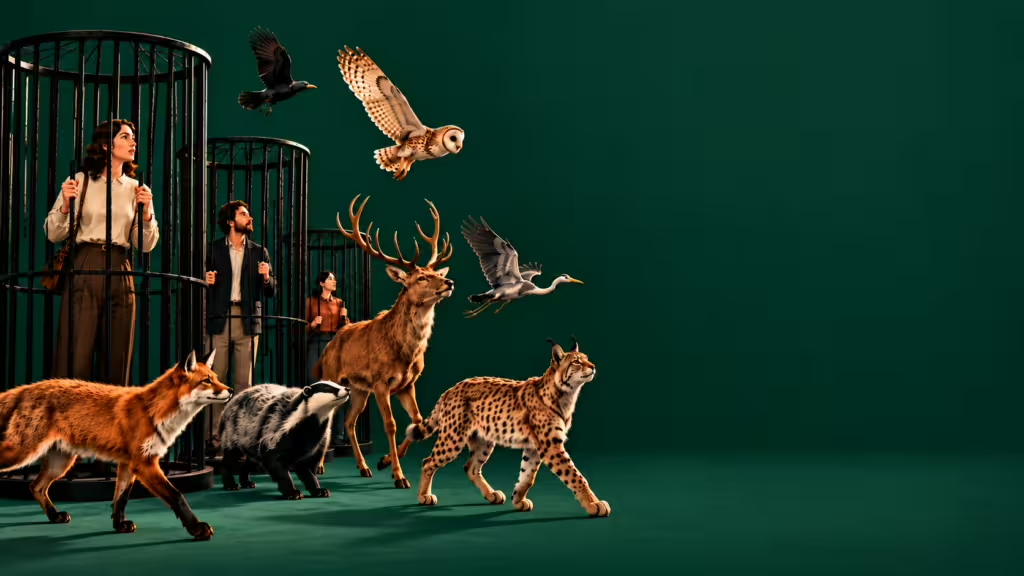
- Art Zoo opened in Amsterdam, enclosing visitors in black metal cages while preserved animals stand uncaged.
- Founders Jaap Sinke and Ferry van Tongeren model the collection on 16th and 17th century curiosity cabinets.
- The pair say every specimen came from European zoos after dying of natural causes.
The latest:
Hundreds of taxidermic animals now inhabit a 17th-century Amsterdam canal house where the cages hold the people, not the exhibits. Art Zoo, created by Dutch artists Jaap Sinke and Ferry van Tongeren, opens with a 12-foot crocodile suspended above the entrance, mouth agape. Van Tongeren told The Associated Press the pair add drama and attitude to the animals rather than mimic nature.
Details:
- The concept: Van Tongeren told the AP the artists wanted all the people in a cage and all the animals free, turning the entire building into a single artwork. The display rooms of the canal house are enclosed by black metal cages, inverting the arrangement of a conventional zoo.
- The collection: Visitors pass artfully arranged piles of bones, illuminated tulips sealed in apothecary jars and a cabinet of grotesque fish. A Japanese giant spider crab stretches its 6-foot legs above a doorway, next to mastodon leg bones that nearly reach the ceiling.
- The sourcing: Sinke said all the animals came from zoos where they died of natural causes, and none were taken from the wild. He acknowledged the paperwork can be challenging, adding that the pair sourced specimens primarily from Europe to be certain of each animal’s history.
- The influence: Both artists draw on wunderkammers, the curiosity cabinets assembled by wealthy Europeans in the 16th and 17th centuries to display objects from the natural world. They contrast their approach with natural history museums, where animals are posed as they would appear in the wild.
- The third artist: Sinke and van Tongeren describe themselves as an artistic trio, crediting naturalist Charles Darwin as the third contributor. They pitched the museum as the return of Darwin’s wonder, and one wall display holds a series of Darwin busts turned sideways.
- The irony: The artists see humor in honoring the man who developed the first scientific theory of evolution inside a building that previously housed the Biblical Museum. The venue is a canal house dating to the 17th century, the same period that produced the curiosity cabinets they imitate.
- The fakes: Not every creature is real. Beneath the ceiling-hung crocodile sits a wall of Jenny Hanivers — ray carcasses reshaped into monstrous forms by 16th-century sailors, who sold them to credulous collectors as genuine sea monsters.
- The breakthrough: The duo rose to prominence in 2015, when British artist Damien Hirst, known for preserving a shark in formaldehyde, bought their entire exhibition at a London art show. No price for that purchase was disclosed.
- The reception: Tomáš Vaško, a Slovak living in the Dutch capital, said he found the museum a little creepy after touring it on a dark October day. A cheetah slouches in an alcove under the watchful eye of a cassowary.
Between the lines:
The inversion is the argument. By caging visitors beside specimens that died in European zoos rather than in the wild, the artists stage the collecting impulse itself — the same impulse behind the wunderkammers they imitate and behind the Jenny Hanivers once sold as sea monsters.
What’s next
The Art Zoo Museum is opening its doors to visitors, offering an unconventional artistic experience featuring hundreds of taxidermied animals housed in a historic building in Amsterdam. Although its opening coincides with the Halloween season, the museum is not dedicated to the occasion, and its organizers have not announced any new exhibitions or plans for expansion.