Key Points
- Austria's central bank governor said oil holding near $100 would require further ECB tightening.
- The ECB raised rates a quarter point to 2.5% on Thursday, its second move in three months.
- Energy costs are pushing eurozone inflation above target for a possible second straight year.
The latest:
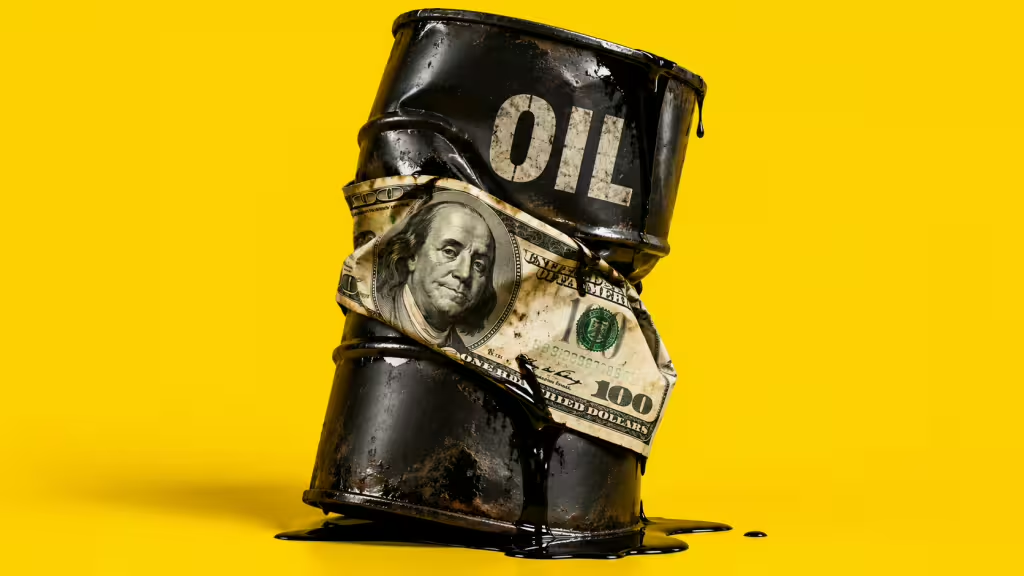
Oil prices hovering around $100 a barrel through the end of the year would force the European Central Bank to raise interest rates again, Austrian central bank governor and ECB governing council member Martin Kocher told the Financial Times in an interview published on 12 September 2026. He said inflation risk is higher than it was a few months ago, with Middle East tensions unresolved and energy prices elevated.
Details:
- The rate decision: The ECB lifted borrowing costs by a quarter point to 2.5% on Thursday, its second increase in three months and the second this year. Kocher’s interview came two days later, according to the Financial Times.
- The energy shock: Oil has jumped more than 45% to above $100 a barrel since the collapse of the US-Iran ceasefire in early July, according to the Financial Times. European gas prices have nearly doubled since June, to just under 80 euros per megawatt-hour.
- The worst case: The ECB’s most pessimistic scenario assumes oil averaging $99 a barrel between October and December and gas at 77 euros per megawatt-hour. Under it, inflation rises to 3.2% next year, overshooting the 2% target for a second consecutive year.
- The base case: The bank’s baseline projects inflation returning to 2% by the end of next year, provided oil averages roughly $90 a barrel in the fourth quarter. Kocher said monetary policy would have to account for a move toward the worse scenario.
- Kocher’s caveat: He acknowledged a temporary rise in inflation may be unavoidable because the oil surge is a supply shock beyond the bank’s control, and that Europeans must live with relatively high inflation short-term. He insisted that period stay brief, with inflation back at target “in about a year”.
- No guidance yet: Kocher said it is too early to discuss the bank’s stance at its late-October meeting or its December session. The ECB does not hold a monetary policy meeting in November.
- Market pricing: Investors are betting on a further quarter-point increase to 2.75% by year-end, followed by another hike in the first half of 2027, according to Reuters data.
- Second-round risk: Kocher said there is no clear evidence yet that higher energy costs are feeding into broader prices and wages, but warned second-round effects become more likely the longer Middle East tensions last. He said the bank is watching wage trends and employee compensation closely.
- The G7 picture: Among G7 central banks, only the ECB and the Bank of Japan have so far responded to inflationary pressure from the Iran war, according to the Financial Times. Traders raised bets on Friday that the US Federal Reserve will hike next week.
Between the lines:
Kocher’s framing leaves the ECB with limited room: the bank concedes the oil surge is an external supply shock it cannot control, yet its own worst-case scenario puts inflation at 3.2% next year, a second straight overshoot. That combination is why the wage and compensation data he flagged, rather than the oil price itself, is likely to decide the next move.
What’s next
The ECB’s next policy meeting falls at the end of October, with no November session and a December meeting after it. Markets are also watching the Federal Reserve’s decision next week, plus fourth-quarter oil and European gas prices.