Key Points
- Huawei is coordinating development and testing of domestic DUV lithography equipment for advanced semiconductor production.
- Investment arms are backing Chinese suppliers of critical chipmaking components as Beijing builds a domestic ecosystem.
- The campaign supports China’s AI ambitions while reducing exposure to Western export controls and equipment suppliers.
The latest
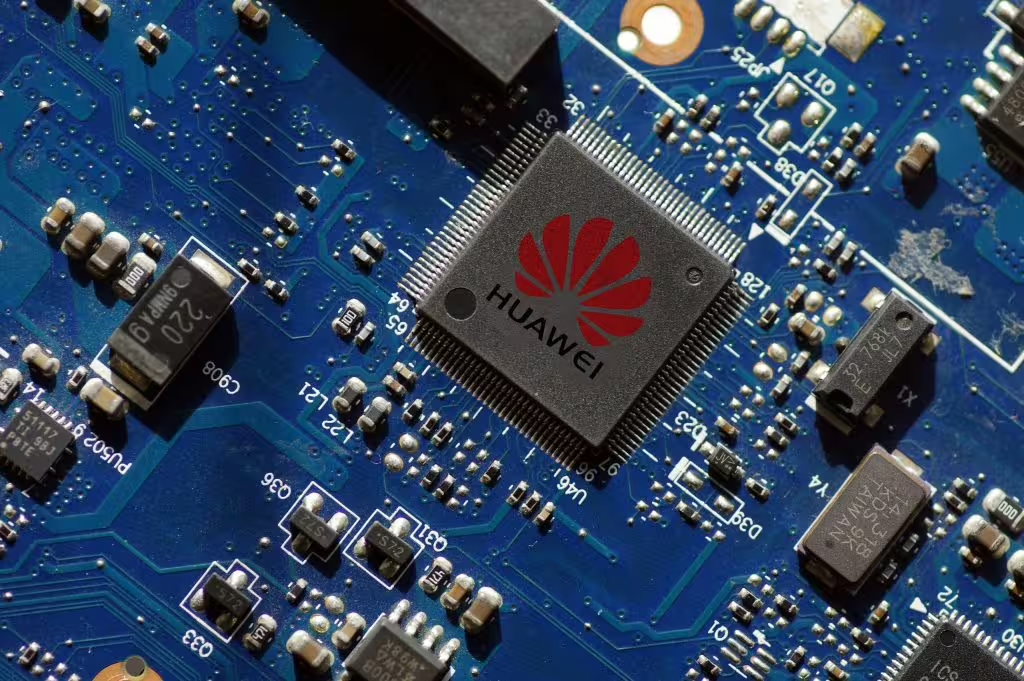
Huawei is taking a central role in China’s effort to build advanced chipmaking machinery, coordinating equipment makers, component suppliers and semiconductor manufacturers around domestic lithography. The company has helped Shanghai-based Yuliangsheng co-develop an advanced deep ultraviolet machine being tested by Semiconductor Manufacturing International Corp., China’s largest chipmaker, and on Huawei’s own production lines. The project broadens Huawei’s position from devices and chip design into the industrial infrastructure needed to manufacture semiconductors.
Details
- Strategic shift: Huawei is linking multiple layers of China’s semiconductor industry and directing capital toward strategic bottlenecks. Its expanding role brings together companies involved in lithography equipment, specialist components and chip fabrication, advancing Beijing’s effort to reduce dependence on foreign manufacturing technology.
- Investment network: Huawei’s investment arms, including Habo Investments and Shenzhen Yuanzhi Xinghuo, have backed domestic component developers. The portfolio includes Fujian Zhiqi Photonics and Beijing RSLaser, which work on technologies required for semiconductor manufacturing.
- DUV priority: China remains far behind in extreme ultraviolet lithography, where ASML alone produces machines used for the world’s most advanced chips. Strict export controls block China from obtaining those systems, pushing Beijing to concentrate more heavily on deep ultraviolet equipment.
- Engineering barriers: Domestic DUV machines still trail ASML’s systems by years in productivity, reliability and overall performance, preventing industry-wide replacement. China also faces difficulties in high-precision projection optics and high-power light sources, areas where Carl Zeiss and Cymer remain dominant suppliers.
- Factory milestone: China began mass production of domestically developed immersion DUV lithography machines in July, adding another building block to its local equipment base. The wider strategy spans chip design, fabrication, production machinery and the components supporting each stage.
- AI stakes: Advanced artificial intelligence systems require increasingly powerful chips, making manufacturing capacity central to China’s technology goals. U.S. controls target both advanced processors and the equipment used to make cutting-edge semiconductors, increasing the strategic value of a more independent domestic supply chain.
- Sanctions context: Huawei has become a symbol of China’s ability to develop sophisticated technologies despite years of U.S. sanctions and restrictions. Its lithography work now extends that role beyond products and processors to the machinery and supplier networks behind chip production.
Between the lines
China’s objective is not to reproduce the entire Western semiconductor ecosystem immediately. It is progressively targeting dependencies that can constrain advanced-chip production, even as domestic lithography remains substantially behind at the leading edge and cannot yet replace ASML equipment across the industry.
What’s next
Testing of Yuliangsheng’s advanced DUV machine at SMIC and on Huawei’s production lines is the next concrete indicator. Its measured productivity, reliability and performance will determine whether the equipment can progress from development toward wider use in Chinese semiconductor manufacturing.