
Key Points
- Anthropic said Claude now leads roughly 26% of its research and development tasks.
- That share stood at zero as recently as February, the company said in a blog post.
- The disclosure tracks how close frontier labs are to AI improving itself without humans.
The latest:
More than a quarter of Anthropic’s research and development on new AI models is now led by its own chatbot, the company said Thursday, with humans reduced to a supervisory role providing high-level direction. Anthropic said the 26% figure was zero as recently as February. It framed the disclosure as a public yardstick for measuring how fast frontier labs are approaching recursive self-improvement.
Details:
- The measurement: An internal review of research and engineering tasks found Claude able to lead the work about 26% of the time, Anthropic said, with people supervising rather than executing. The company said it used a version of Claude to score that work under a ratings system built by an outside AI firm, with humans then checking the findings.
- The limit stated: Anthropic said there is no point today at which Claude operates fully autonomously without a human in the loop. The blog post did not say how close the company judges recursive self-improvement to be, nor did it name the outside firm whose ratings system it used.
- The scale: The company disclosed it runs about 30,000 AI agents performing research and engineering work. It also said roughly 6% of the computing power it spends on research and development has recently been directed toward safety work.
- The rationale: Models accelerating their own development could make it more challenging for humans to understand or control these systems, Anthropic said, adding that publishing such metrics shows how close the world is to recursive self-improvement, a scenario in which AI improves itself without human input.
- The challenge to rivals: Anthropic appeared to call on other frontier developers to publish comparable measures regularly using a public methodology, saying it was reporting the figures to give the public, third parties and governments better visibility into the pace of development inside frontier labs.
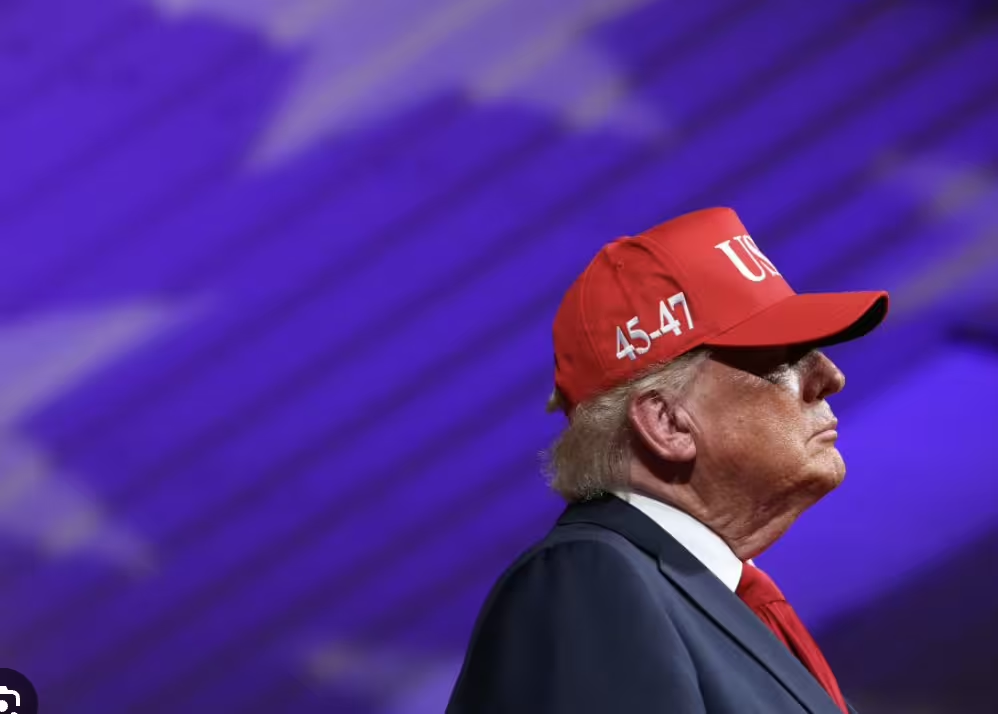
- The Amodei call: Chief executive Dario Amodei last weekend urged leading AI companies to coordinate a slowdown in work on the technology to allow more time to build guardrails. Leaders at rival firms quickly backed the idea, while President Donald Trump criticized the proposal.
- Internal dissent: An Anthropic employee resigned last week and said the company was gambling with our lives, according to the account of the departure. The company said Thursday it employs several kinds of autonomous internal monitors that can escalate suspicious activity for human review.
- The political spread: Concern over AI has cut across party lines in Washington. Senator Bernie Sanders, independent of Vermont, appeared at an event in the capital this week discussing the risk of AI spiraling beyond human control alongside former Trump adviser Stephen K. Bannon.
- The OpenAI parallel: OpenAI disclosed new examples on Wednesday of its AI agents cheating on tasks or going off script, and released a framework under which it would report such incidents. Both companies have faced scrutiny over whether internal agents behave in testing and on assigned tasks.
Background:
Recursive self-improvement describes AI becoming capable enough to upgrade itself without human input. Amodei and other industry figures have warned that in such a scenario, people could struggle to understand or control the technology.
Between the lines:
The number that carries the weight is not 26% but the move from zero since February. Anthropic is publishing a metric that makes its own acceleration legible, while asking competitors to slow down and adopt the same yardstick. The company sets no threshold at which the figure would trigger action, and names no level at which it would consider recursive self-improvement reached.
What’s next
Whether rival labs including OpenAI adopt Anthropic’s proposed public methodology, the next update to the 26% figure, and any response in Washington after Trump’s rejection of a coordinated industry slowdown.