Key Points
- Fitch projects Qatar's economy will contract 18.8% in 2026 as LNG exports collapse.
- Hormuz disruption since the US-Iran war left Qatar without an overland export alternative.
- Government debt is forecast to jump to 64.1% of GDP by end-2026.
The latest:
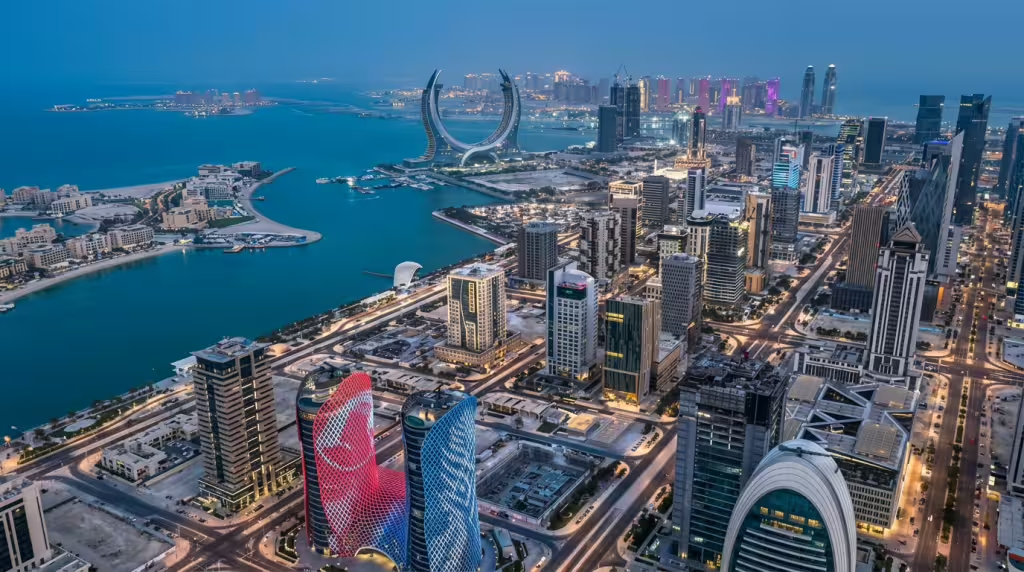
Qatar’s economy is on track to contract 18.8% in 2026, Fitch said in a report issued Friday, as damage to liquefied natural gas exports from shipping disruption through the Strait of Hormuz deepens. The rating agency described Qatar as the Gulf’s most exposed economy, because its LNG shipments depend entirely on the waterway. Other regional producers found partial alternative export routes.
Details:
- The core forecast: Fitch attributed the 18.8% contraction directly to the interruption of LNG shipments through Hormuz since the outbreak of the US-Iranian war. The agency said Qatar has no overland outlet capable of substituting for the strait, unlike oil producers in the region that redirected part of their volumes through alternative corridors.
- The export collapse: According to data published by Reuters in August, Qatari LNG exports fell 96% during the first six months of the war. The agency put the cost at roughly $24 billion in lost gas revenue, an amount equivalent to about five months of income measured against 2025 figures.
- The budget hit: Fitch expects Qatar’s general budget deficit to widen to 2.7% of gross domestic product this year, or 7.1% when investment returns are excluded from the calculation. The bulk of the gap is projected to be covered through borrowing and drawdowns from the financial stability fund.
- Debt trajectory: Government debt is forecast to climb to 64.1% of GDP by the end of 2026, against 51.3% in 2025, according to the agency. The increase follows directly from the financing mix Fitch expects Doha to use to cover the widening shortfall.
- The rating: Fitch kept Qatar’s long-term sovereign rating at AA with a negative outlook, but removed the country from negative watch. The agency judged that the risk of further major damage to gas facilities has receded since the March attack.
- Ras Laffan damage: The March strike on the Ras Laffan complex cost Qatar 17% of its export production capacity, according to Fitch. The agency estimated that capacity will not be restored before the end of 2028, placing the loss beyond the horizon of any near-term shipping settlement.
- The recovery case: Fitch projected a strong rebound starting in 2027, conditional on an agreement allowing exports through Hormuz to resume in the first quarter of that year. The agency did not specify the parties to any such agreement or a timetable for reaching one.
- North Field expansion: The agency linked the recovery scenario to the North Field expansion entering production, which it said could push growth into double digits in 2028. That figure rests on both the export corridor reopening and the new capacity coming online as planned.
Between the lines:
The removal from negative watch alongside a retained negative outlook separates two risks Fitch is tracking: the chance of further physical damage to gas facilities, which it judged lower after March, and the fiscal deterioration already visible in the deficit and debt path, which continues. The 2028 capacity restoration date also sits well beyond the first-quarter 2027 reopening the recovery forecast assumes.
What’s next
Watch for any agreement reopening Hormuz shipping by the first quarter of 2027, Qatari borrowing and stability-fund drawdowns to cover the deficit, and the North Field expansion’s production start date.