Key Points
- The Trump administration is drafting a post-war regional strategy for Washington's final two years, Axios reported.
- The plan rests on containing Iran, closing unresolved conflicts and expanding Arab-Israeli normalization.
- Drafting will take weeks, and it is unclear whether all US regional partners will back it.
The latest:
A post-war Middle East strategy is being drafted inside the Trump administration to guide US policy after the war with Iran and through the president’s final two years, Axios reported, citing two US officials and two other sources familiar with the discussions. The framework rests on three ambitions: containing Tehran, settling conflicts left open since Oct. 7, 2023, and widening normalization toward a Saudi-Israeli deal.
Details:
- The Iran pillar: According to the sources cited by Axios, the administration is weighing a regional alignment of US partners designed to contain Tehran, with Washington acting as guarantor. That would turn the end of the current war into an attempt to build a different security architecture around Iran, rather than a return to the previous regional balance.
- The unfinished files: The second pillar covers business left open from the last two years. Washington wants to advance the next phase of Trump’s Gaza plan, secure a security agreement between Israel and Syria, and implement the Israel-Lebanon agreement, according to Axios.
- The normalization track: The third pillar is expanding the Abraham Accords and pursuing Saudi-Israeli normalization, described in the report as potentially the most politically transformative element. Axios said the emerging plan could culminate in a Saudi-Israeli agreement, without setting out a timetable.
- Trump’s own framing: Axios reported that Trump has already held two meetings with senior advisers on the strategy, and that in private conversations he has spoken of working on “something much bigger” in the Middle East after the Iran war. The White House declined to comment.
- The election calendar: The administration is planning around political uncertainty in Israel, where elections are scheduled for Oct. 27, followed by the US midterms in November. Washington hopes the next Israeli government will cooperate with the strategy, according to the report.
- Proceeding regardless: Some US officials said Trump intends to move ahead whatever the Israeli result, including in the event of political deadlock, Axios reported. That would decouple the strategy’s timetable from the formation of a stable governing coalition in Israel.
- The stated caveats: A source briefed on the process cautioned that it remains unclear whether all US allies in the region will support the emerging framework. The strategy itself is expected to take several more weeks to draft, according to Axios.
- What is not settled: No Arab states have been identified as joining the proposed alignment against Iran, and the security guarantees Washington would offer as guarantor have not been spelled out. No date has been attached to any of the three pillars.
Background:
The conflicts the plan seeks to close — Gaza, the Israel-Syria file and the Israel-Lebanon agreement — all stem from the escalation that followed Oct. 7, 2023. The Abraham Accords, signed during Trump’s first term, never extended to Saudi Arabia.
Between the lines:
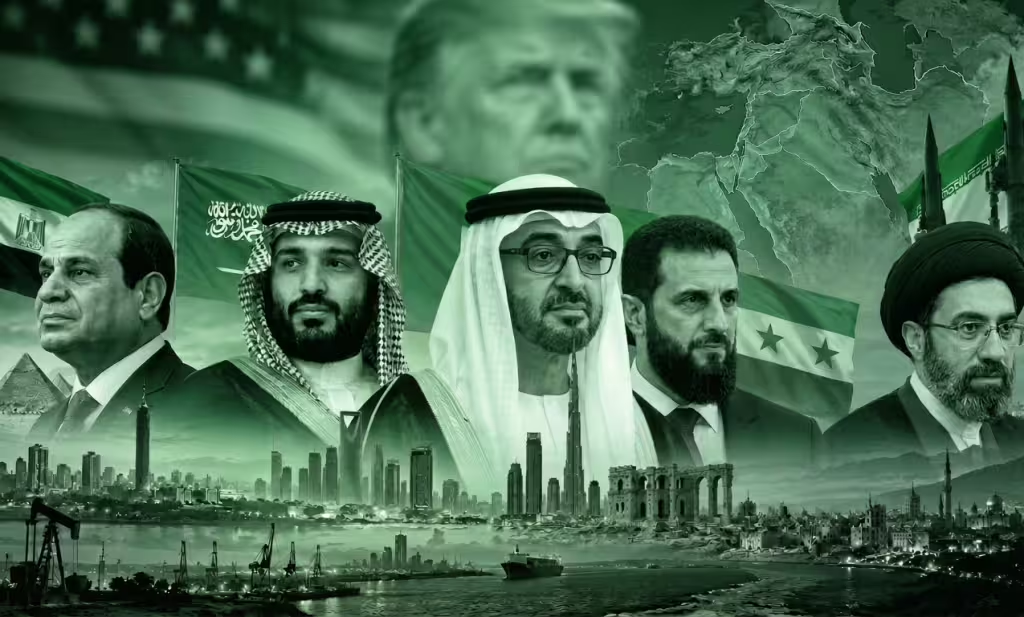
The three pillars are presented as one design, but each depends on a different actor’s consent: Gulf partners on Iran containment, an unformed Israeli government on the regional files, and Riyadh on normalization. The caution reported by Axios — that allied support is not assured and drafting needs weeks more — suggests Washington currently holds a concept rather than an agreed regional order. The war with Iran has begun to redraw the geopolitical map that preceded it. In the Gulf, the UAE is emerging as a rising political and military power, no longer defined primarily by its economic weight, after pursuing a dual strategy of deterrence and diplomacy toward Iran.
Saudi Arabia, meanwhile, has increasingly looked beyond the Gulf for broader strategic alignments, while Egypt’s regional influence has receded. Iran faces a different trajectory. The pressure of war is pushing Tehran toward a more inward-looking posture, even as its regional proxies display a growing degree of autonomy in their decision-making — potentially loosening a network of influence that Tehran spent decades building. Further west, Syria is making a tentative return to the regional map, this time as a potential alternative trade corridor. Lebanon, meanwhile, is approaching a potentially decisive shift as Hezbollah’s position weakens and the regional order that sustained its power edges closer to an end.
What’s next
Israel’s Oct. 27 elections and the US midterms in November are the two dated checkpoints. Watch for the completed strategy document, expected in several weeks, and for any public response from Gulf capitals on the normalization track.
Source: