The latest:
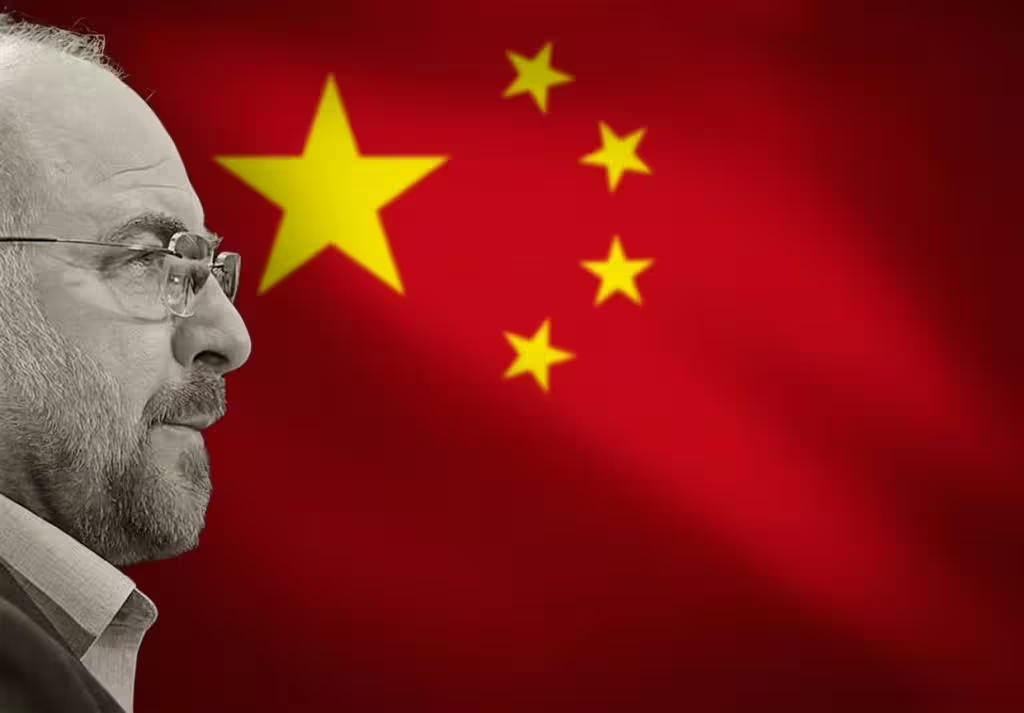
Beijing set explicit conditions before receiving Iran’s parliament speaker Mohammad Baqer Qalibaf and before implementing parts of the 25-year cooperation agreement, Hossein Marashi, secretary-general of the Executives of Construction Party, said in an interview with Eco Iran. Qalibaf’s office rejected attributing any such conditions to China and urged media not to publish claims it said could damage Iran’s national interests and foreign relations.
Details:
- The conditions: Marashi claimed the Chinese told Iran clearly to open the Strait of Hormuz, refrain from imposing transit fees, and resolve its problems with Saudi Arabia and the United States before Qalibaf travels to Beijing, according to Iran International.
- The envoy: Qalibaf was appointed special envoy of supreme leader Mojtaba Khamenei for China affairs in May. He has not yet traveled to China or met Chinese officials in that capacity, Iran International reported. No timetable for the visit has been announced.
- The denial: Qalibaf’s office rejected the attribution of these conditions to China and called on media outlets to refrain from publishing allegations it said could affect Iranian national interests and foreign relations. There is no independent evidence Beijing imposed the conditions Marashi described.
- The backlash: Hardline daily Kayhan called Marashi a facilitator of White House policies and accused him of seeking to poison Iran’s strategic relations with its eastern partners from within. A commentary carried by Fars news agency went further, calling for Marashi to be prosecuted.
- The trigger: The dispute followed a brief encounter between President Masoud Pezeshkian and Xi Jinping on the sidelines of the Shanghai Cooperation Organisation summit in Bishkek. Iranian state media described a short meeting; Chinese media reported nothing, and no dedicated bilateral meeting was held.
- Critics in Tehran: Former parliamentary national security committee member Heshmatollah Falahatpisheh wrote on X that Xi’s cold reception of Pezeshkian was a message to Washington, and that what some in Iran called a strategic partnership was for China only a superficial relationship.
- Conservative warning: Conservative commentator Mostafa Najafi described the encounter as a serious warning and a negative signal in Iranian-Chinese relations, particularly if Tehran requested a meeting and Beijing declined. He warned continued ambiguity could carry heavy costs while Iran’s international options are already narrow.
- The agreement’s record: China pledged up to $400 billion of investment in Iran over 25 years under the comprehensive strategic partnership signed in 2021. Then-deputy economy minister Ali Fekri complained in 2023 that investment since the deal had not exceeded $185 million.
- The oil dependence: China is Iran’s top trading partner and has absorbed up to 90% of Iranian oil exports since the US and Israel launched their war in late February. Iranian crude accounts for roughly 2% of China’s total energy mix, according to Al Jazeera.
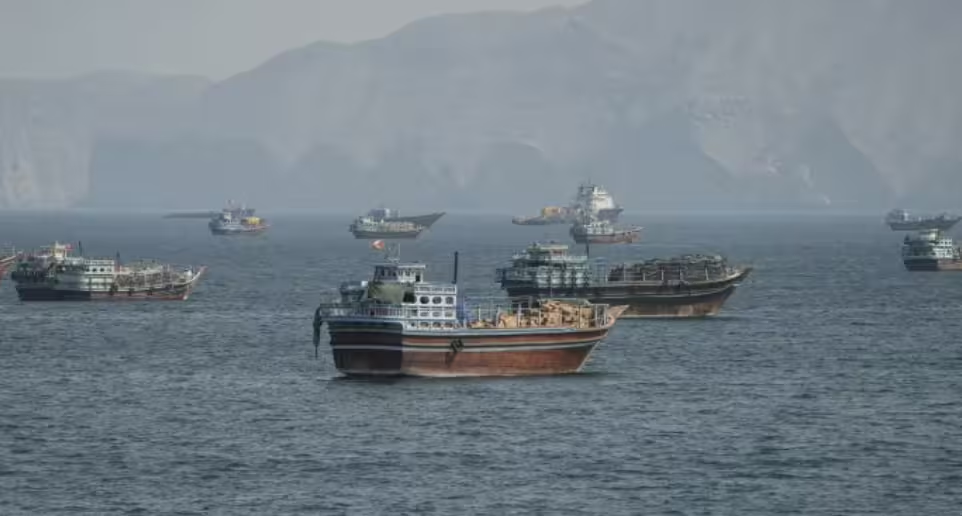
- The collapse in flows: Iranian crude exports through the Strait of Hormuz, mostly bound for China, fell from about 1.85 million barrels per day in March and April to just 240,000 barrels per day in August, according to ship-tracking data from Kpler.
Background:
Tehran promoted closer ties with China and Russia for years as the cornerstone of a look-east strategy meant to reduce dependence on the West. The 2021 agreement was its centerpiece, but analysts say few projects materialized as Chinese firms avoided sanctions exposure.
Between the lines:
The Bishkek non-meeting and Marashi’s claim are being read together in Tehran as evidence of the same thing: that Beijing prices the relationship lower than Iran does. Analysts cited by Al Jazeera argue China balances Tehran against ties with Washington and the Gulf, the logic behind the conditions Marashi described, since two of the three involve Iran’s disputes with Riyadh and Washington.
What’s next
Whether Qalibaf travels to Beijing as envoy, and whether hardline calls to prosecute Marashi advance. The Xi-Trump summit set for September 24 is the next test of how far Beijing will shield Iran.