Key Points
- A scholar links the hit to French nostalgia for leadership the country now lacks.
The latest:
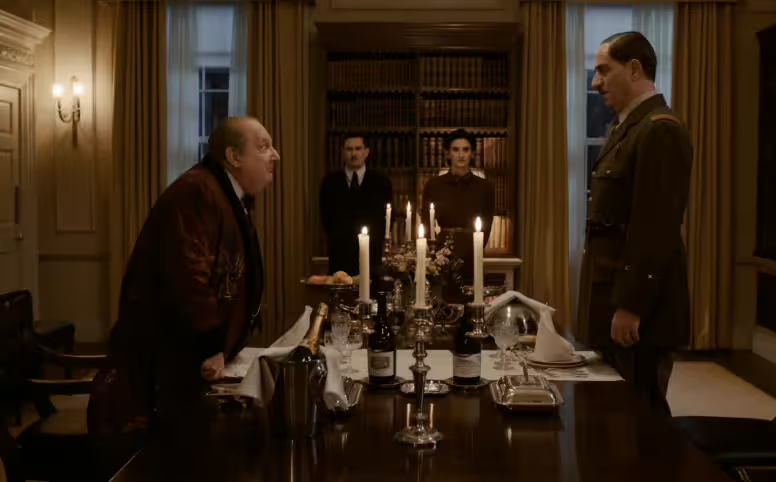
A two-part epic about Charles de Gaulle has turned into one of France’s summer box-office stories, selling 5.3 million tickets and closing much of the gap on Christopher Nolan’s The Odyssey at 7.3 million. Directed by Antonin Baudry, the film stars French-Armenian actor Simon Abkarian as the wartime resistance leader. Distributor Pathé has not announced a United States release.
Details:
- The numbers: The New York Times reported the biopic sold 5.3 million tickets in France, against 7.3 million for The Odyssey. Industry figures were surprised that a two-part biography of a long-dead politician drew blockbuster audiences, in a record-hot summer that pushed people into air-conditioned theaters.
- The portrayal: Abkarian plays de Gaulle as defiant, proud and unyielding, by turns inspiring and exasperating in his moral rectitude, stubborn and pedantic but occasionally willing to puncture his own pretensions. British actor Simon Russell Beale plays Winston Churchill as a wily curmudgeon.
- The American villain: De Gaulle’s obstinacy is expressed most vividly in clashes with Washington, and Franklin D. Roosevelt, played by Campbell Scott, is portrayed as imperious and dismissive. Audiences appeared to relish the depiction of a traditional French boogeyman at a moment when President Trump has threatened to seize Greenland.
- Young viewers: History student Antoine Grépin, 23, told the Times de Gaulle had become a mythologized figure whose wariness of American interventionism in Europe still had relevance, adding that Washington was again meddling in European politics. Journalism student Philomène Dubois, 23, said she left the film almost very patriotic.
- The academic read: Philippe Marlière, professor of French and European politics at University College London, said the French widely distrust parties and politicians, viewing them as superficial and self-interested. He argued that an admiring, nostalgic view of de Gaulle is the primary reason for the film’s success.
- Election backdrop: France is less than a year from an election to replace Emmanuel Macron, who has served nine years and cannot run again. Far-right candidate Marine Le Pen holds a durable lead in polls, while the center right, de Gaulle’s natural political home, remains fractured with no single candidate.
- Political embrace: Endorsing the film has become obligatory across French politics, including parties that historically rejected Gaullism. National Rally adviser Pierre-Romain Thionnet said he discussed it with party president Jordan Bardella, who watched it after reading the source biography, and said “De Gaulle belongs to all French people.”
- The historian: Julian Jackson, the British historian whose 2018 biography A Certain Idea of France underpins the film, worked with Baudry and his wife Bérénice Vila on the adaptation. He said the filmmakers altered facts and invented characters, including a Polish plumber recruited to answer de Gaulle’s phone in London.
- Where it stretches: Jackson said the second installment exaggerates American plans for an occupation government in postwar France, though Roosevelt’s misgivings about de Gaulle and France’s postwar role were genuine. He said the embellishments conveyed a poetic truth and did not trouble him as a historian.
Background:
De Gaulle led the Free French resistance against Nazi Germany from exile in London during World War II, later serving as president. For many French people, especially the young, he now exists mainly as a name attached to schools, public squares and the main airport outside Paris.
Between the lines:
Jackson said the film’s heavy focus on de Gaulle’s divisions with Washington gave it a slight anti-American tinge that may have added to its appeal, and that distrust of America was essentially de Gaulle’s theme in the 1960s. That reading aligns with Marlière’s nostalgia argument and Grépin’s comments on American interventionism: the box office tracks a present-day mood as much as a historical figure.
What’s next
Whether Pathé announces a United States release, and how heavily candidates invoke de Gaulle as France’s presidential campaign to succeed Macron takes shape over the coming year.