Key Points
- Dubai's index rose 0.5% to 5,843 points Thursday, leading gains across most Gulf markets.
- Purchasing managers' surveys showed UAE non-oil activity at its fastest since December 2024.
- Growth data outweighed investor concern over the heaviest US-Iran exchange of fire since July.
The latest:
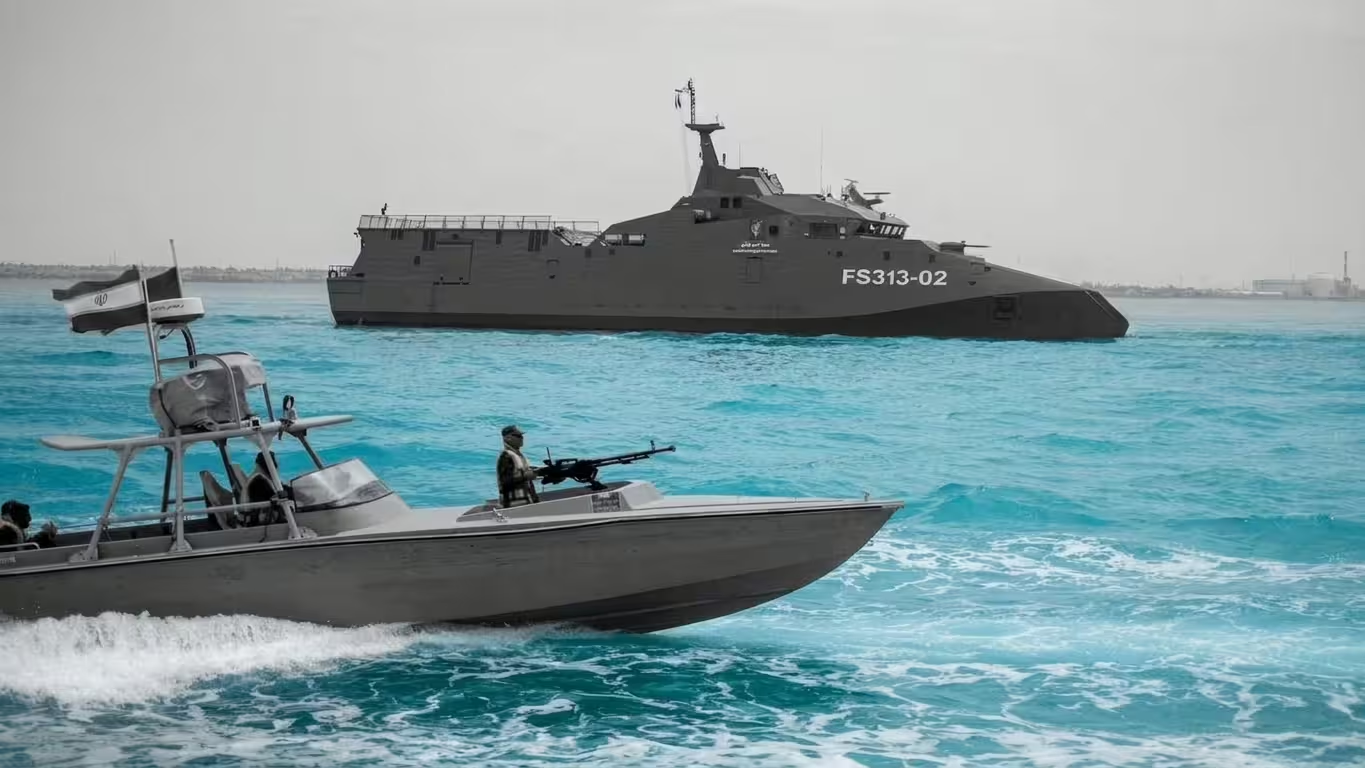
Gulf equities closed higher on Thursday, 3 September 2026, with Dubai’s benchmark up 0.5% at 5,843 points as every sector advanced. Strong private-sector surveys in the UAE and Saudi Arabia outweighed investor concern over renewed US-Iran clashes, described as the largest exchange of fire between the two sides since July as the war entered its seventh month.
Details:
- The UAE data: A purchasing managers’ survey showed non-oil private sector activity in the UAE expanded in August at its fastest pace since December 2024, supported by larger increases in output and new business. The reading was the single strongest driver cited for Thursday’s move in Dubai and Abu Dhabi.
- The Saudi data: Saudi Arabia’s non-oil private sector recorded its fastest growth in six months during the same month, driven by improved output as market activity recovered, according to the survey. Riyadh’s index added 0.2% to close at 11,033 points, led by financials, information technology and materials.
- Dubai movers: Emaar Properties gained 1.1% and Emirates NBD rose 0.5%, with all sectors on the Dubai index in positive territory. The benchmark’s 0.5% advance was the largest among the Gulf markets tracked on the day.
- Abu Dhabi: The Abu Dhabi index climbed 0.2% to 9,927 points, led by real estate and basic materials. Aldar Properties added 0.9% while Space42 jumped 6.7%, the biggest single-stock move reported among Gulf constituents.
- The war’s market cost: Bahri shares fell 1.6% after Saudi Arabia announced on Wednesday that an Iranian attack on an oil tanker owned by the company killed two Filipino sailors. It was the only Saudi decliner named on the day, against gains of 1.7% for Maaden and 1.1% for Riyad Bank.
- Smaller markets: Qatar’s index rose 0.1% to 9,764 points, helped by Ooredoo up 1.2% and Gulf International Services up 3.8%. Kuwait’s index fell 0.2% to 9,246 points, Bahrain closed flat at 1,939 points and Oman gained 0.3% to 7,628 points.
- Shipping workaround: Vessel-tracking companies reported that three liquefied natural gas cargoes loaded from Qatar and the UAE were transferred ship-to-ship outside the Strait of Hormuz in recent weeks, for delivery to India and Japan. The trackers did not identify the vessels involved.
- Egypt outperforms: Egypt’s main index rose 1.1% to 56,270 points, with most constituents higher, including Commercial International Bank up 1.5% and Talaat Moustafa Group up 1.2%. The Egyptian cabinet said on Thursday the economy grew 5.1% in fiscal year 2025/2026, against 4.4% the previous year.
Background:
The US-Iran war entered its seventh month in September 2026. Thursday’s fighting was reported as the heaviest exchange of fire between the two since July, and Saudi Arabia said an Iranian strike on a Bahri-owned tanker killed two crew members a day earlier.
Between the lines:
The split between the macro data and the war risk is visible inside the indices themselves: Riyadh closed higher on financials and materials even as Bahri, directly hit by the tanker attack, fell 1.6%. The ship-to-ship LNG transfers outside Hormuz point to exporters routing around the chokepoint rather than halting shipments, which keeps the conflict a company-level cost rather than a market-wide one so far.
What’s next
Watch whether the next purchasing managers’ readings hold the August momentum, any Saudi or Iranian follow-up after the tanker attack, and whether more Gulf LNG cargoes shift to ship-to-ship transfers outside Hormuz.