The latest:
Roughly 40 vessels carrying millions of barrels of oil transited the Strait of Hormuz on September 1, US officials told Axios, and Energy Secretary Chris Wright said tankers moved more than 17 million barrels on August 31 — the highest since the war began. The Institute for the Study of War assessed that Iran is struggling to keep some commercial ships off the southern route.
Details:
- The assessment: ISW concluded that US attacks significantly damaged Iran’s ability to monitor Hormuz and lay mines there, citing the September 1 surge in oil flows as evidence Tehran can no longer reliably deny the southern route to commercial traffic.
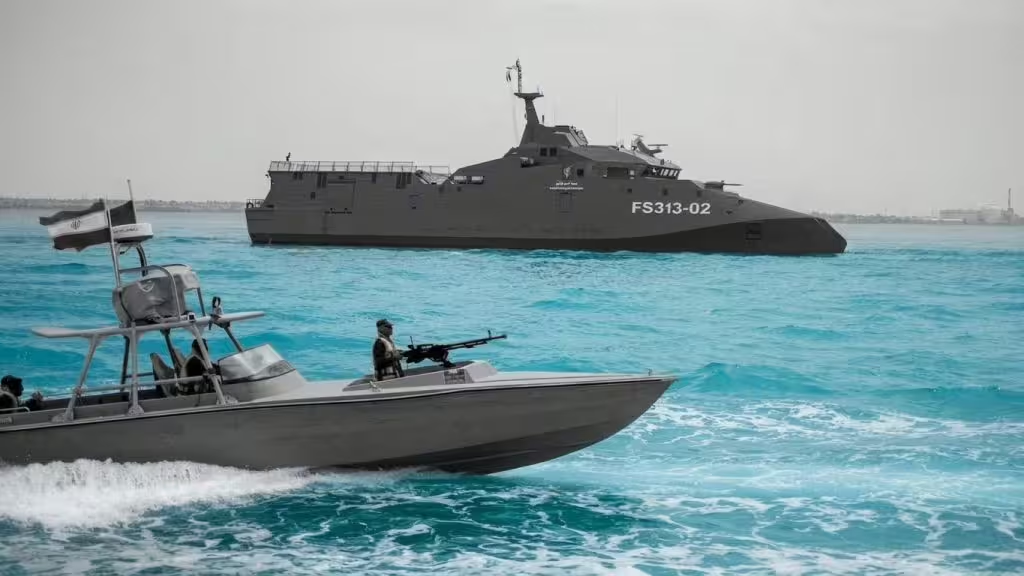
- The workarounds: According to ISW, the Revolutionary Guard recently tried using coastal missile launch platforms instead of fast attack craft to deploy mines, and used fast attack craft to physically identify ships because Iran has only a few functioning radars covering the southern route.
- The strike targets: US Central Command confirmed its September 1 strikes hit Iranian air defense sites, radar systems, naval assets, mine-laying capabilities and communications nodes. ISW said Iran appears to be rebuilding its radar network, citing Trump’s statement that Tehran nearly restored some systems before being struck again.
- The US figures: Vice President JD Vance said about 15 million barrels passed through Hormuz the previous day. Two US officials told CNN that 40 commercial ships carrying some 18 million barrels crossed on September 1 under naval escort. Treasury Secretary Scott Bessent put daily flow at at least 10 million barrels.
- The Iranian claim: Parliament Speaker Mohammad Bagher Ghalibaf said the enemy managed to help some ships pass, but insisted Iranian forces retain full control and will not allow the strait to open. He accused Washington of giving false guarantees and warned unauthorized ships risk being targeted.
- The mine dispute: Admiral Brad Cooper said last week US forces cleared a path out of the Gulf and that mines were largely destroyed. Army spokesman Ebrahim Zolfaghari claimed Wednesday more mines were planted overnight on southern routes. ISW judged such claims likely aimed at sustaining an impression of danger.
- The tracker gap: Kpler recorded 6 transits Wednesday, 11 Tuesday and 5 Monday, a 13-ship 10-day average. Lloyd’s List Intelligence logged about 12 daily crossings between August 26 and September 1, and 14 daily from August 17 to 23 — well below the 30 to 40 Washington cited.
- The volumes: TankerTrackers.com put average daily crude exports from the Gulf through the US blockade at 7.5 million barrels over the 28 days ending Wednesday, of which 5 million moved via Hormuz. Pre-war flows averaged 21.6 million barrels daily in the last quarter of 2025.
- The counting problem: Drewry’s Eric Huber said the US tally likely includes naval auxiliaries, support and tug vessels, small coastal craft and wooden boats that Kpler excludes by size or cargo type. Lloyd’s Bridget Diakun said many ships switch off transponders, leaving late-August transits classed as dark.
- The risk picture: The Joint Maritime Information Center reported Monday that commercial traffic remains far below peacetime norms and the risk level in Hormuz is still very high. Two tankers were attacked Monday off Oman, and Saudi Arabia said an Iranian attack on a Saudi tanker killed two Filipino sailors.
Background:
The strait, which carried a fifth of global oil and gas in peacetime, closed after the US-Israeli war on Iran began on February 28. Trump declared in August that Washington held total control of the waterway, now the hardest knot in negotiations between the two sides.
Between the lines:
Both the workarounds ISW described — missile platforms laying mines, patrol boats doing radar’s job — and Iran’s push to rebuild radars point the same way: Tehran is spending scarce assets to hold a chokepoint it can no longer watch. But the tracker figures cut against Washington too. With transits far below the 30 to 40 claimed and most ships running dark, each side has reason to overstate its grip.
What’s next
Watch whether tanker counts hold above the 13-ship 10-day average, whether Iran restores radar coverage before further CENTCOM strikes, and whether Kayhan’s call to cut undersea fiber-optic cables is acted on.