The latest:
Iran’s parallel banking network is far larger than the structure US sanctions hit last month, according to an Iran International investigation that identified 15 foreign banks in China and the Gulf channeling Iranian money into the global financial system. Thirteen of them have faced no US sanctions or enforcement over that involvement, based on publicly available records. The probe drew on leaked internal correspondence and offshore transaction records from Iran’s Bank Parsian.
Details:
- The documents: The investigation rests on leaked internal letters and offshore transaction records from Bank Parsian covering November 2022 to May 2023, according to Iran International. The Iranian bank has been under US sanctions since 2018, and the records cover a single network over seven months, indicating a much wider full scope.
- The numbers: Iran International counted 33 instruction letters directing movements of dirhams, yuan and dollars worth roughly 36 million dollars in total. Dollars made up the largest share of the value transferred, meaning the dominant currency inside the network remains the one US sanctions were designed to control.
- The mechanics: Iranian banks use intermediaries to move foreign currency abroad while hiding their role, according to the US Treasury. Those brokers rely on so-called Rahbar companies, which in turn use shell and front firms offshore. At each stage identifying details disappeared, leaving foreign banks facing non-Iranian trading companies.
- One transaction: A letter dated 22 May 2023 showed Bank Parsian asking another Iranian lender, Bank Shahr, to settle purchased dirhams. The letter said Parsian had bought 3.06 million UAE dirhams from Iran’s central bank, held in a trust account at Bank Shahr, and asked that the funds be moved to an account at Banque Misr.
- The Treasury case: On 28 August the Treasury proposed cutting Banque Misr’s UAE operations off from the US financial system via correspondent banking services, describing the unit as a vital node for the Iranian system’s access to dollars. Treasury estimated it processed about 1.8 billion dollars for 103 companies between 2024 and 2026.
- The timing gap: Iran International said US investigations into some banks lagged the network’s activity by years. The leaked records show central bank funds already being routed to accounts at Banque Misr’s UAE branches as early as November 2022. Banque Misr and Bank Parsian did not respond to requests for comment.
- The China side: Seven Chinese banks received funds on Iran’s behalf, Iran International found, including some of the country’s largest lenders by assets. The files contain 23 yuan-denominated instruction letters, and one bank specializing in cross-border settlement for small exporters received 11 payment orders. None of the seven has faced US enforcement.
- The beneficiaries: Thirteen companies registered in the Gulf appeared as beneficiaries of eight banks operating there, five holding accounts at Banque Misr. Most other recipients were general trading firms registered in Hong Kong and Singapore, banked from mainland China. Of 33 beneficiaries, only three have been publicly identified by the US Treasury.
- The tool: Washington used Section 311 of the Patriot Act, which can restrict a foreign institution’s access to the US financial system. Unlike a sanctions designation, a 311 finding does not require Treasury to prove a bank knowingly handled Iranian funds. Iran International found no evidence UAE or Chinese banks knowingly facilitated evasion.
- Beijing’s response: After the US sanctioned dozens of Chinese entities and threatened an unnamed major financial institution, Beijing said its relationship with Iran must not be disrupted or undermined. Foreign ministry spokesman Lin Jian warned China would take all necessary measures to protect its interests.
Background:
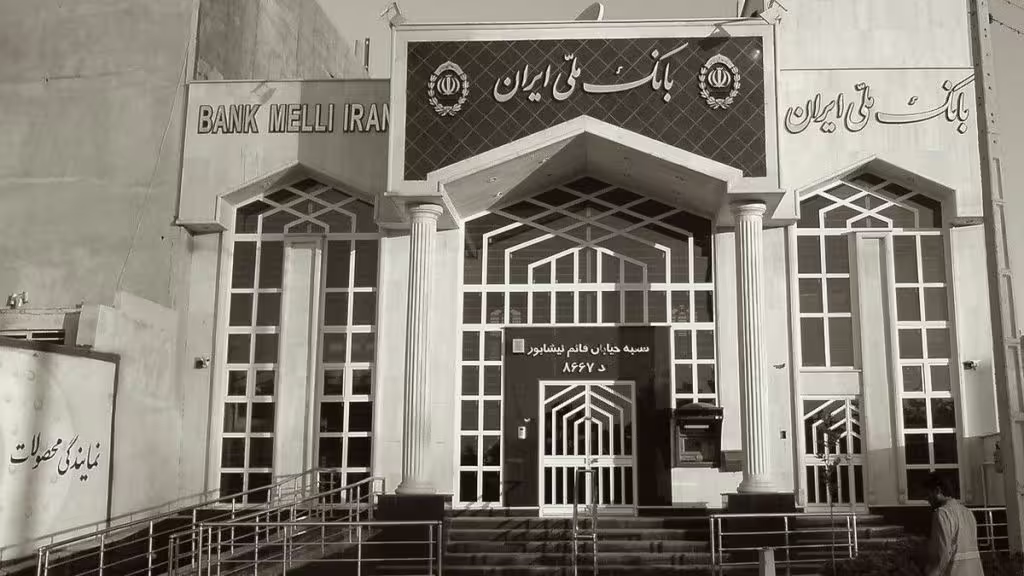
Treasury Secretary Scott Bessent called on all governments on 24 August to close Bank Melli Iran branches, part of the Economic Victory Day campaign Washington billed as an assault on Iran’s financial links worldwide. Bessent said the department had mapped Iran’s smuggling networks, facilitators and financial channels.
Between the lines:
The 13 unsanctioned banks and the three of 33 named beneficiaries point to enforcement narrower than the network itself. US sanctions have concentrated on oil revenue and supply chains rather than correspondent banking and trade finance, and Washington has held back from designating major Chinese lenders — a reluctance Beijing’s retaliation warning helps explain. Former Treasury official Miyad Maleki argued the diplomatic pressure accompanying the package accelerates what sanctions alone would take years to achieve.
What’s next
Washington has signaled further action against foreign banks. Watch whether Treasury moves on any of the 13 unsanctioned institutions, whether the Banque Misr 311 proposal is finalized, and whether a major Chinese lender is designated.