The latest:
International Atomic Energy Agency inspectors have not carried out a single field verification inside Iran’s declared nuclear facilities since February, apart from Bushehr, according to a draft quarterly report. The agency says it cannot monitor centrifuge activity, does not know the precise location or legal status of the Isfahan fuel enrichment plant, and has lost the ability to track declared stockpiles at bombed sites since June 2025.
Details:
- The core gap: According to the draft report, the agency states it is unable to verify that Iranian nuclear material has not been diverted to military purposes. It also says Iran has not applied the Additional Protocol and has submitted no updated declarations since February 2021, leaving Vienna without the reporting channel it normally relies on.
- The missing stockpile: Reuters, citing a copy of the confidential quarterly report, said Tehran has provided no information on roughly 440 kilograms of uranium enriched to 60%. Experts quoted say that quantity could yield several nuclear weapons if enriched slightly further. The 2015 accord capped enrichment at 3.67%.
- The last full count: The agency’s final verified inventory before June 2025 listed 2,391.1 kilograms enriched up to 2%, 6,024.4 kilograms up to 5%, 184.1 kilograms up to 20%, and 440.9 kilograms up to 60%. Since then it has confirmed neither the quantities nor the locations of that material.
- The fourth plant: Iran notified the agency on 12 June 2025 that it intended to build an enrichment plant at the Nuclear Reactor Fuel Company site in Isfahan, its fourth declared facility after two at Natanz and one at Fordow. A planned design verification the next day was cancelled when Israeli strikes began.
- Never inspected: The agency says it has never inspected the new plant and does not know its exact location, whether it has begun operating, or whether it holds nuclear material. Iran later told the agency the site had come under military attack, something the watchdog says it could not verify.
- Grossi’s assessment: Director General Rafael Grossi said earlier this year the agency believes slightly more than 200 kilograms of Iran’s 60% uranium was stored in the wider Isfahan tunnel complex and probably remains there. In June he said the prevailing impression was that the stockpile had not moved.
- Satellite findings: The draft report says satellite imagery showed damage to the Khondab heavy water plant after a 27 March attack, and regular vehicle activity at the entrance of the Isfahan tunnel where uranium enriched to 60% is stored.
- Iran’s position: Atomic Energy Organization head Mohammad Eslami said last week Tehran still considers itself at war and will not allow inspection of struck sites until a new inspection protocol is agreed, while inspections may continue at facilities that were not attacked.
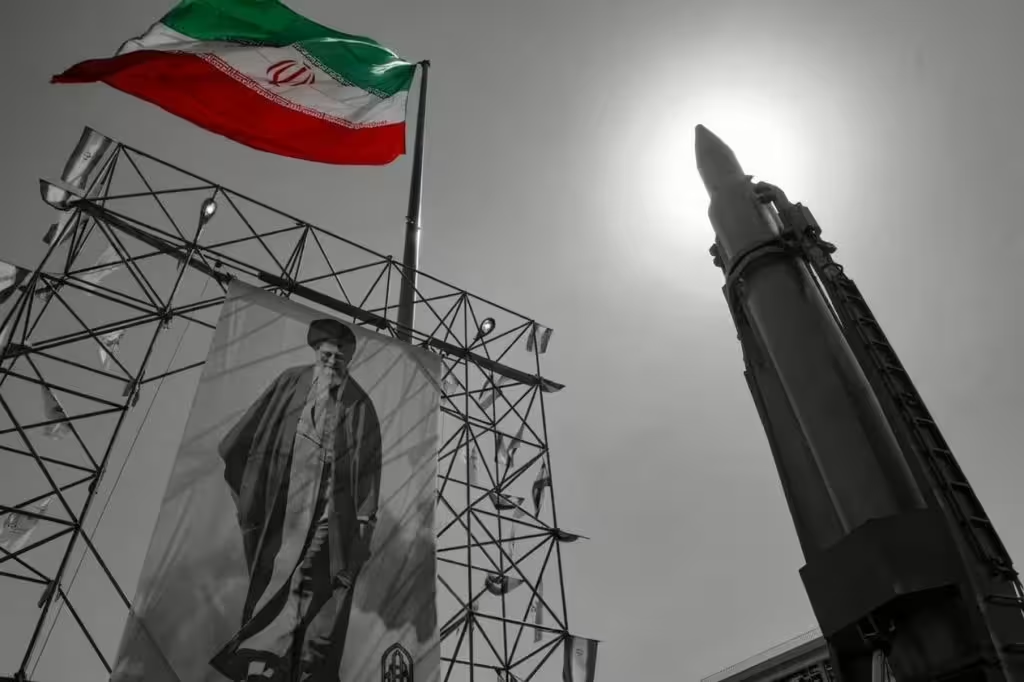
- Deterrence argument: Mohsen Rezaei, secretary of Iran’s Supreme National Security Council, suggested Tehran may reconsider its long-standing rejection of nuclear weapons, arguing that American strikes strengthened the case for a bomb as deterrence. He stopped short of saying a decision had been taken; Tehran maintains its program is peaceful.
- Natanz structure: The Institute for Science and International Security said last week it had identified a possible uranium hexafluoride storage facility at Natanz, partly underground and hardened, built between 2010 and 2017. The institute said it appeared untargeted in the 2025 and 2026 strikes, with no vehicle movement visible since.
Background:
Isfahan hosts one of Iran’s largest nuclear complexes, including uranium conversion and fuel fabrication facilities and equipment tied to centrifuge component manufacturing. Parts of the complex were damaged in strikes on Iranian nuclear sites, and Tehran announced a new tunnel-based enrichment facility there in 2025.
Between the lines:
The report describes a monitoring system that has stopped functioning rather than one producing alarming findings. With no field verification since February, no updated declarations since 2021 and no confirmed location for the 60% stockpile, the agency’s statements about Isfahan and the fourth plant rest on satellite imagery and Iranian notifications it cannot check. Rezaei’s deterrence remarks land in exactly that blind spot.
What’s next
Watch whether Iran grants the access the agency says it is fully ready to use, whether a new inspection protocol is negotiated with Eslami’s organization, and whether the next quarterly report restores any verified figure for the 60% stockpile.