Key Points
- OpenAI urged a judge to reject Apple’s injunction request as Apple accused it of destroying evidence.
- The dispute follows a 2024 ChatGPT partnership and OpenAI’s $6.4 billion move into AI hardware.
- Discovery could expose sensitive details about recruitment, hardware development and safeguards at two secretive technology companies.
The latest
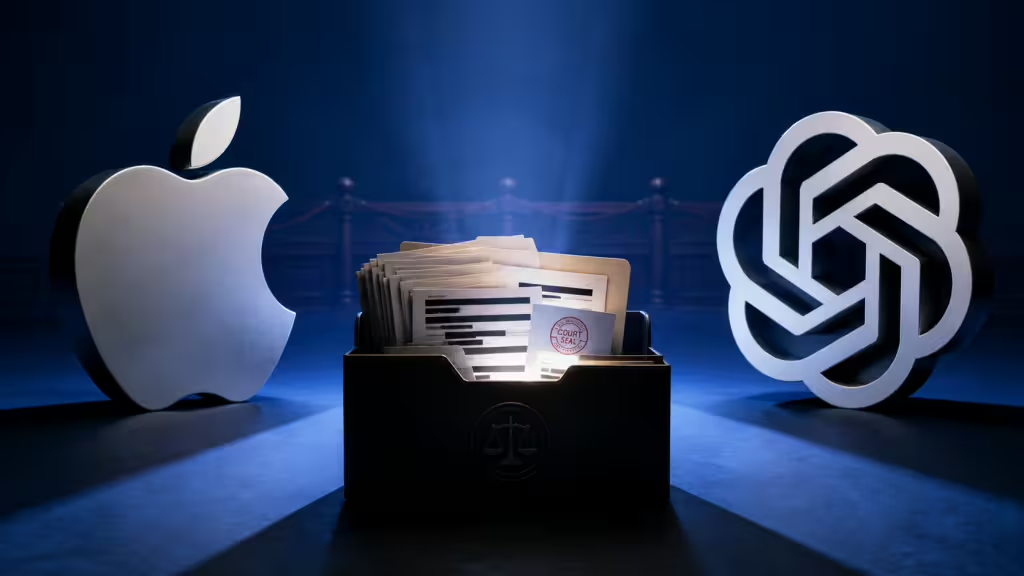
Apple and OpenAI escalated their federal trade-secrets battle on Monday with competing court filings over confidential information allegedly obtained through Apple employees. OpenAI asked the judge to deny Apple’s request for a preliminary injunction barring use of disputed information while the lawsuit proceeds, calling the case a “witch hunt” and “a mess of Apple’s own making.” Apple, meanwhile, accused OpenAI of actively destroying evidence connected to the litigation. The case centers on the former partners’ recruitment practices, hardware ambitions and confidential-information safeguards.
Details
- Partnership origins: The companies began working together in June 2024 to integrate ChatGPT into the iPhone, iPad and Mac. OpenAI chief executive Sam Altman visited Apple’s headquarters for the announcement, saying the partnership would make it easier for Apple users to benefit from artificial intelligence. Their relationship appeared sufficiently close that Elon Musk accused the companies in 2025 of illegal collusion.
- Hardware turning point: Signs of a split emerged in May 2025, when OpenAI acquired io, the startup created by former Apple designer Jony Ive, for $6.4 billion. Ive and Altman promoted their collaboration with a cinematic video hinting at a future AI device. The deal signaled OpenAI’s expansion into consumer hardware long dominated by Apple.
- Apple’s AI strategy: OpenAI’s hardware push coincided with Apple recalibrating its position in the artificial-intelligence race, emphasizing how AI services integrate with its software. In January, Apple partnered with Google to support Apple Intelligence features, including Siri, using Google’s Gemini models and cloud technology. The shift widened competition over talent and product development.
- Central allegations: Apple filed its federal lawsuit in July, accusing OpenAI of stealing trade secrets and taking intellectual property to develop consumer hardware products. Apple alleges that OpenAI executives and former Apple employees coordinated a broader effort to obtain confidential information about unreleased products. It also accused OpenAI of approaching Apple partners with confidential information. OpenAI said it knew of no evidence supporting the claims and defended employees’ right to change jobs.
- Escalating motions: Apple sought the preliminary injunction on Aug. 3. OpenAI responded with a blog post titled “Apple is getting this wrong,” saying it had never pursued Apple’s secrets, then moved to dismiss the lawsuit on Aug. 5. OpenAI argued that the case reflected Apple’s difficulty retaining engineers and keeping pace in AI. Apple countered on Aug. 19 that OpenAI’s dismissal arguments should be tested through discovery. On Monday, OpenAI said Apple could not blame others for its “sloppy procedures.”
What’s next
The judge must decide Apple’s injunction request and OpenAI’s dismissal motion. Those rulings will determine whether the case advances to discovery and an exchange of internal evidence.