The latest:
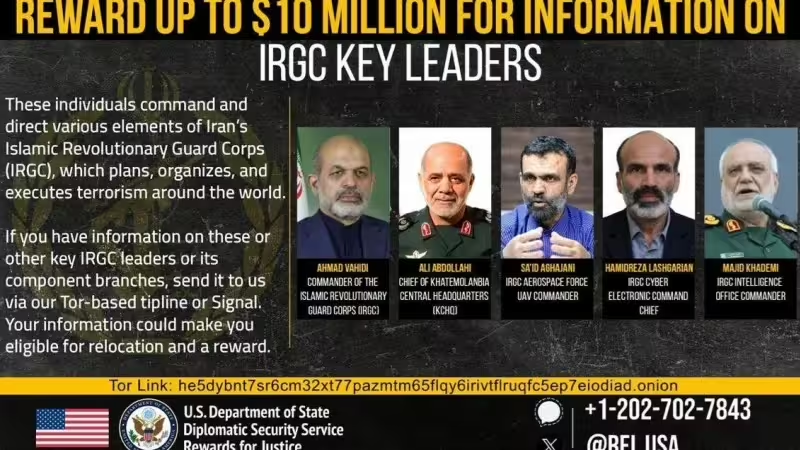
The United States is offering rewards of up to $10 million for information on the leadership of Iran’s Revolutionary Guard, adding Supreme Leader Mojtaba Khamenei to its wanted list. The State Department’s Rewards for Justice program announced the decision, publishing photographs of senior commanders alongside an appeal for tips. President Donald Trump followed with a post on Truth Social claiming Tehran is failing to pay large numbers of its own soldiers.
Details:
- The names: According to the official U.S. announcement, the list includes Mojtaba Khamenei; his deputy chief of staff Ali Asghar Hejazi; Yahya Rahim Safavi, who advises the Supreme Leader on military and security affairs; Interior Minister Eskandar Momeni; IRGC commander Ahmad Vahidi; Ali Abdollah, commander of Khatam al-Anbiya; and IRGC intelligence chief Majid Khademi.
- The pitch: A post accompanying the photographs told potential informants that details on those named, or on senior members of the Revolutionary Guard and its branches, should be sent to the program. It said such information could qualify the sender for relocation elsewhere and a financial reward — an offer aimed squarely at insiders.
- Trump’s claim: The president wrote that the failed Islamic Republic is not paying the salaries of large numbers of its soldiers while killing protesters, including outside periods of unrest, at unprecedented levels. He described the situation as a humanitarian crisis of catastrophic dimensions that must be stopped now.
- The rationale: The Rewards for Justice website says the Revolutionary Guard, part of Iran’s official armed forces, is central to Tehran’s use of terrorism as a foreign policy tool, and that it founded, funded and directed other militant groups. It holds the force responsible for attacks on Americans and U.S. facilities.
- The economics: The program states the Guard currently controls broad sectors of the Iranian economy and shapes domestic politics, having played a prominent role in foreign policy since its founding in 1979. That description frames the force as a financial network as much as a military one.
- The designations: The statement notes the State Department designated the IRGC, including the Quds Force, a foreign terrorist organization on April 15, 2019, while the Treasury Department listed it as a specially designated global terrorist in 2017 over its activities.
- The legal edge: All IRGC assets and interests under U.S. jurisdiction are frozen, and Americans are generally barred from any transactions with the force. Providing, attempting to provide, or conspiring to provide support or resources to the Guard is a criminal offense under U.S. law.
- Diplomatic track: The New York Times reported that diplomats who left the Middle East because of the war are expected to return. No date was announced for the returns, and the announcement did not tie the rewards program to any negotiating timetable.
Background:
Rewards for Justice is the State Department program that pays for information on designated groups and individuals. Its extension to the leadership of a state’s official armed forces, and to the Supreme Leader himself, marks an unusually direct targeting of a governing hierarchy.
Between the lines:
The offer’s design reveals its target audience. Relocation paired with cash is an inducement written for people already inside the Guard’s chain of command, not for outside observers. Trump’s assertion that soldiers are going unpaid works in the same direction, presenting the force as financially strained even as Washington’s own program describes it as controlling broad sectors of the economy. Whether that tension translates into defections is untested.
What’s next
Watch for any Iranian official response to the wanted list, further additions to the named commanders, and the timing of the diplomats’ return to the region reported by The New York Times.